
SOCE Correctional Officer Practice Exam
$69.00
- Buy to unlock unlimited access to all Quiz questions.
- After purchase you can print a PDF of the whole quiz at any point. The PDF will contain the questions and the correct answers.
About this Exam
The Florida State Officer Certification Examination (SOCE) is the final, essential step to becoming a certified correctional officer in the State of Florida. It is designed for individuals who have successfully completed an approved Florida Department of Law Enforcement (FDLE) Basic Recruit Training Program, or who have obtained an Equivalency of Training (EOT) exemption. This comprehensive examination is the benchmark that verifies a candidate’s knowledge, skills, and abilities required to safely and effectively supervise, protect, care for, and control inmates in Florida’s state and county correctional facilities. Passing the SOCE demonstrates that a recruit is fully prepared to uphold the high standards of Florida's law enforcement and corrections profession.
Ready to test your knowledge?
Buy Now to Access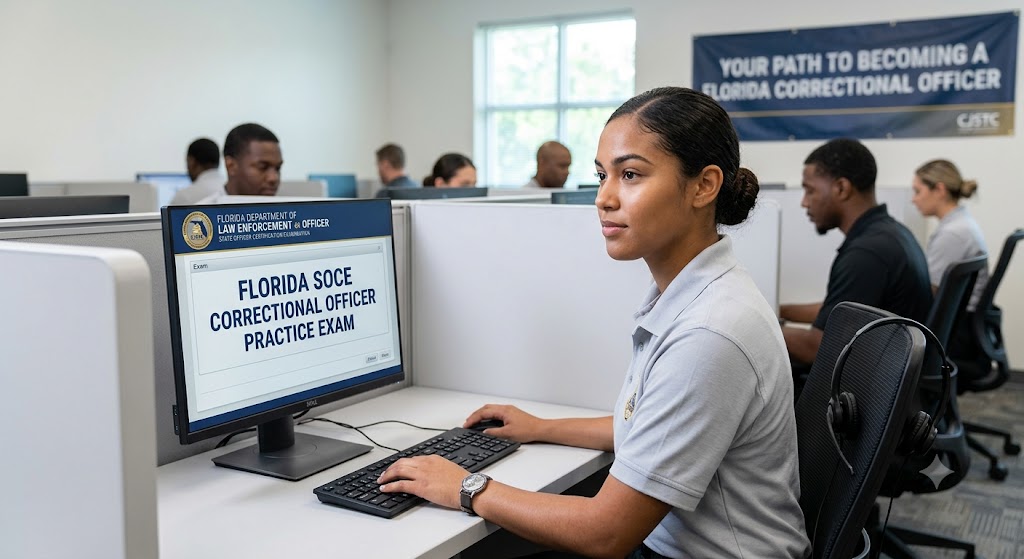
Additional Information
What the Course Entails and Exam Details
The SOCE for Correctional Officers does not encompass a "course" itself; rather, it assesses the content learned during the mandatory basic training academy. The examination is derived directly from the standardized FDLE Criminal Justice Standards and Training Commission (CJSTC) Basic Recruit Curriculum for Corrections.
The exam content is extensive and is split into major subject areas, each making up a specific percentage of the test:
Legal Foundations and Florida Statutes: Understanding search and seizure, arrest laws, and inmate rights.
Managing Offenders: Techniques for communication, supervision, and maintaining discipline.
Control and Offender Movement: Safe methods for transporting inmates within and outside facilities.
Maintaining Health, Safety, Sanitation, and Communications: Ensuring a secure and hygienic environment and effective report writing.
Officer Wellness and Physical Conditioning: Strategies for stress management, fitness, and survival.
Defensive Tactics and Use of Force: Proper application of defensive techniques and understanding the Florida Use of Force Guidelines.
First Aid and Medical Emergency Response: Basic medical care for officers and inmates.
Interpersonal Skills and Crisis Intervention: Effectively interacting with diverse populations and defusing tense situations.
Correctional Operations and Procedures: Facility security, key control, and intake processes.
Intake and Classification: Determining inmate housing and needs.
Supervising Special Populations: Working with youth, elderly, and mentally ill inmates.
The final examination consists of 200 multiple-choice and true-or-false questions. It is a comprehensive, timed test, with candidates given a maximum of four hours to complete it.
What to Expect in the Final Exam
The SOCE is a computer-based test (CBT) that is not designed to trick you, but to thoroughly evaluate your knowledge of the training curriculum. Expect questions that present realistic scenarios or ask direct factual questions based on the Florida law and procedures you were taught.
All questions come directly from the learning objectives within the Basic Recruit Training Program. It is crucial to answer only based on this training and not to rely on personal experience, an individual agency's policies, or other sources. You are encouraged to take the on-screen tutorial before starting to understand how to navigate and use exam tools. There are no scheduled breaks, though you may use the restroom.
To pass the examination, candidates must achieve a passing score as determined by the FDLE. This passing standard is a specific raw score translated to a percentage. Your official score report, received immediately upon completion, will state your "Pass" or "Fail" status and your numerical result. If you fail, you are eligible for retakes within your four-year eligibility period (starting from your academy start date). You are authorized three administrations of the exam (initial + two retakes) without needing to repeat basic training.
How to Study and Exam Centers
A successful strategy for the SOCE requires active and repeated review of the primary course materials from your academy.
How to Study:
Focus on learning objectives: The entire exam is structured around the CJSTC learning objectives. Know them for every chapter.
Review official curriculum: Reread your original FDLE manuals. The exam does not add new information; it tests what is in the curriculum.
Utilize review books and practice exams: High-quality practice tests and SOCE review guides are excellent for simulating the test experience and identifying weak areas. They expose you to the multiple-choice format and style.
Do not memorize, understand: Focus on the concepts and procedures, so you can apply them to different scenarios.
Form study groups: Reviewing content with peers from your academy can reinforce your learning and cover areas you may have missed.
Exam Centers:
Authorized sites only: The SOCE must be taken at an authorized Pearson VUE professional testing center. These facilities offer a standardized, secure testing environment with proctors, secure login, and monitored stations. Pearson VUE centers are located throughout the state of Florida.
You will typically register for the exam through your CJSTC-certified training academy or authorized external vendor. Candidates must arrive at the test center at least 30 minutes early and provide two forms of valid, government-issued photo identification. All personal items must be stored securely and are not allowed in the testing room.
Job Opportunities from the Course
Successfully passing the SOCE unlocks a career in a vital public safety sector. While the exam itself doesn’t provide job opportunities, the mandatory state certification that results opens doors to these career paths in Florida:
Florida State Correctional Officer: Employment with the Florida Department of Corrections (FDC) in one of their over 140 facilities.
Florida County Jail Correctional Officer: Opportunities in county sheriff's offices or local government correctional systems.
Specialized Roles (after experience): K-9 Unit Officer, Close Management Supervisor, Gang Intelligence Officer, Transport Officer, Court Security Officer (if crossover-certified).
Career Advancement: Leadership positions such as Correctional Officer Sergeant, Lieutenant, Captain, and beyond.
Crossover Path to Law Enforcement: Having a corrections certification can simplify the process of also becoming a certified law enforcement officer (LEO).
Frequently Asked Questions
Reviews
5.0
Based on 0 reviews
Leave a Review
No reviews yet. Be the first to review!