
SOAP Hospital Corpsman Practice Test
$69.00
- Buy to unlock unlimited access to all Quiz questions.
- After purchase you can print a PDF of the whole quiz at any point. The PDF will contain the questions and the correct answers.
About this Exam
The [SOAP Hospital Corpsman Practice Test] is not a stand-alone, external certification exam, but rather a vital internal practice tool and assessment component within your Navy Hospital Corpsman (HM) training. SOAP stands for Subjective, Objective, Assessment, and Plan, and it is the industry-standard method for medical documentation. This practice resource is designed for Navy Hospital Corpsmen at various stages of their careers, from initial basic training to specialized roles. Its core purpose is to build proficiency in clearly and accurately charting patient encounters, which is paramount for effective patient care, professional communication among medical teams, and legal documentation. By utilizing this practice test, you are preparing to excel in your required training courses and ultimately perform your duties with confidence and expertise in diverse environments, from naval hospitals to operational field settings.
Ready to test your knowledge?
Buy Now to Access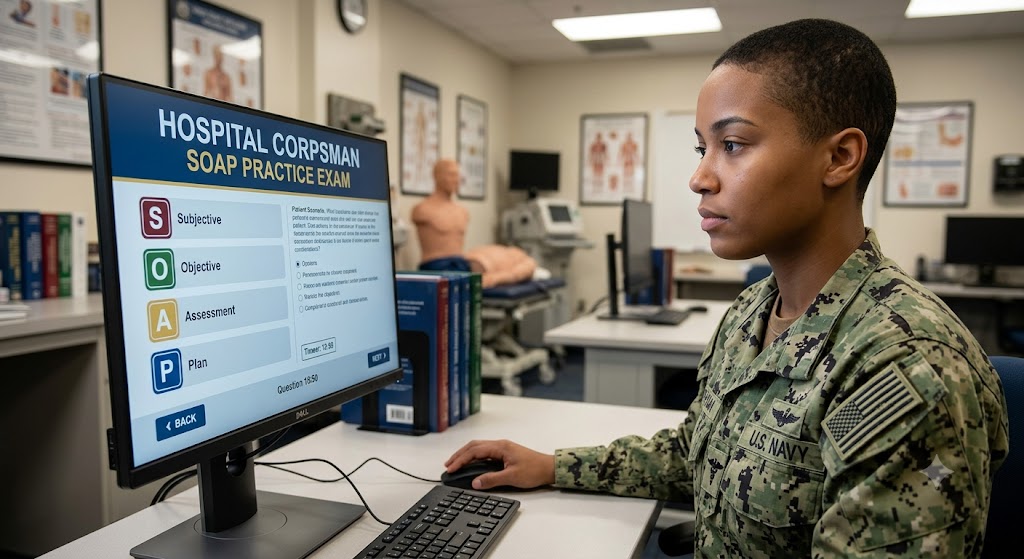
Additional Information
WHAT THE COURSE ENTAILS AND EXAM DETAILS
The underlying knowledge for a Hospital Corpsman's SOAP skills is typically embedded within broader Navy medical training, such as the Hospital Corpsman Basic Course or the Sick Call Screener Course (SCSC). These comprehensive programs cover a vast range of essential topics that you must master and apply correctly using the SOAP format:
Medical Terminology: A thorough understanding of medical terms, abbreviations, and anatomical references is fundamental.
Patient Assessment Skills: Gathering and interpreting patient information, both what they report (Subjective) and what you observe or measure (Objective).
Vital Signs: Accurately taking, interpreting, and documenting blood pressure, heart rate, temperature, respiratory rate, and oxygen saturation.
Subjective Data Gathering: Interviewing patients to elicit Chief Complaints, History of Present Illness (HPI), medical history, allergies, and Review of Systems (ROS).
Objective Observations: Performing and documenting physical examinations, laboratory tests, and imaging findings.
Assessment & Clinical Reasoning: Synthesizing subjective and objective data to form a clinical impression or diagnosis.
Plan of Care: Developing and documenting specific, actionable plans for treatment, medications, referrals, patient education, and follow-up.
Professional Standards and Ethics: Adhering to the high ethical and professional standards expected of Navy medical personnel.
The actual [SOAP Practice Test] will present scenarios and ask questions that require you to correctly identify or construct elements within the four sections. It may feature a variety of formats, reflecting the practical application needed in your final assessments. The specific details (e.g., number of questions, potential passing scores, etc.) are determined within each Navy training program, but you can expect the content to directly model these core competencies. Remember, mastery of these principles is not just about passing a test, but about ensuring the highest quality of care for your fellow service members and their families.
WHAT TO EXPECT IN THE FINAL EXAM
While there is no single external "Final SOAP Exam" for Hospital Corpsmen, your proficiency in SOAP charting will be rigorously assessed as part of your comprehensive final evaluations within Navy training courses (like SCSC final performance or written exams). When a final assessment focuses on SOAP skills, you should be prepared for the following:
Scenario-Based Questions: You may be presented with a patient scenario, including their history, symptoms, and exam findings. The test will then require you to select the correct SOAP note entries from multiple choices or to evaluate a pre-written SOAP note for accuracy and completeness.
Note Completion: Some practical tests may require you to draft a full SOAP note for a simulated patient encounter within a specific timeframe.
Evaluation and Critique: You might need to review and critique a partner's or a simulated SOAP note, identifying errors in data categorization or professional terminology.
Timed Sections: To simulate the real-world pressure of clinical environments, some portions of these assessments may be timed.
High Performance Standards: Navy medicine demands a high level of proficiency. While specific passing scores can vary (e.g., 80% is common), you must strive for perfection to ensure safe, effective patient care and professional advancement. The [SOAP Practice Test] is your key to achieving this.
HOW TO STUDY AND EXAM CENTERS
How to Study
Effective preparation for your SOAP assessments within Navy training is about active practice and reinforcing fundamental concepts:
Simulate Charting: Practice writing SOAP notes for every patient encounter you experience in training, using simulated cases, or even based on public case studies. The more you write, the more natural the structure will become.
Master Medical Terminology: Use flashcards, mobile apps, or workbooks to memorize key terms, abbreviations, and body systems. Consistency is crucial.
Utilize Study Guides and Handbooks: Review the specific Corpsman manuals, training guides, and presentation materials provided in your courses. Pay close attention to the standardized forms and templates used in Navy medicine.
Practice with Real Scenarios: Form study groups with fellow Corpsmen and role-play patient encounters, with one person acting as the patient and another as the Corpsman. Rotate roles to see both perspectives.
Request Feedback: Show your practice SOAP notes to instructors, mentors, and experienced Corpsmen. Ask for constructive criticism on accuracy, clarity, and formatting.
Review Sample Notes: Study high-quality example SOAP notes for common patient complaints to understand the appropriate language and level of detail required.
Repeated Practice Tests: Make regular use of your internal [SOAP Practice Test] resources. Don't just take it once; repeat the sections you find challenging and understand why the correct answers are correct. Use them as both a diagnostic and a learning tool.
Exam Centers
You will not register for or take a Hospital Corpsman SOAP Practice Test at a commercial testing center like Pearson VUE. Instead, these crucial educational assessments are delivered entirely within the Navy training system:
Training Portals: Accessible via secure, internal Navy online platforms (e.g., Navy eLearning, MyNavyHR).
Classroom Environments: As part of structured training days at Navy medicine schools or simulation labs.
Medical Facility Computers: Within specialized training software or charting systems used at Naval hospitals or clinics.
Workbooks and Performance Checklists: In physical training materials that you will use throughout your courses.
Simulated Clinical Settings: As part of practical assessments and scenario-based training within simulation labs on base.
Your instructors and training command will provide you with clear guidance on where and how to access these practice materials and when your progress will be officially assessed.
JOB OPPORTUNITIES FROM THE COURSE
Proficiency in SOAP charting is not just a training requirement; it is a foundational skill that opens numerous pathways and contributes significantly to your career development within the U.S. Navy. Excelling in this area directly translates to:
General Hospital Corpsman: Performs a wide range of patient care duties in various clinical settings.
Sick Call Screener: Provides initial assessment and care for minor illnesses and injuries in primary care settings.
Independent Duty Corpsman (IDC): Serves as the primary medical provider aboard small ships, submarines, or isolated duty stations with no medical officer.
Combat Medic/Fleet Marine Force (FMF) Corpsman: Renders emergency medical care and medical support to Marine Corps units in operational environments.
Specialized Technician Roles: Opportunities in various specialties (e.g., Surgical Tech, Respiratory Therapist, Lab Tech), all of which require accurate documentation of patient interventions and data.
Leadership and Promotion: Mastery of critical clinical skills and efficient communication is a key factor in performance evaluations and advancement within the Navy's enlisted medical ranks.
Transferable Skills: While this practice test itself is for Navy training, the skills you build are highly transferable and valuable for pursuing civilian healthcare careers after your service, such as:
Registered Nurse
Paramedic
Physician Assistant
Medical Assistant
By dedicating yourself to mastering the SOAP method now, you are building a vital skill set for current and future success in both military and civilian healthcare. Embrace the challenge, utilize the resources available, and know that each accurate entry contributes to the mission of providing world-class medical care. Good luck with your studies and your service!
Frequently Asked Questions
Reviews
5.0
Based on 0 reviews
Leave a Review
No reviews yet. Be the first to review!