
SMFD Scott Air-Pak X3 Self‑Contained Breathing Apparatus Drill (SCBA) Practice Test
$69.00
- Buy to unlock unlimited access to all Quiz questions.
- After purchase you can print a PDF of the whole quiz at any point. The PDF will contain the questions and the correct answers.
About this Exam
The SMFD Scott Air-Pak X3 Self-Contained Breathing Apparatus Drill is a critical practical examination designed to ensure that firefighters possess the essential skills required to operate safely and effectively in immediately dangerous to life or health (IDLH) atmospheres. This certification validates a firefighter's ability to quickly and properly don, doff, inspect, and troubleshoot the standardized SCBA equipment used on the fireground. The drill is intended for both recruit firefighters undergoing initial training and experienced personnel who must maintain mandatory proficiency certifications. This indispensable component of fire service safety protocols guarantees that all personnel can rely confidently on their respiratory protection in high-stress, dangerous environments.
Ready to test your knowledge?
Buy Now to Access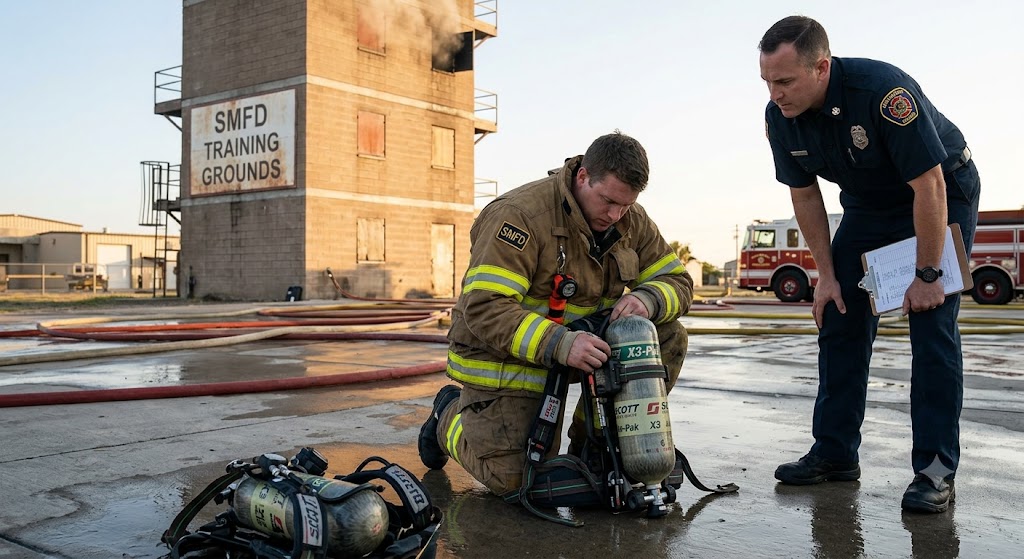
Additional Information
What the Course Entails and Exam Details
Candidates preparing for the SMFD Scott Air-Pak X3 SCBA Drill will cover a comprehensive curriculum focused strictly on practical application. The course provides in-depth, hands-on instruction on the complex pre-use inspection process, ensuring that every crucial component—including cylinder pressure, high-pressure lines, regulators, harness, and facepiece—is fully functional and secure. Critical modules include mastering the standardized donning procedures, establishing and verifying a perfect facepiece seal, and operating the integrated Personal Alert Safety System (PASS) device effectively. The rigorous curriculum also emphasizes key survival skills, such as air management techniques, emergency breathing procedures, and buddy-breathing operations during simulated fireground scenarios. The ultimate goal is to build deep muscle memory for these lifesaving actions under realistic conditions.
What to Expect in the Final Exam
The final examination for the SMFD Scott Air-Pak X3 SCBA Drill is a performance-based practical skills assessment. It does not typically involve a written multiple-choice test; instead, candidates are required to demonstrate hands-on proficiency in a series of timed and evaluated stations. The core of the exam is the rapid, flawless donning and operational sequence. Candidates must generally go from full structural PPE to fully dressed and "on air" with a positive facepiece seal within a strict time limit, such as sixty seconds. Evaluators will then assess the complete pre-trip safety check, the ability to communicate clearly through the speaking diaphragm, and the correct execution of emergency survival maneuvers. Scoring is typically on a pass/fail basis, with any major safety violation or critical equipment failure resulting in immediate disqualification. Speed is important, but accuracy and safety are paramount.
How to Study and Exam Centers
The key to mastering the practical SMFD SCBA drill is repeated, disciplined physical practice. Studying standard operating procedures (SOPs) and equipment manuals provides essential foundational knowledge, but muscle memory must be developed through physical exertion. Establish a regular practice schedule for the entire donning and inspection process until every movement becomes fluid and reflexive. Time yourself consistently during every training session to simultaneously improve speed and maintain accurate procedural integrity. Utilize peer reviews and request video feedback from officers to identify subtle errors. The actual certification drills are administered by authorized personnel, including individual fire departments (e.g., SMFD Training Division), certified regional training facilities, or established firefighter academies. Since these are practical exams, you must register through your department's training officer or the designated testing institution for a scheduled time slot.
Job Opportunities from the Course
Achieving and maintaining proficiency in the SMFD Scott Air-Pak X3 SCBA Drill is fundamental to success and safety in the fire service. Because respiratory protection is non-negotiable in this hazardous career, this certification unlocks several essential career opportunities and advancement paths within both career and volunteer organizations. Passing this rigorous practical standard demonstrates readiness for emergency operations and a commitment to essential safety procedures.
Potential career opportunities include:
Career Firefighter: This is a foundational requirement for all career firefighters to be considered fit for duty.
Volunteer Firefighter: Essential certification to respond safely to structural fire incidents.
Fire Captain or Lieutenant: Leading an engine or ladder company requires maintaining absolute proficiency to supervise personnel safely.
Industrial Fire Brigade Member: Managing emergencies within complex industrial facilities using specialized SCBA equipment.
Fire Service Instructor: Teaching practical skills like SCBA use requires mastering and standardizing the procedure first.
HazMat (Hazardous Materials) Technician: Operating in chemical, biological, or radioactive environments often involves working under Air-Pak.
Fire Department Training Officer: Developing departmental curriculum and conducting required annual skills testing.
Aircraft Rescue and Firefighting (ARFF) Specialist: Specialized airport response relies on robust SCBA proficiency for passenger rescue operations.
Frequently Asked Questions
Reviews
5.0
Based on 0 reviews
Leave a Review
No reviews yet. Be the first to review!