
SIFT Mechanical Comprehension Practice Test
$69.00
- Buy to unlock unlimited access to all Quiz questions.
- After purchase you can print a PDF of the whole quiz at any point. The PDF will contain the questions and the correct answers.
About this Exam
The Selection Instrument for Flight Training (SIFT) is a critical aptitude test used by the U.S. Army to select candidates for aviation warrant officer and officer flight training programs. Within this comprehensive exam, the Mechanical Comprehension subtest measures your understanding of basic physical principles and your ability to apply them to mechanical scenarios. It is not designed for experienced engineers, but rather for individuals who possess a strong intuitive grasp of how the physical world works. If you are aspiring to pilot Army helicopters or fixed-wing aircraft, performing well on this section is essential to demonstrating your potential for success in flight school.
Ready to test your knowledge?
Buy Now to Access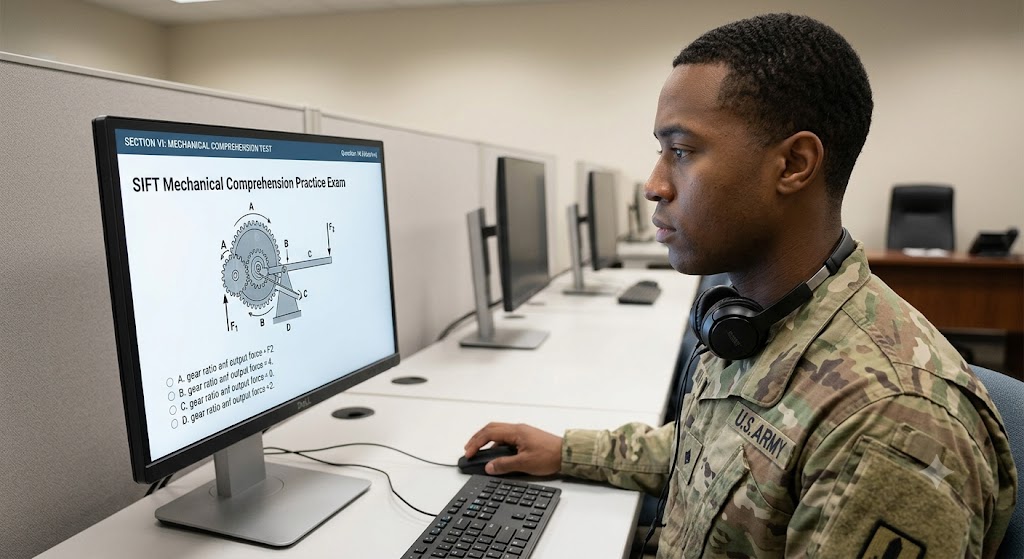
Additional Information
What the Course Entails and Exam Details
The Mechanical Comprehension section evaluates your knowledge across a range of fundamental Newtonian physics and mechanical concepts. The syllabus generally covers basic mechanics, including the operation of simple machines such as levers, pulleys, gears, and inclined planes. You must be prepared to solve problems involving force, work, velocity, acceleration, and fluid dynamics (basic principles of hydraulics and aerodynamics). The test assesses your ability to look at a diagram of a mechanical system and deduce how it will function or which component will experience a particular effect.
What to Expect in the Final Exam
This is a standardized, computer-based multiple-choice test administered by military entrance processing stations (MEPS) or authorized testing centers. The Mechanical Comprehension subtest is usually a timed section, often requiring you to answer approximately 20 to 25 questions in roughly 15 to 20 minutes. It is rapid and demands efficient problem-solving. While a physical calculator is typically not permitted, a digital calculator interface or scratch paper may be provided. A passing score on the SIFT is 40 (out of 80), but competitive flight candidates aim significantly higher, as a strong score improves selection chances.
How to Study and Exam Centers
Effective preparation requires a two-pronged approach: reviewing core concepts and practicing their application. Start by refreshing your knowledge of high school level physics and the definitions of simple machines. Utilize reputable SIFT study guides and specialized online aptitude test platforms that offer targeted Mechanical Comprehension practice tests. Analyze your mistakes to identify which principles (e.g., gear ratios, lever classes) need more focus. Remember, the key is understanding how a system works rather than memorizing formulas. The test itself is administered as part of the total SIFT examination, which you will schedule through your Army recruiter at a Military Entrance Processing Station (MEPS) or sometimes a mobile testing site.
Job Opportunities from the Course
A strong performance on the SIFT, including the Mechanical Comprehension section, is the gateway to some of the Army's most competitive and rewarding technical roles. Successfully passing the test and being selected for training can unlock the following career paths:
Army Warrant Officer Aviator: Pilot complex rotary-wing aircraft (like the AH-64 Apache or UH-60 Black Hawk) or fixed-wing aircraft. This is the primary destination for most SIFT applicants.
Army Commissioned Officer Aviator: Lead aviation units while maintaining pilot qualifications, balancing leadership responsibilities with flight operations.
Flight Operations Specialist: Utilize your understanding of physics and mechanics in planning, directing, and controlling air traffic.
UAS (Unmanned Aircraft Systems) Operator: While SIFT is primarily for manned flight, a strong mechanical aptitude profile supports selection and performance in operating sophisticated drone systems.
Frequently Asked Questions
Reviews
5.0
Based on 0 reviews
Leave a Review
No reviews yet. Be the first to review!