
SIFT Math Practice Test
$69.00
- Buy to unlock unlimited access to all Quiz questions.
- After purchase you can print a PDF of the whole quiz at any point. The PDF will contain the questions and the correct answers.
About this Exam
The Selection Instrument for Flight Training (SIFT) is a comprehensive aptitude test used by the U.S. Army to select the best candidates for its rotary-wing aviation program.
While the complete SIFT evaluates multiple facets of an individual's skills, the Math Skills Test (MST) is a pivotal subtest.
It measures a candidate's quantitative reasoning and mathematical capability, areas vital for navigating, performing flight calculations, and managing complex systems in the cockpit.
This exam is designed for aspiring Army pilots, both Warrant Officers and Commissioned Officers.
It is a critical hurdle that must be cleared to enter the prestigious world of military aviation.
Achieving a high score is not merely about passing; it is about demonstrating the mental agility required for flight school and the high-stakes environment of Army aviation.
Ready to test your knowledge?
Buy Now to Access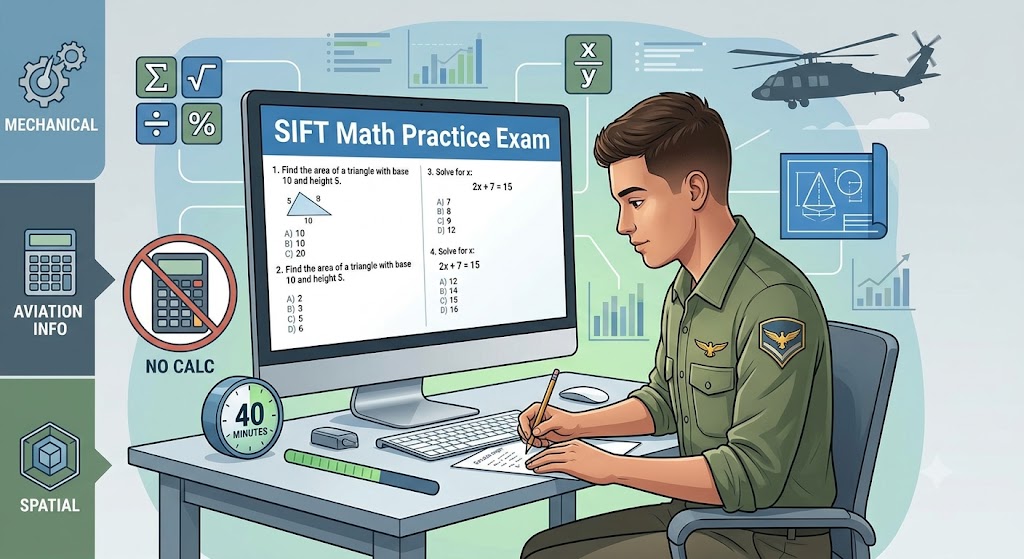
Additional Information
What the Course Entails and Exam Details
The SIFT Math Skills Test evaluates high school-level mathematical concepts and their practical application.
It does not dive into advanced calculus but expects complete mastery and rapid recall of foundational skills.
The key domains you must master include:
Arithmetic Reasoning: This involves solving arithmetic problems presented in word format. You must be able to translate real-world scenarios into mathematical expressions. Topics include percentages, ratios, proportions, interest calculations, and profit/loss scenarios.
Basic Algebra: You will encounter questions that test your understanding of algebraic principles.This includes solving linear equations, understanding inequalities, working with exponents, and factoring simple expressions.
Fundamental Geometry: Expect questions that require you to understand properties of shapes, angles, triangles, circles, and coordinate geometry. This can include calculating area, perimeter, volume, and slope.
Data Interpretation and Numerical Series: You must quickly analyze data presented in charts, tables, or graphs and determine the next number in a sequence based on a pattern.
The SIFT MST is not just a test of what you know; it is a test of how efficiently you can apply that knowledge under pressure.
What to Expect in the Final Exam
The full SIFT exam is typically a computer-administered test that takes approximately two to three hours to complete, including an optional break.
However, the Math Skills Test is a discrete, timed section with unique characteristics:
Exam Format: The SIFT MST is a computer-adaptive, multiple-choice test. The computer will present questions based on your performance on previous questions. It is vital that you work as quickly and accurately as possible from the start.
Time Limit and Question Count: Candidates have exactly 40 minutes to complete the MST section. While the number of questions can vary slightly due to the adaptive nature of the test, it usually consists of around 40 questions.This allows for approximately one minute per question.
Passing Score and Attempts: SIFT scores range from 20 to 80, with 50 being the average.A minimum score of 40 is required to qualify for further aviation training.You are allowed only two attempts at the SIFT in your lifetime.If you pass (score 40 or higher) on your first attempt, you cannot retake it.
Specific Rules: You will be provided with scratch paper and a pencil for calculations.Crucially, calculators are not allowed. Your mental math skills and speed of estimation are paramount. Guessing strategically is advisable if time is running low, but rapid, accurate reasoning is the goal.
How to Study and Exam Centers
Effective preparation is essential for success on the SIFT MST.
Here are actionable study strategies and guidance on how to take the test:
How to Study and Practice
Systematic Concept Review: Do not rely solely on practice tests. Begin by reviewing the fundamental concepts of algebra, geometry, and arithmetic. Use high school math textbooks or reputable online resources like Khan Academy.
Practice with Real SIFT Math Practice Tests: Utilize authentic practice exams that simulate the computer-adaptive format, structure, and content of the actual SIFT MST. Focus on your accuracy before increasing your speed.
Master Mental Math: Since calculators are forbidden, you must be proficient in mental calculations. Practice estimation and mental arithmetic daily to improve your speed.
Simulate Exam Conditions: Take full-length, timed MST practice sessions without a calculator. This will build your stamina and teach you to manage your time effectively under pressure.
Review Your Mistakes: After every practice session, analyze the questions you answered incorrectly or struggled with. Understand the underlying mathematical principle you missed to avoid repeating the error.
How to Take the Exam
The SIFT is not a standalone exam you can schedule privately through Pearson VUE or a public testing center.
It is administered through the U.S. Army.
To take the SIFT, you must:
Contact an Army Recruiter: If you are not currently in the military, your initial point of contact is an Army recruiter or an Army Warrant Officer Recruiter.
Request a Test Date: The recruiter will schedule your SIFT, which is usually administered at a Military Entrance Processing Station (MEPS), a post-servicing education center, or an Army personnel testing office.
Complete the Full SIFT: Remember, the MST is just one subtest within the complete Selection Instrument for Flight Training. You will take all seven subtests in one sitting.
Job Opportunities from the Course
A strong performance on the SIFT, particularly the Math Skills Test, is the key that unlocks the door to a highly coveted career in Army aviation.
By achieving a qualifying score and completing the follow-on training requirements, you can access the following job titles and career paths:
Army Warrant Officer Aviator (153A): This is the most direct and common career path. You will fly a variety of helicopters, including the AH-64 Apache, UH-60 Black Hawk, CH-47 Chinook, and the newer UH-72 Lakota.
Army Commissioned Officer Aviator (15A): If you pursue the path of a Commissioned Officer (via ROTC, West Point, or OCS) and branch aviation, your SIFT score is a essential component of your application package.Commissioned Aviators serve as pilots and also assume leadership and command roles within aviation units.
Future Roles in Aviation Operations and Management: Your foundational math skills on the SIFT contribute to your overall aptitude for the specialized training required for advanced aviation operations, safety management, and aviation leadership.
Ultimately, excelling on the SIFT is the first critical step toward a dynamic career flying powerful aircraft and serving as an integral member of the U.S. Army's aviation team.
Frequently Asked Questions
Reviews
5.0
Based on 0 reviews
Leave a Review
No reviews yet. Be the first to review!