
SIFT Army Aviation Information Practice Test
$69.00
- Buy to unlock unlimited access to all Quiz questions.
- After purchase you can print a PDF of the whole quiz at any point. The PDF will contain the questions and the correct answers.
About this Exam
The Selection Instrument for Flight Training (SIFT) is a critical comprehensive aptitude test designed specifically for individuals aspiring to become military aviators within the U.S. Army. This rigorous exam serves as a primary gatekeeper, ensuring that candidates possess the necessary cognitive abilities, technical understanding, and spatial reasoning skills required to succeed in the demanding environment of Army aviation training. It is designed for both enlisted personnel seeking to become Warrant Officer Aviators and for applicants entering the Army with the specific goal of attending flight school. Your performance on the SIFT is a significant factor in your overall selection package.
Ready to test your knowledge?
Buy Now to Access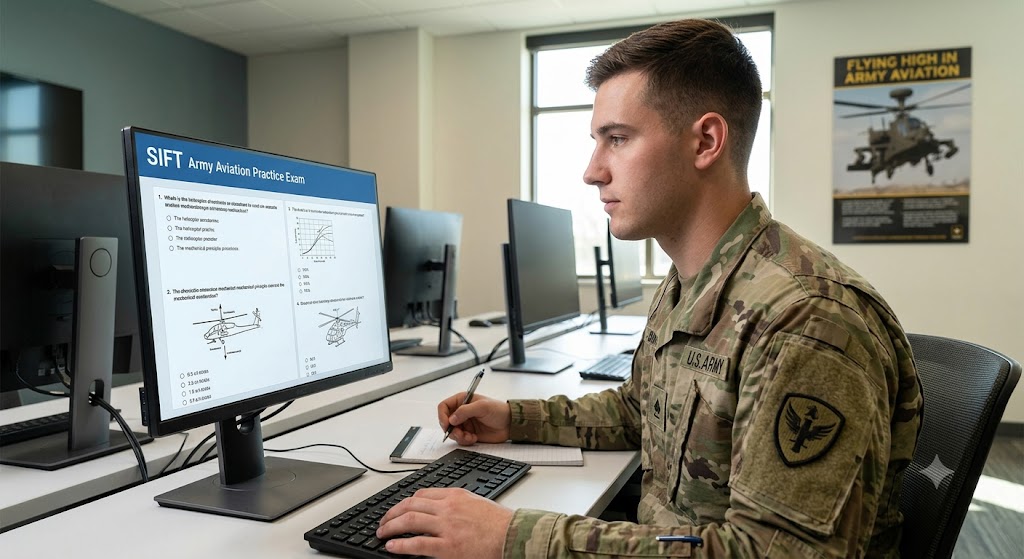
Additional Information
What the Course Entails and Exam Details
Preparing for the SIFT is not about a single course, but rather a focused study effort across several distinct sections that evaluate different cognitive domains.
The exam details and core sections include:
Simple Drawings: This section measures visual discrimination and speed, requiring candidates to quickly identify and mark simple figures from a larger set.
Hidden Figures: This section tests spatial ability and field independence, challenging candidates to locate a simple geometric figure hidden within a complex drawing.
Army Aviation Information: This area assesses specific knowledge related to Army aviation, including aircraft types, components, fundamental principles of flight, and general military aviation history and procedures.
Spatial Apperception: This section evaluates a candidate's ability to perceive the position of an object in three-dimensional space, requiring they determine the orientation of an aircraft based on a provided cockpit view.
Reading Comprehension: This portion measures reading and reasoning ability, involving reading passages and answering questions that require understanding, analysis, and inference.
Math Skills: Candidates are tested on a range of mathematical concepts, including arithmetic, algebra, geometry, and data interpretation, focusing on problem-solving skills relevant to flight.
Mechanical Comprehension: This section assesses understanding of mechanical and physical principles, such as leverage, pulley systems, gears, and basic physics concepts.
What to Expect in the Final Exam
The SIFT is a computer-based, multiple-choice exam administered at various military testing locations and educational institutions.
The overall test typically takes approximately two to three hours to complete, with each section having its own specific time limit. The number of questions and time allocated vary by section. For example, the Simple Drawings and Hidden Figures sections are relatively brief and speed-oriented, while the Math Skills and Mechanical Comprehension sections provide more time per question.
A critical point to note is that the SIFT scoring is complex. You are given a raw score, but the final, relevant score is a scaled score, typically ranging from 20 to 80, with 50 being the average. There isn't a fixed, single "passing" score; instead, individual Army Aviation branches use a variety of composite scores to assess competitiveness. It's generally advised to aim for a scaled score of 50 or above, and a higher score will make you a more competitive candidate. Retesting is possible, but usually only after a significant waiting period.
How to Study and Exam Centers
Effective preparation is essential for a competitive SIFT score. Here are highly recommended strategies:
Official Study Guides: Utilize official Army Aviation materials and study guides specifically created for the SIFT. These often provide the best insight into the exam's content and style.
Practice Tests: Taking SIFT practice tests, such as those available from reliable educational publishers, is invaluable. This helps you familiarize yourself with the format, practice time management, and identify weak areas.
Focus on All Sections: While you may have natural strengths, don't neglect any section. Dedicated study time to aviation information, mechanical principles, and math skills is crucial. For the spatial apperception, practice with visualization.
Simulate Test Conditions: When taking practice tests, try to mimic the actual testing environment as closely as possible—time yourself, minimize distractions, and take the entire practice test in one sitting.
The SIFT exam itself is usually taken at a Military Entrance Processing Station (MEPS) for initial applicants. Active duty Army personnel can typically take the exam at a test center or Education Center located on their base. ROTC cadets may also have opportunities to take the test through their detachment. It is not generally administered at civilian-style testing centers like Pearson VUE.
Job Opportunities from the Course
A strong score on the SIFT is the first mandatory step to entering the Army Aviation pipeline and unlocks prestigious career opportunities, primarily as an Army Warrant Officer Aviator.
Below are specific job roles and career paths this achievement makes possible:
Army Warrant Officer Aviator: This is the core career path, providing the opportunity to pilot a variety of advanced aircraft.
Helicopter Pilot (AH-64 Apache, UH-60 Black Hawk, CH-47 Chinook, or UH-72 Lakota): Fly and command combat, utility, and cargo helicopters in support of ground forces.
Fixed-Wing Pilot: Though less common, opportunities exist to pilot specific Army fixed-wing aircraft for reconnaissance, transport, and special missions.
Aviation Leader and Instructor: Progress to leadership positions within aviation units or become an instructor pilot, training the next generation of aviators.
Special Operations Aviation: For those seeking additional challenges, paths into elite special operations aviation units (like the 160th Special Operations Aviation Regiment) may become available after initial training and experience.
Your successful performance on the SIFT is a critical gateway to a high-impact and rewarding career as an Army Aviator.
Frequently Asked Questions
Reviews
5.0
Based on 0 reviews
Leave a Review
No reviews yet. Be the first to review!