
SIA Art Law Practice Exam
$69.00
- Buy to unlock unlimited access to all Quiz questions.
- After purchase you can print a PDF of the whole quiz at any point. The PDF will contain the questions and the correct answers.
About this Exam
The SIA Art Law Practice Exam is a targeted assessment designed to prepare students and professionals for the official Art Law examinations offered by the prestigious Sotheby’s Institute of Art. This course and subsequent practice test are meticulously crafted for a broad spectrum of individuals navigating the global art market. Ideal candidates include aspiring and practicing art lawyers, art consultants, collection managers, gallery and museum professionals, auction house specialists, and high-net-worth collectors. The certification validates a deep, practical understanding of the complex legal landscape that governs the entire life cycle of art—from creation and acquisition to ownership, exhibition, and eventual disposition.
Ready to test your knowledge?
Buy Now to Access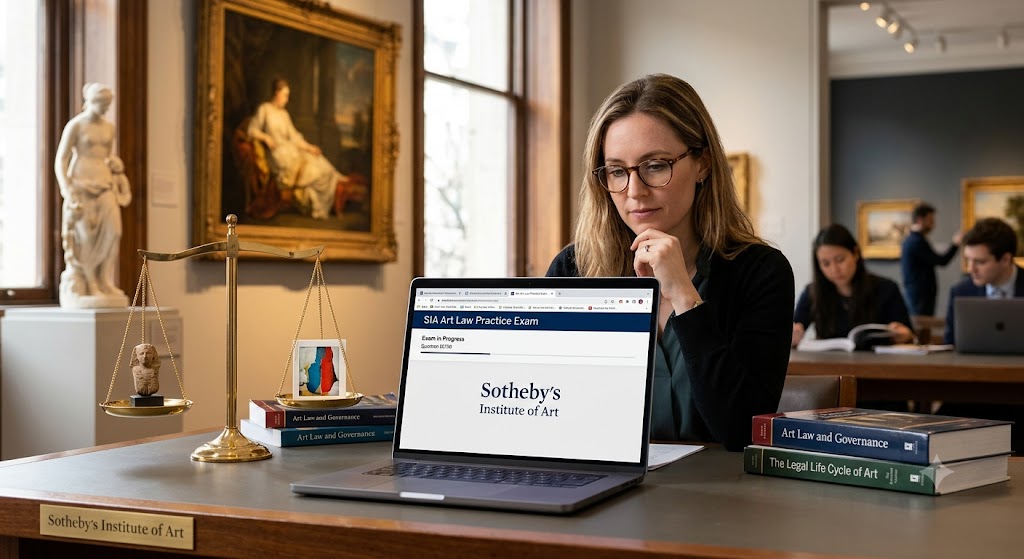
Additional Information
What the Course Entails and Exam Details
The SIA Art Law course provides an immersive and cross-disciplinary foundation in the principles of art law. It doesn't just cover abstract legal theory but focuses on how these laws function in the real-world international art market.
Core Topics Covered in the Curriculum:
Intellectual Property and Copyright: Understanding artists' moral rights, fair use, licensing, and protection of original works against reproduction and plagiarism.
Art Market Contracts and Transactions: A detailed breakdown of consignment agreements, private sales, and the legal mechanics of an art auction.
Title, Provenance, and Due Diligence: The process of authenticating a work of art, investigating its ownership history, and navigating claims related to stolen, looted, or illegally exported objects.
Art and Cultural Heritage Law: Navigating legal frameworks concerning national treasures, repatriation claims, and the international trade of antiquities.
Taxation, Import, and Export: The complex world of art finance, including tax implications for sales, gifts, and donations, as well as import/export duties.
Dispute Resolution: Practical methods for handling art-related disputes, including alternative dispute resolution (ADR) and high-profile litigation case studies.
What to Expect in the Final Exam
While the exact structure of the final exam at Sotheby’s Institute of Art may vary slightly by course (e.g., intensive short course vs. part of a Master’s program), students can generally expect a robust assessment designed to test practical application of legal principles.
The Standard Exam Format Includes:
Format: A combination of Multiple-Choice questions to test core knowledge, and nuanced, narrative-based Case Studies. These scenario questions present a real-world legal dilemma and require a comprehensive analysis and solution.
Passing Score: Typically, a score of 70% or higher is required to pass the SIA Art Law assessment and receive the certificate of completion.
Time Limit: For intensive courses, the exam usually has a set time limit, for example, 90 minutes to 2 hours for an online assessment.
Delivery Method: The formal SIA examinations are frequently delivered via an online learning portal, making them accessible to a global audience. Some programs may offer in-person options.
The SIA Art Law Practice Exam you are using now is designed to mirror these conditions, providing you with a similar mix of question types, including complex case analysis, to ensure you are fully prepared for the rigor of the actual certification.
How to Study and Exam Centers
Effective study is paramount to success in a subject as detail-oriented as art law.
Actionable Study Strategies:
Review Course Materials Thoroughly: Your foundational study resource must be the course lectures, video content, and detailed reading materials provided by SIA.
Deep Dive into Key Case Law: Art law is frequently built upon pivotal case studies. Know the details of landmark decisions (e.g., cases involving appropriation art like Prince v. Cariou or cases of theft/restitution).
Leverage Practice Questions: This is where the SIA Art Law Practice Exam is your critical tool. Repeatedly practice in exam mode to manage your time and refine your analytical skills, paying special attention to the rationale behind both correct and incorrect answers.
Study in Groups: For the case study portion, discussing potential scenarios with peers can expose you to different perspectives and legal arguments.
How to Take the Exam:
Online Portal: Most current SIA Art Law courses utilize a proprietary, secure online learning platform. Once registered for a course, you will receive login details to access all materials and, ultimately, the final online examination from anywhere in the world with a reliable internet connection.
Specific Institutions and Partners: Some highly specialized in-person intensive programs or academic programs (like the MA in Art Business) will conduct examinations at the Sotheby's Institute of Art main campuses in London or New York City. Always verify the specific rules and location details provided in your course registration confirmation.
Job Opportunities from the Course
A certification from the Sotheby’s Institute of Art in Art Law is a powerful differentiator in the professional art world. It demonstrates to employers and clients that you possess not only a passion for art but also the rigorous legal acumen required to navigate its complex business environment.
Key Job Opportunities this Certification Unlocks:
Art Law Attorney (within a dedicated art law firm or general practice with art law specialty)
Auction House Specialist (specifically in compliance, business development, or legal counsel)
Collection Manager for a private collector or foundation
Provenance Researcher for a museum, gallery, or auction house
Art Consultant or Advisor
Art Finance Associate
Art Insurer and Claims Adjuster
Registrar (handling legal and logistical movement of art)
Gallerist / Gallery Manager (enhancing operational legal compliance)
Museum Curator or Administrator (with focused knowledge of governance and repatriation law)
Your specialized knowledge will make you an invaluable asset in protecting cultural heritage and ensuring the legal integrity of transactions in the global art market. Good luck with your studies, and use this guide and practice exam to achieve your professional goals.
Frequently Asked Questions
Reviews
5.0
Based on 0 reviews
Leave a Review
No reviews yet. Be the first to review!