
SGLA LARE Inventory, Analysis, and Project Management (IAP) Practice Exam
$69.00
- Buy to unlock unlimited access to all Quiz questions.
- After purchase you can print a PDF of the whole quiz at any point. The PDF will contain the questions and the correct answers.
About this Exam
The Landscape Architect Registration Examination (LARE) is a rigorous and comprehensive four-part computerized test designed to assess the knowledge, skills, and abilities required to practice landscape architecture safely and effectively. It is a mandatory requirement for licensure in the United States, Canada, and select US territories, with the ultimate goal of protecting the health, safety, and welfare of the public and the environment.
Section 1: Inventory, Analysis, and Project Management (IAP) focuses on the foundational stages of any professional project. It evaluates a candidate’s ability to gather and interpret essential data, perform complex environmental analyses, facilitate stakeholder engagement, and manage critical aspects of project planning, such as scope, schedule, and risk.
This practice exam and guide are designed for aspiring licensed landscape architects who are either preparing for their first LARE section or are looking for a focused review to master the IAP domain. Whether you are a fresh graduate or a working professional, mastering this section is your crucial first step on the path to becoming a recognized, licensed professional.
Ready to test your knowledge?
Buy Now to Access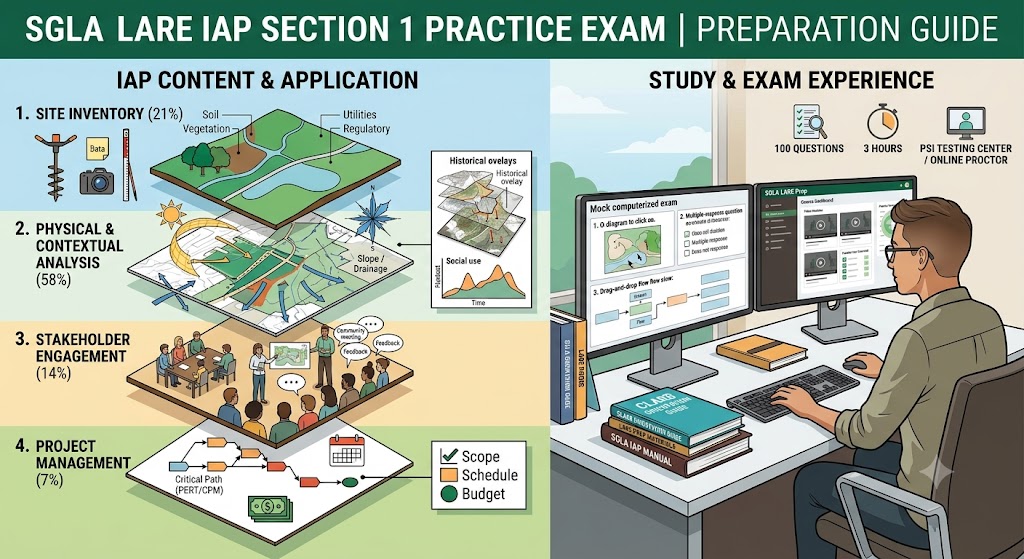
Additional Information
What the Course Entails and Exam Details
As Section 1 of the new LARE blueprint (introduced in December 2023), the IAP exam covers five critical sub-domains of professional practice. A dedicated "SGLA LARE Prep" course, which is often recommended for its structure, will mirror this official syllabus to ensure a comprehensive understanding of each task.
The core topics and knowledge areas include:
Sub-domain 1: Project Management (7%)
Determining project scope, schedule, and budget.
Managing project-related risk and contract terms.
Sub-domain 2: Inventory and Data Collection (21%)
Identifying, collecting, and managing necessary site data (topography, soil, vegetation, utilities).
Gathering off-site contextual data (regulatory, historical, social).
Sub-domain 3: Stakeholder Engagement Process (14%)
Identifying and engaging project stakeholders and user groups.
Facilitating public meetings, workshops, and participation efforts.
Sub-domain 4: Physical Analysis (39%)
Analyzing physical site conditions, such as sun/shade patterns, wind, and hydrology.
Assessing biological factors, wildlife, and natural systems.
Evaluating land use, zoning, and legal constraints.
Sub-domain 5: Contextual Analysis (19%)
Analyzing socio-cultural, historical, and economic contexts.
Synthesizing findings into complex analysis maps and documents to inform design.
What to Expect in the Final Exam
The IAP exam is a fully computerized, independent section. CLARB utilizes professional testing standards to ensure the examination remains legally defensible.
Key Exam Format Details:
Total Number of Questions: 100 questions.
Total Seat Time: 3.5 hours, with 3 hours of actual testing time.
Passing Score: Licensure candidates must achieve a scaled score of at least 650 on a scale of 100 to 900.
Question Types: The exam uses a blend of question types to measure depth of knowledge. This includes traditional single-choice multiple-choice, but also more complex formats such as:
Multiple-response (select all that apply).
Drag-and-drop (to order or match items).
Hotspot (click on the correct part of an image or map).
Candidates are advised to familiarize themselves with all question formats, as they require a synthesis of fact-based knowledge and practical application.
How to Study and Exam Centers
Preparation for the LARE requires a multifaceted approach. To maximize your chances of success, you should integrate official CLARB materials with high-quality third-party resources, such as the highly structured courses and materials provided by SGLA LARE Prep.
Actionable Study Strategies:
Start with the Source: Download and thoroughly read the official CLARB LARE Orientation Guide. This document defines the exact job task analysis upon which all test questions are based.
Use the Reading List: CLARB provides a list of recommended reference books. Use this list to deep-dive into areas where your academic or professional background may be weaker.
Invest in Structure: Candidates often find that a preparatory course, like those from SGLA, is "well worth the cost," as it provides organized study modules, logical content delivery, and mental techniques to maintain focus.
Take Practice Exams: Utilize both CLARB’s official retired question practice exams and SGLA's practice tests. SGLA exams can serve as your primary content review, while official CLARB materials can help you "simulate test day" and normalize the language and complex question types.
Review, Don't Memorize: When taking practice tests, the goal is to understand why an answer is correct. A quality prep course and detailed explanations in practice exams are crucial for this. For wrong answers, revisit the source material to identify and fill knowledge gaps.
Exam Centers and Scheduling:
The LARE is administered globally by PSI Services. You can take the exam via two methods:
Physical Testing Centers: You can schedule an appointment at a secure, computerized PSI location.
Online Proctoring: You can take the exam from a private, secure location (like your home or office) via a live proctor, provided you meet strict technical and environmental requirements.
Candidates must create a CLARB record, confirm their eligibility within their specific jurisdiction, and then register and schedule their appointments as early as possible within the designated administration windows.
Job Opportunities from the Course
Successfully completing all four parts of the LARE, including Section 1, is the defining step for obtaining licensure. Becoming a Licensed Landscape Architect (PLA/RLA) opens diverse and impactful career paths.
Passing the exam is a requirement for, and directly unlocks, the following roles and specializations:
Licensed Landscape Architect (PLA / RLA)
Senior Landscape Architect / Project Manager
Urban Designer / Master Planner
Environmental Planner / Resource Manager
Parks and Recreation Planner
Campus or Corporate Site Planner
Public Works Project Manager (Municipal/Government)
Green Infrastructure and Stormwater Specialist
Landscape Construction Administrator
Cultural Landscape / Historic Preservation Specialist
Principal or Owner of a Landscape Architecture Firm
Frequently Asked Questions
Reviews
5.0
Based on 0 reviews
Leave a Review
No reviews yet. Be the first to review!