
ServSafe Quiz Minimum Internal Cooking Temperatures.
$69.00
- Buy to unlock unlimited access to all Quiz questions.
- After purchase you can print a PDF of the whole quiz at any point. The PDF will contain the questions and the correct answers.
About this Exam
The ServSafe Minimum Internal Cooking Temperatures certification assessment, often part of the broader ServSafe Manager or Food Handler qualifications, is essential for anyone handling food in a professional setting. This specific quiz focuses entirely on a critical cornerstone of food safety: knowing exactly which internal temperature different types of food must reach to kill harmful bacteria and pathogens. It is designed for chefs, line cooks, managers, and all kitchen staff, as well as students in culinary arts programs, to ensure they have the precise, life-saving knowledge required to prevent foodborne illnesses and maintain health code compliance. Understanding and applying these standards is not just a regulatory requirement but a fundamental duty in protecting public health.
Ready to test your knowledge?
Buy Now to Access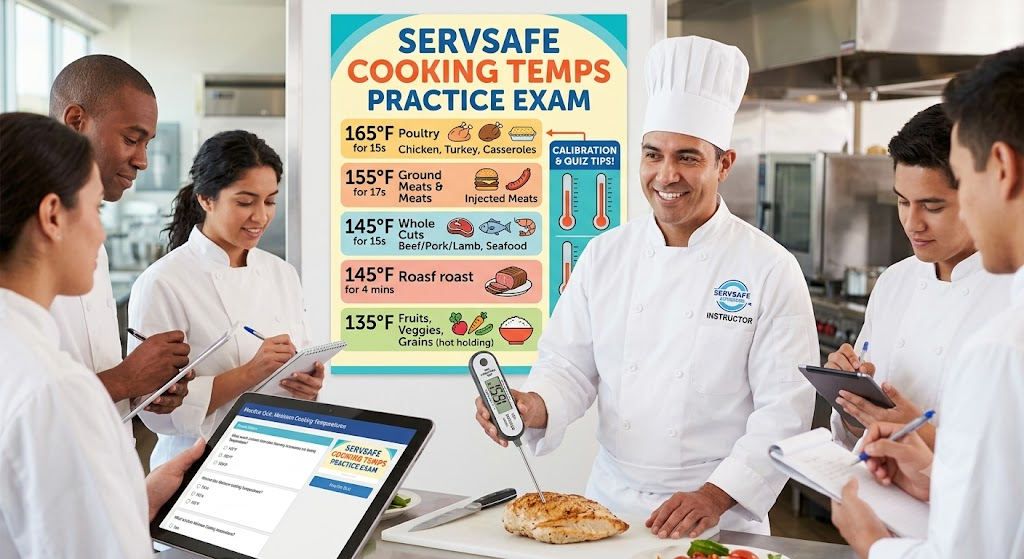
Additional Information
What the Course Entails and Exam Details
This focused area, and any associated training or practice, covers the comprehensive FDA and state-level standards for safe minimum internal cooking temperatures. The core topics include:
Understanding Pathogens: A brief overview of the types of harmful micro-organisms that are eliminated by proper cooking temperatures.
Temperature Categories: Differentiating the required temperatures for various food categories:
165°F (for 15 seconds): Poultry (chicken, turkey, duck), stuffed meats, stuffing containing meat, casseroles, and reheated leftovers.
155°F (for 17 seconds): Ground meats (beef, pork), injected meats, mechanically tenderized meats, ground seafood, and shell eggs for hot holding.
145°F (for 15 seconds): Whole cuts of beef, pork, veal, and lamb; seafood (fish, shellfish, crustaceans); and shell eggs cooked to order.
145°F (for 4 minutes): Roasts of beef, pork, veal, and lamb.
135°F: Fruits, vegetables, grains, and legumes that will be hot-held for service.
Thermometer Calibration & Use: The absolute necessity of using calibrated, appropriate food thermometers and how to properly insert and read them.
Cross-Contamination Prevention: The related principles of preventing the spread of contaminants before, during, and after cooking.
Safe Cooling and Reheating Protocols: While focused on cooking, understanding the full cycle, including how to handle food safely after it has been cooked, is implicitly connected.
The detailed, mandatory nature of this knowledge means it is a key component of any comprehensive food safety certification.
What to Expect in the Final Exam
For a standalone ServSafe Quiz Minimum Internal Cooking Temperatures and its representation as a critical section in larger exams:
Format: The most common format is a multiple-choice questionnaire. Questions are typically direct scenarios or direct requests for the specific minimum internal temperature of a particular food item and its holding time. You might encounter scenario-based questions like "To what temperature should you cook a chicken breast?" or "A customer orders a medium-rare whole cut steak; what is the required minimum temperature?". True/False or matching questions are also common in study guides and practice quizzes, but the final, high-stakes assessment is overwhelmingly multiple choice.
Passing Score: For the comprehensive ServSafe Manager exam, which heavily incorporates this content, the passing score is usually 75%. For an isolated topic quiz, expect a similarly high benchmark (75% to 80%) to demonstrate mastery of this life-critical information.
Time Limits: A focused quiz on this topic alone would typically be relatively short, often 20 to 30 minutes. When integrated into the full 90-question ServSafe Manager exam, you will have approximately 90 minutes to 2 hours for the entire test.
Rules: The exam, whether a stand-alone quiz or part of a larger certification, is generally a proctored, closed-book assessment. No study guides, notes, or outside materials are allowed. You must rely solely on the knowledge you have studied. Ensure you understand the proper use of required technology for online formats, such as a webcam and reliable internet connection, or adhere to the regulations of an in-person testing center.
How to Study and Exam Centers
Preparation is paramount for this critical knowledge. Here are actionable study strategies and information on where to find assessment opportunities:
Actionable Study Strategies:
Flashcards: This is the ultimate method for this type of test. Create digital or physical flashcards with the food name on one side and the required temperature and time on the other (e.g., "Chicken Breast" -> "165°F for 15 seconds"). Mix them up and quiz yourself repeatedly.
Study Guides and Temp Charts: Utilize official ServSafe study materials and visually impactful temperature charts. Place a large chart prominently in your study area or kitchen to reinforce the information constantly.
Practice Tests: Access reputable online portals that offer free and paid ServSafe practice exams. Look for quizzes specifically focused on internal cooking temperatures. Analyze your results to identify weak areas.
Hands-on Application: Make a habit of using a calibrated thermometer at home or at work for every relevant meal or prep task. Physically checking temperatures makes the numbers concrete. Practice calibrating a thermometer (boiling and ice point methods).
Teach Others: Explaining the standards and the reasoning behind them (which foods are higher risk, which bacteria are killed at what temps) is an excellent way to deepen your own understanding.
Focus on Categories: Group the temperatures. Memorize the major groups (165, 155, 145, 135) and the foods within each to provide a stronger mental framework.
Exam Centers and Formats:
Online Portals with Remote Proctors: Many online educational institutions and specific ServSafe portals (like ServSafe.com itself and various authorized partners) offer the ability to take exams and quizzes digitally, often utilizing remote live proctoring (e.g., with services like ProctorU). This requires a reliable computer, webcam, and microphone.
Physical Testing Centers: You can take the exam in person at official ServSafe test centers. These are often located in culinary schools, community colleges, vocational centers, or specifically designated testing facilities. Check the ServSafe website to find a center near you.
Authorized Schools & Facilitators: Many organizations, including restaurants, hotel chains, and local community health programs, are authorized to conduct ServSafe training and exams in-person, utilizing a certified proctor. Culinary programs and schools frequently include these certifications as part of their coursework.
Job Opportunities from the Course
A strong grasp of minimum internal cooking temperatures, validated through certification, directly qualifies you for and enhances your value in numerous critical roles within the food service and hospitality industry:
Line Cook
Sous Chef
Executive Chef
Catering Chef
Kitchen Manager
Restaurant Manager
Food Safety Officer / Coordinator (Internal roles within large food service companies)
Health Inspector (With further government/environmental health qualifications)
Hotel Food and Beverage Manager
Hospital or School Cafeteria Manager
Personal Chef
Dietary Manager
Product Developer (Food Industry)
Possessing this specific knowledge and certification can be a crucial requirement and a competitive differentiator for these positions, demonstrating your commitment to high safety standards and professionalism.
Frequently Asked Questions
Reviews
5.0
Based on 0 reviews
Leave a Review
No reviews yet. Be the first to review!