
ServSafe Practice Test Topic Before You Come Back to Work
$69.00
- Buy to unlock unlimited access to all Quiz questions.
- After purchase you can print a PDF of the whole quiz at any point. The PDF will contain the questions and the correct answers.
About this Exam
The ServSafe "Before You Come Back to Work" module and associated practice tests are designed specifically for foodservice employees returning to the workplace following a prolonged absence or during a significant operational shift (such as reopening after a public health crisis). This training serves as a crucial primer to ensure that all staff members are re-aligned with essential food safety protocols and updated on any new health and safety regulations. It targets both frontline employees and managers, reinforcing the fundamental practices required to keep both staff and customers safe in a food service environment.
Ready to test your knowledge?
Buy Now to Access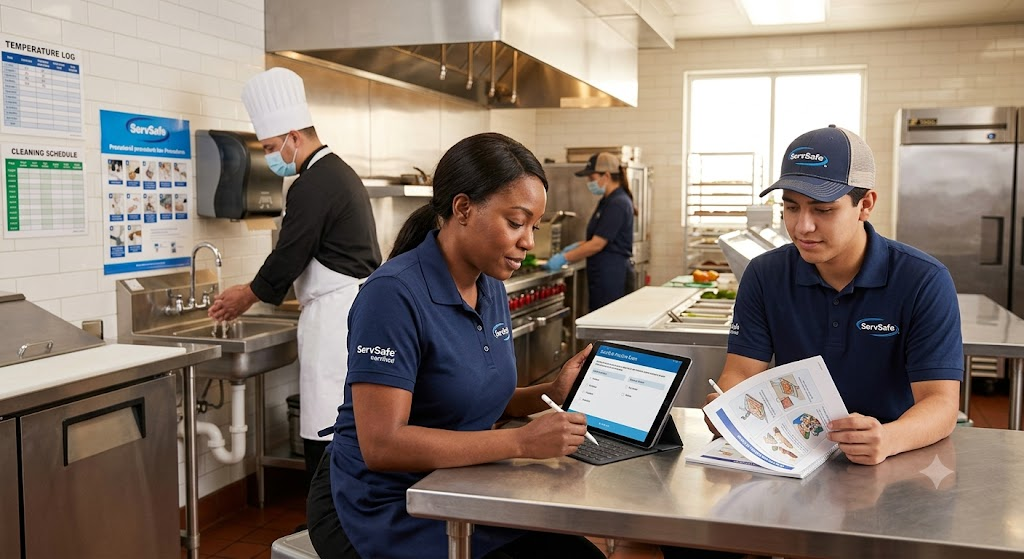
Additional Information
What the Course Entails and Exam Details
The training primarily covers the critical steps needed to maintain a safe and sanitary food service operation. Core areas include:
Employee Health and Hygiene: Re-emphasizing proper handwashing techniques, personal cleanliness, and health reporting requirements.
Cleaning and Sanitizing: Reviewing the differences between cleaning and sanitizing, including the correct procedures for surfaces, equipment, and high-touch areas.
Safe Food Handling: Reaffirming the fundamentals of time and temperature control, preventing cross-contamination, and safe food storage.
Operational Changes: Introducing or reinforcing any updated protocols specific to the reopening or operational environment, which may include physical distancing, revised service methods, and health screening procedures.
The practice test is a diagnostic tool, mimicking the structure and content areas of a formal ServSafe assessment (such as the Food Handler or Manager certification exams, depending on which level this specific topic is integrated into) but focuses solely on the "back-to-work" and reintegration principles.
What to Expect in the Final Exam
While the "Before You Come Back to Work" module is often delivered as a standalone training with a quiz rather than a full, official certification exam, the assessment usually follows the standard ServSafe format:
Format: Multiple-choice questions.
Scope: Approximately 10–30 questions when given as a standalone module quiz; more questions (40–90) if integrated into a full certification exam like Food Handler.
Passing Score: Typically 70% to 75%, consistent with standard ServSafe certifications.
Time Limit: Generally not timed when taken as a training quiz, but official ServSafe exams often have a time limit (e.g., 1.5 to 2 hours).
The focus is on practical knowledge and scenario-based application.
How to Study and Exam Centers
How to Study
Effective preparation for this assessment involves both reviewing training materials and practical application:
Review ServSafe Materials: Diligently review the specific "Before You Come Back to Work" training videos, guides, and presentations provided by ServSafe or your employer.
Take Practice Quizzes: Utilize official ServSafe practice questions and reputable online practice tests (like this one) repeatedly to identify knowledge gaps and familiarize yourself with the question format.
Flashcards: Create flashcards for critical information, such as proper temperature ranges (the Temperature Danger Zone), chemical concentrations for sanitizers, and correct handwashing steps.
Practical Reinforcement: Mentally (or physically, if in the workplace) walk through the processes—imagine correctly setting up a sanitation bucket, explaining handwashing steps, or describing what to do if you feel sick.
Where to Take the Exam
The actual assessment for this specific module is often administered differently than a full certification:
Online Portals: Employers frequently deliver this training and the associated quiz directly through an online Learning Management System (LMS) or the ServSafe online platform.
Employer-Led Sessions: Managers or owners may administer the training and quiz on-site as part of a staff meeting or reopening orientation.
Note on Official Exams: If this topic is part of your preparation for the full ServSafe Manager or Food Handler Certification, those official proctored exams are taken either online via a registered proctor (often remotely supervised) or at authorized physical testing locations (such as specific Pearson VUE centers or authorized hospitality schools). This standalone module quiz usually does not require a formal proctoring center.
Job Opportunities from the Course
Successfully completing this training and any subsequent ServSafe certification (like Food Handler or Manager) directly supports a wide range of roles within the food service industry. Employers highly value staff who are certified, as it demonstrates a commitment to food safety.
Restaurant Manager
Kitchen Manager
Chef / Sous Chef
Line Cook / Prep Cook
Food Service Supervisor
Catering Manager / Staff
Server / Waitstaff
Cafeteria Manager
Frequently Asked Questions
Reviews
5.0
Based on 0 reviews
Leave a Review
No reviews yet. Be the first to review!