
ServSafe Practice Test Chapter 5 Purchasing, Receiving, and Storage
$69.00
- Buy to unlock unlimited access to all Quiz questions.
- After purchase you can print a PDF of the whole quiz at any point. The PDF will contain the questions and the correct answers.
About this Exam
The ServSafe certification is the premier food safety training program for the foodservice industry, accredited by the American National Standards Institute (ANSI)-Conference for Food Protection (CFP). It is designed for managers, supervisors, and any culinary professional responsible for handling food and leading teams. Achieving this certification demonstrates a comprehensive understanding of essential food safety practices, ensuring the protection of public health and the success of any foodservice operation. This practice guide focuses specifically on the critical knowledge required for Chapter 5, ensuring you are prepared to manage the complex flow of food from the moment it is ordered until it is safely stored.
Ready to test your knowledge?
Buy Now to Access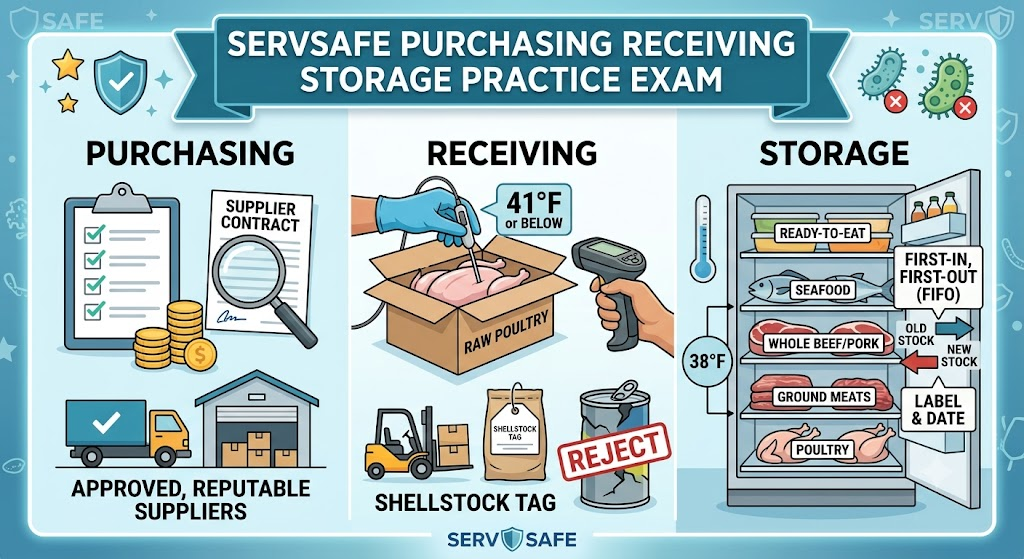
Additional Information
What the Course Entails and Exam Details
This focused study guide for ServSafe Chapter 5: "The Flow of Food: Purchasing, Receiving, and Storage," details the regulatory requirements and best practices for securing safe food sources and maintaining their integrity upon arrival. The core topics you must master include:
Approved Suppliers: Recognizing the criteria for a reputable supplier, including their adherence to local, state, and federal laws and their track record of food safety inspections (USDA, FDA, or third-party audits).
The Inspection Process: Detailing exactly how to receive a delivery, including planning, staffing, necessary tools (thermometers, purchase orders, scales), and conducting a visual inspection of the delivery vehicle itself.
Receiving Temperature & Quality Standards: Memorizing the precise temperature acceptance and rejection criteria for a wide range of products, including cold TCS foods (≤41°F), hot TCS foods (≥135°F), frozen foods (must be frozen solid), live and shucked shellfish, milk, and shell eggs.
Criteria for Rejecting Food: Identifying visual cues for rejection, such as damaged, leaky, or pest-infested packaging; abnormal colors, textures, or odors; and the presence of large ice crystals on frozen items.
General Storage Guidelines: Mastering safe storage techniques to prevent time-temperature abuse and contamination. This includes proper labeling (product name, use-by date), the First-In, First-Out (FIFO) method for stock rotation, and safe air temperature requirements for dry and refrigerated storage areas.
Specific Storage Rules: Understanding the specific storage needs for different types of food to prevent cross-contamination, such as the correct vertical order for storing raw and ready-to-eat foods in a cooler.
What to Expect in the Final Exam
While you are preparing for a focused test on Chapter 5, the final, official ServSafe Food Protection Manager Certification Exam is a comprehensive assessment. Here is a general outline of what to expect on the full exam day:
Format: The exam consists entirely of multiple-choice questions. It includes 90 questions in total, though only 80 are scored. The remaining 10 are pilot questions used for research and do not affect your final score. You will not know which questions are unscored, so treat every question as if it counts.
Passing Score: To become a Certified Food Protection Manager, you must achieve a passing score of 75% on the scored questions, which means answering at least 60 out of the 80 scored questions correctly.
Time Limit: You are allotted approximately 2 hours (120 minutes) to complete the exam. This is generally ample time to read and carefully answer every question.
Rules: The exam is strictly proctored, whether you take it online or in person. For online proctoring, you must complete a system check, have a working webcam and microphone, and use a private room free of notes and other people. For in-person exams, you must bring a valid government-issued photo ID and meet with a registered ServSafe proctor. Any questions left blank are scored as incorrect.
How to Study and Exam Centers
Preparation is key to passing both this chapter test and the final certification exam. Use these expert strategies to build your confidence and knowledge:
Practice Scenarios, Not Just Facts: ServSafe questions frequently present hypothetical workplace situations and ask what a manager should do. Shift your studying from simple memorization to applying concepts. Ask yourself, "What would I do if a delivery of poultry arrived at 45°F?" or "How would I organize this new shipment of beef and lettuce?"
Lock in the Numbers Early: Time and temperature values are a major part of this chapter and the entire exam. Use flashcards to drill the acceptance/rejection temperatures for every food type until they are automatic. The 41°F to 135°F Temperature Danger Zone must be ingrained.
Use Full-Length Practice Tests: Taking multiple-choice practice tests is essential. They help you get used to the wording of the questions and the types of scenarios you will face. Analyze every question you get wrong to understand the reasoning behind the correct answer.
Review and Recite Key Vocabulary: Don't just read the definitions. Recite them in your own words and explain how they apply to daily kitchen management (e.g., First-In, First-Out, Shellstock Identification Tag, TCS food).
When you are ready to take the official exam, you have two primary options for testing centers:
Online Proctoring: You can take the exam from the comfort of your own home or office using a computer with a webcam and microphone. This service is provided through ProctorU, an approved remote proctoring service. You will need to purchase an exam access code and schedule a time through their portal.
Physical Testing Centers: You can take a print or online exam in a proctored environment. This can be at authorized testing centers such as Pearson VUE, local community colleges, culinary schools, or through instructor-led classes. You can find a registered proctor or instructor in your area through the ServSafe website's locator tool.
Job Opportunities from the Course
Obtaining your ServSafe Food Protection Manager Certification is a standard, and often legally required, step for leadership roles across the diverse hospitality and foodservice landscape. It demonstrates a commitment to public safety that is highly valued by employers. Some of the career paths and job titles unlocked by this certification include:
Restaurant General Manager
Kitchen Manager
Executive Chef
Sous Chef
Dietary Manager or Supervisor (in healthcare facilities like hospitals and nursing homes)
Catering Manager
School Food Service Director
Hotel Food and Beverage Director
Grocery Store Department Manager (e.g., Deli, Bakery)
Corporate Food Safety Auditor
Health Inspector (often requires additional degree)
Frequently Asked Questions
Reviews
5.0
Based on 0 reviews
Leave a Review
No reviews yet. Be the first to review!