
Security Operations Question CISSP Course Practice Test
$69.00
- Buy to unlock unlimited access to all Quiz questions.
- After purchase you can print a PDF of the whole quiz at any point. The PDF will contain the questions and the correct answers.
About this Exam
The Certified Information Systems Security Professional (CISSP) designation is the gold standard for cybersecurity leadership, validated globally as the premier certification for information security professionals. This comprehensive exam, developed by (ISC)², assesses a candidate's mastery across eight critical domains of the Common Body of Knowledge (CBK). Within this framework, Domain 7, Security Operations, is arguably one of the most vital, focusing on the real-world application and management of security principles in day-to-day business functions.
This study guide is designed to help professionals preparing for the Security Operations segment of the CISSP. Whether you are an aspiring security analyst, a seasoned systems administrator, or a manager looking to deepen your practical knowledge, mastering these concepts is essential for both passing the rigorous exam and achieving long-term career success.
Ready to test your knowledge?
Buy Now to Access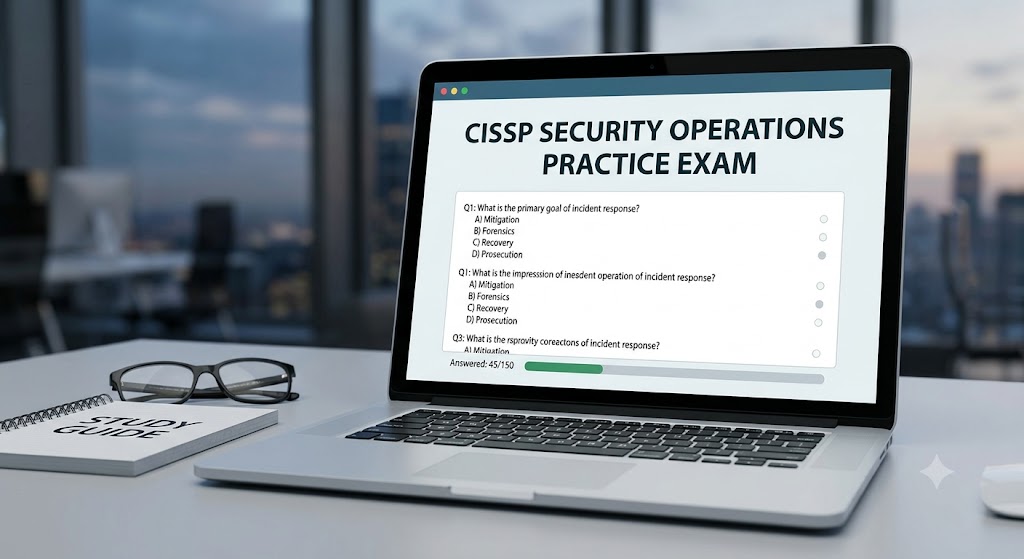
Additional Information
What the Course Entails and Exam Details
This practice test specifically targets the material covered
under Domain 7 of the CISSP CBK: Security Operations. It probes your deep
understanding of operational security concepts and your ability to apply them
in a corporate environment. The broad topics you must master include:
Investigations: Understanding the legal, ethical, and
practical requirements for conducting security investigations. This involves
knowledge of digital forensics, evidence handling, and investigation
techniques.
Incident Management: A cornerstone of security
operations, covering the entire lifecycle of an incident: detection, response,
mitigation, reporting, and recovery.
Disaster Recovery and Business Continuity:
Developing, implementing, and testing strategies to maintain critical
operations during and after a significant disruptive event.
Change and Configuration Management: Learning how to
securely manage modifications to systems and software to prevent unauthorized
or insecure changes.
Patch and Vulnerability Management: Understanding how
to identify, prioritize, and remediate security vulnerabilities in an organized
and efficient manner.
Personnel Security and Awareness: Recognizing the
crucial role that training and clear policies play in building a
security-conscious organizational culture.
What to Expect in the Final Exam
While this specific resource is a practice test, it
is crucial to understand the format of the actual, official CISSP exam, which
is a formidable challenge. The official CISSP exam utilizes Computerized
Adaptive Testing (CAT) for the English version. This means the difficulty level
of the questions you see is dynamically adjusted based on your performance on
previous answers.
The actual exam contains between 100 and 150 questions.
Candidates are given three hours (180 minutes) to complete
the test.
The passing score is 700 out of 1000 points.
It is critical to note that you cannot skip questions or go
back to change answers in the CAT format, making each answer final and
emphasizing the need for decisive knowledge. Our practice test is designed to
mirror this rigor, forcing you to commit to an answer and build the confidence
needed for the actual proctored experience.
How to Study and Exam Centers
Effective preparation for the CISSP Security Operations
domain requires a blend of deep theoretical knowledge and practical, applied
scenario analysis. We recommend a structured study plan:
Leverage Official Resources: Start with the (ISC)²
CISSP Official Study Guide and the Official Practice Tests book. These are
fundamental to understanding the breadth and depth required.
Utilize Practical Labs: Since Security Operations is
hands-on, practicing scenarios in virtual labs—such as analyzing logs,
simulating incident response, and reviewing forensic evidence—can be incredibly
valuable.
Master Flashcards and Summary Sheets: Consolidate
your learning by making flashcards for key terms, regulatory requirements (like
HIPAA or GDPR in the context of investigations), and specific processes (e.g.,
the incident response lifecycle).
Take Timed Practice Exams: This is perhaps the most
crucial step. Our practice test provides a realistic environment to gauge your
readiness, identify your weaknesses, and build the mental stamina required for
the three-hour CAT exam. Analyze every wrong answer and understand why the
correct answer is superior.
Regarding taking the official exam, the CISSP exam is
administered exclusively through Pearson VUE at their authorized testing
centers worldwide. There are no legitimate online-proctored options for the
CISSP; you must schedule and attend a physical testing center. You can find
locations and schedule your exam directly on the Pearson VUE website after
registering with (ISC)².
Job Opportunities
from the Course
Earning your CISSP certification, with a strong mastery of
Security Operations, opens doors to numerous advanced roles in cybersecurity.
This certification signals that you have the practical leadership skills
required to manage complex security environments. Common job titles and career
paths this achievement unlocks include:
Information Security Manager Cybersecurity Analyst Incident
Response Manager Security Operations Center (SOC) Manager IT Security Director
Chief Information Security Officer (CISO) Forensic Analyst Penetration Tester
(with an operational focus) Compliance Manager
Frequently Asked Questions
Reviews
5.0
Based on 0 reviews
Leave a Review
No reviews yet. Be the first to review!