
Security Architecture and Engineering Question CISSP Course Practice Test
$69.00
- Buy to unlock unlimited access to all Quiz questions.
- After purchase you can print a PDF of the whole quiz at any point. The PDF will contain the questions and the correct answers.
About this Exam
The (ISC)² CISSP (Certified Information Systems Security Professional) certification is widely regarded as one of the premier credentials in the cybersecurity world, validating a professional's deep knowledge and experience in information security. This specific study guide and practice test course is designed to focus intensely on one of the certification's largest and most technical domains: Domain 3 – Security Architecture and Engineering.
This practice test is an invaluable tool for experienced cybersecurity practitioners, architects, and engineers preparing for the full CISSP exam or those specifically seeking to solidify their expertise in this crucial domain. The resource is designed to mimic the challenging nature and critical thinking required in the actual (ISC)² certification process. By targeting this domain, it provides a crucial step towards achieving the overall CISSP certification, thereby unlocking significant professional growth and demonstrating high-level proficiency in secure system design.
Ready to test your knowledge?
Buy Now to Access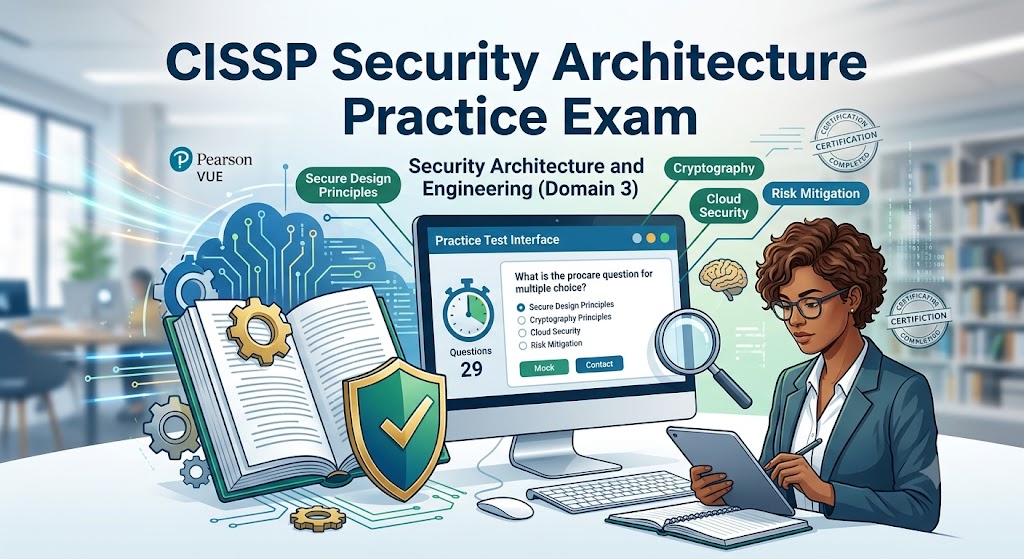
Additional Information
What the Course Entails and Exam Details
This specialized practice course focuses solely on the
intricate details of CISSP Domain 3: Security Architecture and Engineering,
a cornerstone area of the overall CISSP Common Body of Knowledge (CBK).
Successful completion of this specific practice test indicates a strong
readiness for this portion of the final exam, or, as a standalone achievement
within this domain, significantly boosts relevant skills.
The course entails a deep dive into applying secure design
principles, fundamental security models, and engineering processes. This domain
ensures you can build and assess systems that are resilient to attack and
compliant with organizational and regulatory requirements.
The Security Architecture and Engineering domain
typically covers the following topics within its broader context:
- Security
Design Principles: Understanding how to implement engineering
processes using secure design principles like Zero Trust, security by
design, and defence in depth.
- Security
Models: Deep knowledge of fundamental concepts such as the
Bell-LaPadula (confidentiality), Biba (integrity), Clark-Wilson, and
Graham-Denning models.
- Cryptographic
Systems: Applying symmetric, asymmetric, and hash functions, managing
key management life cycles, and understanding cryptographic attacks and
countermeasures.
- Physical
Security: Securing physical spaces, facilities, and the intersection
of physical and logical security controls.
- Security
Capabilities of Information Systems: Evaluating and managing security
in hardware, firmware, software, cloud architectures (IaaS, PaaS, SaaS),
web applications, network architecture, virtualization, and mobile
computing.
- Vulnerability
Mitigation: Understanding vulnerabilities, applying mitigations to
common and complex systems (e.g., embedded devices, IoT, SCADA), and
integrating security at all phases of the systems development lifecycle
(SDLC).
The specific Practice Test details are as follows
(Simulated/Practice format):
- Format:
A varied set of multiple-choice and complex scenario-based questions
focusing solely on Domain 3.
- Length:
A comprehensive set of questions, potentially shorter than a full, 6-hour
linear exam but designed to provide realistic, challenging practice in
this specific domain within a more practical timeframe.
- Goal:
To simulate the complexity and focus on critical thinking required by the
real CISSP CAT exam, specifically for this domain, rather than providing
an official score or certification itself. Your performance on this test
helps identify strengths and weaknesses within this area.
What to Expect in the Final Exam
While this practice course targets Domain 3, it is crucial
to understand the format and rules of the actual, full (ISC)² CISSP
Computerized Adaptive Testing (CAT) or Linear exam that you will eventually
take. The knowledge honed in this practice test is essential to success on the
real, rigorous certification exam.
Here is what you can expect in the final (ISC)² CISSP exam:
- Exam
Type: Computerized Adaptive Testing (CAT) for most English speakers,
which adjusts question difficulty based on your answers. Linear exams
(longer, fixed question set) may still be used in some languages or
conditions. The real CISSP isn't just multiple choice; it includes
innovative questions (drag & drop, hotspot, etc.).
- Number
of Questions: For the CAT version, you will answer between 100 and
150 questions. For the linear version, you will face 250 questions,
including 25 pretest/experimental questions which are un-scored and
randomly placed.
- Time
Limit: You will have 3-6 hours (depending on CAT vs. linear,
language, and other factors) to complete the actual exam. CAT versions are
shorter, typically 3 hours.
- Passing
Score: The passing score is 700 out of a possible 1000 points.
Since CAT doesn't tell you how many correct answers are needed,
your ability to think through each tough scenario is paramount.
- Critical
Rules: You cannot go back to previous questions in the CAT
version. You must manage your time carefully and answer all presented
questions. The exam uses complex adaptive algorithms and professional
scenarios to assess practical knowledge, not just rote memorization.
- Testing
Environment: The official CISSP exam is highly secure and administered
at authorized physical testing centers, often Pearson VUE, which
are monitored and regulated globally. You will need a valid government ID
and will follow strict security protocols.
How to Study and
Exam Centers
Preparation for the CISSP, including this targeted domain,
requires a disciplined and comprehensive study strategy.
Effective Study Strategies:
Multiple Official Resources:
Start with official (ISC)² materials – the CISSP Common Body of Knowledge
(CBK), and official study guides. Read broadly from reputable authors and
publishers.
Targeted Domain Review:
Use the outline from Section 2 as a checklist. Master each concept, model, and
standard in Security Architecture and Engineering. Spend extra time where you
have identified gaps.
Active Learning &
Practice: This practice test is critical. Take it multiple times. Analyze
not just why an answer is correct, but why other options are incorrect. Read
the explanations thoroughly for each question. Look for themes and consistent
weaknesses.
Simulate Test Conditions:
When comfortable with the material, take simulated exams (including this one or
other reputable practice tests) in a quiet, time-controlled environment with no
outside materials. This builds stamina and time management skills.
Join Study Groups:
Discussing difficult concepts with peers preparing for the same exam can
provide new perspectives and deep learning. (ISC)² has official local chapters
and numerous online communities.
Analyze Wrong Answers:
Keep a log of errors. Are you rushing? Making simple reading mistakes?
Misinterpreting terminology? Addressing these weaknesses is as important as
learning the concepts themselves.
Exam Centers & Registration:
- Actual
CISSP Exam: To take the actual (ISC)² CISSP certification exam,
you must register through the (ISC)² website and then schedule your
appointment with their authorized testing partner, Pearson VUE.
- Physical
Testing: The vast majority of CISSP exams are administered at Pearson
Professional Centers (PPCs) or Pearson VUE authorized test centers
globally. These are secure, physical facilities designed for proctored
examinations. Use the Pearson VUE test center locator tool on their
website to find a center near you. Note that you must go to a physical,
verified location to take the final official exam. Limited or trial
online proctoring may sometimes be available or tested, but should be
verified on the official (ISC)² and Pearson VUE websites for current
availability and eligibility.
- Practice
Test Access: This specific practice test course is accessed through
the provider's online learning platform or course materials. Please refer
to your enrollment information for the precise location and methods of
taking this mock exam.
Job Opportunities from the Course
While this specific course is a targeted practice tool, the
foundational knowledge and targeted focus on Domain 3 directly enhance your
skill set and credibility, contributing significantly to your journey towards
the full CISSP certification. Achieving the CISSP, and demonstrating high
competence in Security Architecture and Engineering, significantly expands your
career horizons in high-demand technical roles.
Below is a non-exhaustive list of job opportunities and
career paths often enhanced or unlocked by achieving the full CISSP, especially
with expertise in Domain 3:
- Cybersecurity
Architect / Security Architect: Design and oversee the security
architecture of large-scale, complex IT environments and enterprise
networks. This is a direct alignment with the skills validated by Domain
3.
- Senior
Security Engineer / Security Engineering Lead: Implement and manage
secure systems, networks, and applications, applying deep technical
knowledge.
- Information
Security Manager / Cybersecurity Manager: Lead teams, manage security
programs, and bridge technical needs with business objectives.
- Chief
Information Security Officer (CISO) (Advanced Career Goal): Eventually
advance to top-level leadership, setting strategy and managing all aspects
of an organization’s security.
- Network
Security Architect / Network Security Engineer: Specifically focus on
the design and security of an organization's network infrastructure.
- Cloud
Security Engineer / Cloud Security Architect: Design and implement
security solutions for cloud environments (AWS, Azure, Google Cloud).
- Identity
and Access Management (IAM) Specialist/Architect: Design and manage
the systems for controlling user access to sensitive systems.
- System
Security Analyst (Advanced/Lead): Analyze and mitigate complex
system-level vulnerabilities.
- IoT
Security Specialist: Apply security principles to connected, embedded
devices.
The knowledge reinforced by this practice test is
fundamental to these roles, demonstrating your ability to build secure
environments and understand the underlying security principles that protect an
organization. Mastering Domain 3 is a testament to your technical depth within
the broader security landscape. Good luck with your study and with achieving
the highly respected CISSP certification!
Frequently Asked Questions
Reviews
5.0
Based on 0 reviews
Leave a Review
No reviews yet. Be the first to review!