
Science Olympiad Water Quality Practice Test
$69.00
- Buy to unlock unlimited access to all Quiz questions.
- After purchase you can print a PDF of the whole quiz at any point. The PDF will contain the questions and the correct answers.
About this Exam
Science Olympiad is a renowned national competition that challenges middle and high school students across a wide range of scientific disciplines. The Water Quality event, specifically designed for students in Division B (Middle School) and Division C (High School), focuses on the fundamental principles of freshwater ecosystems and the impact of human activities on water resources. This practice exam serves as a crucial preparation tool, allowing participants to test their knowledge, sharpen their practical skills, and build the confidence necessary to excel in this highly competitive event.
Ready to test your knowledge?
Buy Now to Access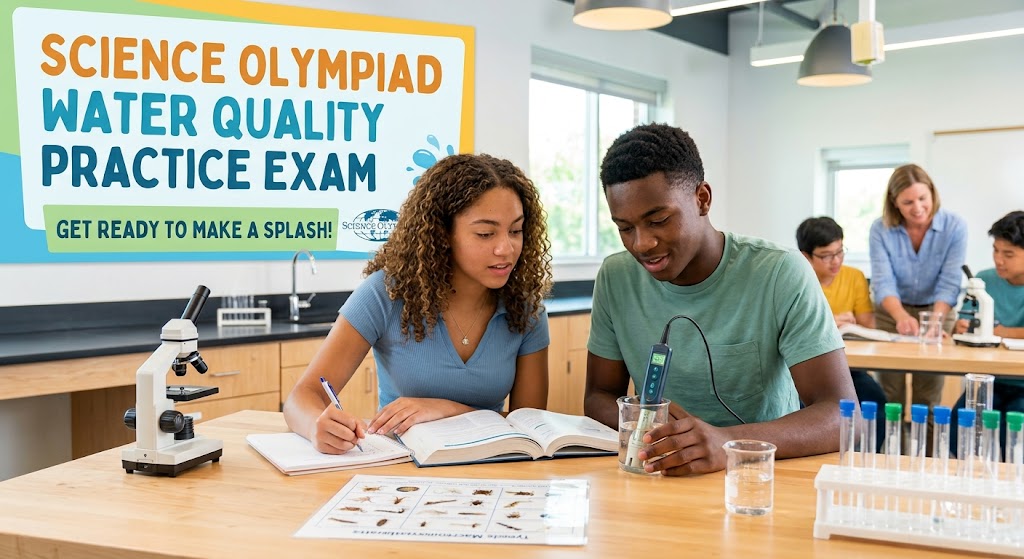
Additional Information
What the Course Entails and Exam Details
The Science Olympiad Water Quality event encompasses a diverse range of topics related to freshwater environments and water quality assessment. Key areas of focus include:
Understanding Freshwater Ecosystems: Participants explore the characteristics and dynamics of various freshwater habitats, such as lakes, rivers, streams, ponds, and wetlands. This includes understanding nutrient cycles, food webs, and the roles of aquatic organisms.
Water Quality Assessment: Students must master the principles and procedures for measuring various water quality parameters, both physical and chemical. This includes variables like dissolved oxygen, pH, temperature, turbidity, nitrates, phosphates, and total dissolved solids.
Identification of Aquatic Organisms: A significant component of the event involves identifying a variety of aquatic organisms, including macroinvertebrates, fish, algae, and aquatic plants. Participants must understand their ecological roles and how they serve as indicators of water quality.
Water Pollution and Management: The event also covers different types and sources of water pollution, their impacts on ecosystems and human health, and strategies for water resource management and conservation.
What to Expect in the Final Exam
In the official Science Olympiad Water Quality event, teams of up to two students are typically required to complete a multi-part exam that combines written questions with practical activities. The written portion may feature a variety of question formats, including multiple-choice, matching, and short-answer questions, covering theoretical concepts and data interpretation.
The practical part often involves rotating through several stations where teams must perform specific tasks, such as:
Measuring water quality parameters using various testing kits and instruments.
Identifying aquatic organisms from specimens, slides, or pictures.
Interpreting data related to water quality assessment and ecosystem health.
Solving problems related to water management or pollution control scenarios.
While specific rules and event structures can vary from year to year and between different tournament levels (invitational, regional, state, national), the event generally emphasizes hands-on skills, critical thinking, and teamwork. There is no predetermined passing score, as performance is evaluated relative to other participating teams. Time limits are strictly enforced for both the written and practical components.
How to Study and Exam Centers
To effectively prepare for the Science Olympiad Water Quality event, students can utilize a combination of study strategies:
Review Official Resources: Begin by thoroughly studying the official Science Olympiad rules and any event-specific resources provided. Pay close attention to the designated topics, required skills, and any specific identification lists.
Utilize Textbooks and Online Materials: Enhance your understanding of key concepts by consulting relevant textbooks, online resources, and educational materials. Look for resources focused on environmental science, limnology, water chemistry, and aquatic biology.
Practice with Field Guides and Identification Keys: Develop your organism identification skills by practicing with field guides, identification keys, and online images. Create flashcards to help memorize the characteristics of key macroinvertebrates, fish, and other aquatic life.
Get Hands-on Experience: Whenever possible, seek opportunities to practice water quality testing and organism identification in a real-world setting. Participate in field trips, volunteer for water monitoring programs, or utilize school science labs.
Take Practice Exams and Form Study Groups: Engage in practice testing by taking mock exams and working through past competition questions. Consider forming a study group with your event partner or other interested students to share knowledge and discuss challenging concepts.
The Science Olympiad Water Quality event takes place within the context of officially sanctioned Science Olympiad tournaments. These tournaments are typically held at a variety of locations, including schools, universities, and other educational or research institutions designated as host centers.
Job Opportunities from the Course
Participating and excelling in the Science Olympiad Water Quality event can spark an interest in various career paths related to water resources, environmental science, and natural resource management. While not a direct job qualification itself, the knowledge, skills, and competitive experience gained through this event can lay a strong foundation for future study and career opportunities in fields such as:
Water Quality Technician
Hydrologist
Aquatic Biologist
Limnologist
Environmental Consultant
Water Resources Engineer
Environmental Scientist
Wastewater Treatment Operator
Conservationist
Natural Resource Manager
Fisheries Biologist
Marine Biologist (with a focus on freshwater ecosystems)
These roles can be found within various sectors, including government agencies (local, state, federal), non-profit organizations, environmental consulting firms, research institutions, and utility companies.
Frequently Asked Questions
Reviews
5.0
Based on 0 reviews
Leave a Review
No reviews yet. Be the first to review!