
Science Olympiad Thermodynamics Practice Test
$69.00
- Buy to unlock unlimited access to all Quiz questions.
- After purchase you can print a PDF of the whole quiz at any point. The PDF will contain the questions and the correct answers.
About this Exam
The Science Olympiad Thermodynamics event is a thrilling competition designed for middle school (Division B) and high school (Division C) students who have a passion for physics, engineering, and problem-solving. This event challenges students to apply their knowledge of heat, energy, and the laws of thermodynamics to solve complex theoretical problems and to design, construct, and test a device that accurately maintains a specific temperature. It is a fantastic opportunity for students to delve deeper into a core scientific discipline beyond the standard classroom curriculum.
Ready to test your knowledge?
Buy Now to Access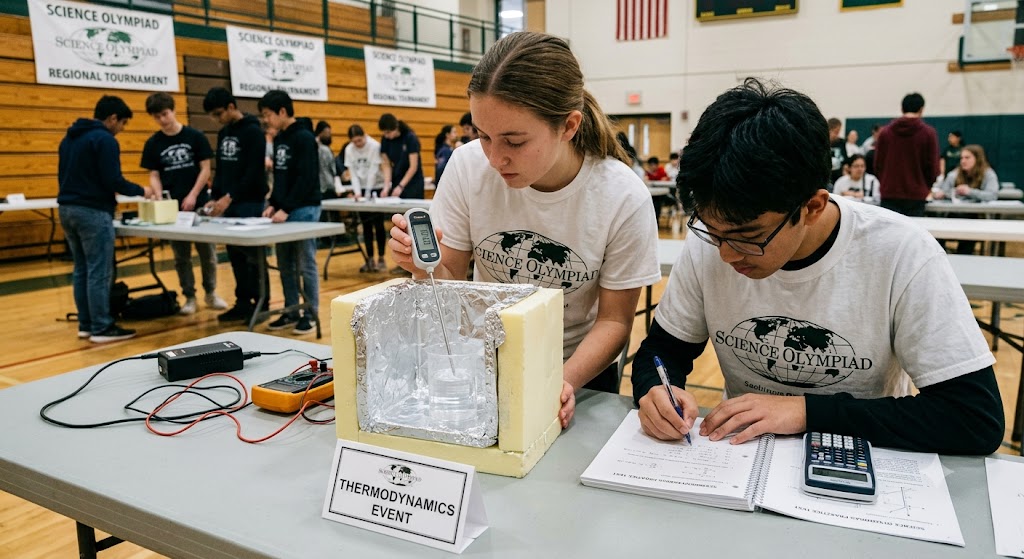
Additional Information
What the Course Entails and Exam Details
As a competitive event within Science Olympiad, rather than a standalone course, Thermodynamics requires students to master several key concepts. The syllabus typically covers:
The Laws of Thermodynamics (Zero, First, Second, and Third Laws)
Heat transfer mechanisms: conduction, convection, and radiation
Specific heat capacity and calorimetry calculations
Phase changes, latent heat, and heating/cooling curves
The concept of entropy and thermodynamic efficiency
Furthermore, students must apply these principles practically by constructing an insulated device, such as an incubator or a solar water heater. The event requires meticulous engineering, data logging, and calibration of their device prior to the competition.
What to Expect in the Final Exam
The Thermodynamics competition is split into two distinct parts, contributing to an overall team score.
Part I is a written test focusing on the theoretical concepts outlined above. This test usually involves a mix of multiple-choice questions, free-response calculations, and data analysis problems. Students are typically permitted to use calculators and a single 8.5" x 11" sheet of notes (double-sided). The time limit for this portion is usually around 50 minutes.
Part II is the device testing phase. Students bring their pre-constructed, insulated device to the competition. They are given a specific volume of water and a target temperature change to achieve within a specified time frame. The score for this part is based on the accuracy of their device in reaching and maintaining the target temperature.
How to Study and Exam Centers
Effective preparation for Science Olympiad Thermodynamics involves a dual approach focusing on both theory and practical application.
Study Resources: Utilize standard high school or introductory college physics textbooks. Reviewing previous Science Olympiad state and national tournament tests is highly recommended for understanding the types of questions and problems typically asked.
Practice Problems: Focus on solving computational problems related to heat transfer, calorimetry, and thermodynamic laws. Developing strong mathematical skills is crucial.
Device Engineering: This is critical. Teams must spend significant time designing, building, and, most importantly, testing their insulated device. Collect data over multiple trials to create calibration curves, which will help predict the device’s performance under competition conditions.
Collaborate with Partners: As this is a team event, work closely with your partner. Divide responsibilities for the written test and the device construction/testing.
The "exam centers" for Science Olympiad are the official regional, state, and national tournaments. These events are hosted at various locations, often high schools or university campuses, throughout the competition season. Information about registration and specific tournament locations can be found through your state's Science Olympiad organization.
Job Opportunities from the Course
Participating in Science Olympiad Thermodynamics develops critical thinking, engineering design, and analytical skills that are highly valued in numerous STEM careers. Success in this event can be a stepping stone toward future degrees and professions in fields such as:
Mechanical Engineer
Chemical Engineer
Aerospace Engineer
Environmental Engineer
Energy Consultant/Auditor
Research Scientist (Physics or Materials Science)
HVAC (Heating, Ventilation, and Air Conditioning) Engineer
Process Engineer
Frequently Asked Questions
Reviews
5.0
Based on 0 reviews
Leave a Review
No reviews yet. Be the first to review!