
Science Olympiad Solar System Practice Test
$69.00
- Buy to unlock unlimited access to all Quiz questions.
- After purchase you can print a PDF of the whole quiz at any point. The PDF will contain the questions and the correct answers.
About this Exam
The Science Olympiad Solar System event is a premier competitive knowledge event designed for middle school students (Grades 6–9) across the United States. This event challenges students to demonstrate their depth of understanding regarding the celestial bodies within our solar system. Participants work in teams to solve problems, identify astronomical objects, and answer complex questions related to planetary science and basic orbital mechanics. It is specifically designed to foster a deep interest in astronomy and space exploration in young scientists.
Ready to test your knowledge?
Buy Now to Access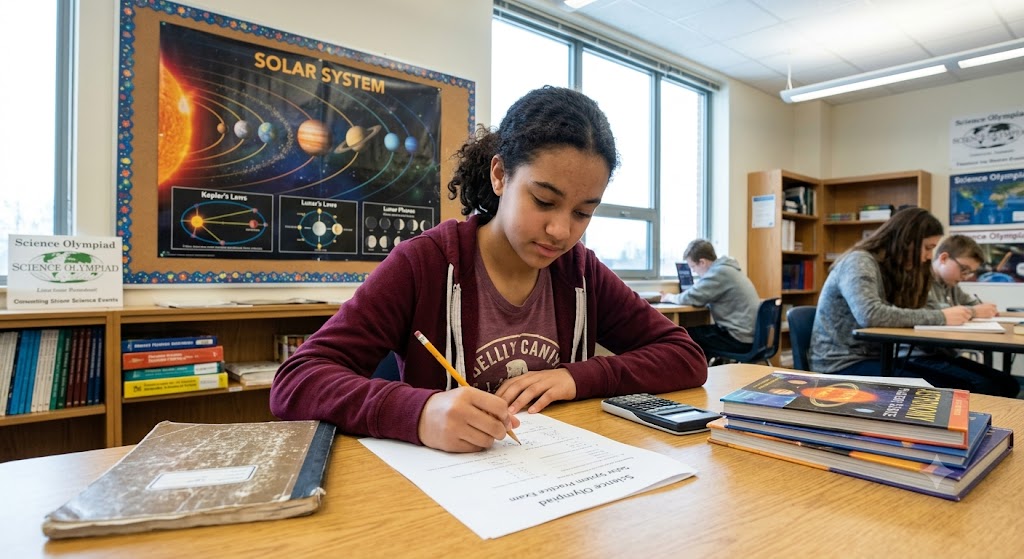
Additional Information
What the Course Entails and Exam Details
This event requires students to master a diverse syllabus focused purely on our immediate cosmic neighborhood. The core curriculum covers the physical characteristics, atmospheres, and surface features of all major planets, their moons, dwarf planets, and small solar system bodies (like asteroids, comets, and meteoroids). Students must understand the sun's structure and its impact on the solar system, the history and notable discoveries of major NASA and international space exploration missions, and fundamental concepts of orbital mechanics, including Kepler’s Laws. The exam challenges students not only to recall facts but also to interpret data tables, spectroscopic images, and graphs.
What to Expect in the Final Exam
The final event at a Science Olympiad tournament typically consists of a written exam. The format is generally a combination of multiple-choice questions, matching exercises (especially for identifying moons or planets from surface photos), and short-answer free-response questions that require problem-solving or data analysis. The exam is highly structured, and teams of two are usually given a strict time limit, often around 50 minutes, to complete the entire test. While there isn't a single 'passing score' as it is a competition, teams are ranked based on their total points, with the highest scores receiving medals or moving on to the state or national level.
How to Study and Exam Centers
Effective preparation for the Solar System event requires a combination of rote memorization and conceptual understanding. Students should create comprehensive 'binder' study guides containing fact sheets for every planet, major moon, and mission, complete with visual aids. Utilizing official NASA resources, textbooks on introductory astronomy, and reliable space news outlets is crucial. Taking numerous practice tests from previous years' regional, state, and national tournaments is the best way to acclimate to the question format and time pressure. Since this is a competition, the 'exam centers' are the actual Science Olympiad tournament locations, which are hosted at registered middle schools, high schools, or university campuses.
Job Opportunities from the Course
Participating in the Science Olympiad Solar System event lays a strong foundation for future academic and career paths in STEM. Students who excel in this area often go on to pursue higher education and careers such as:
Astronomer
Planetary Scientist
Aerospace Engineer
Data Analyst (for space mission data)
Science Educator
Astrophysicist
Space Policy Analyst
Satellite Operator
Frequently Asked Questions
Reviews
5.0
Based on 0 reviews
Leave a Review
No reviews yet. Be the first to review!