
Science Olympiad Simple Machines Practice Test
$69.00
- Buy to unlock unlimited access to all Quiz questions.
- After purchase you can print a PDF of the whole quiz at any point. The PDF will contain the questions and the correct answers.
About this Exam
The Science Olympiad Simple Machines event is a thrilling competition designed for middle school students, testing their understanding of fundamental physics and mechanics. It challenges young minds to not only grasp the theoretical concepts of simple machines but also to apply that knowledge in practical, hands-on scenarios. Participants must build devices that interact with these machines, predicting and calculating mechanical advantages and other relevant values. This event forms part of the broader Science Olympiad, a national competition that fosters interest in science, technology, engineering, and mathematics (STEM).
Ready to test your knowledge?
Buy Now to Access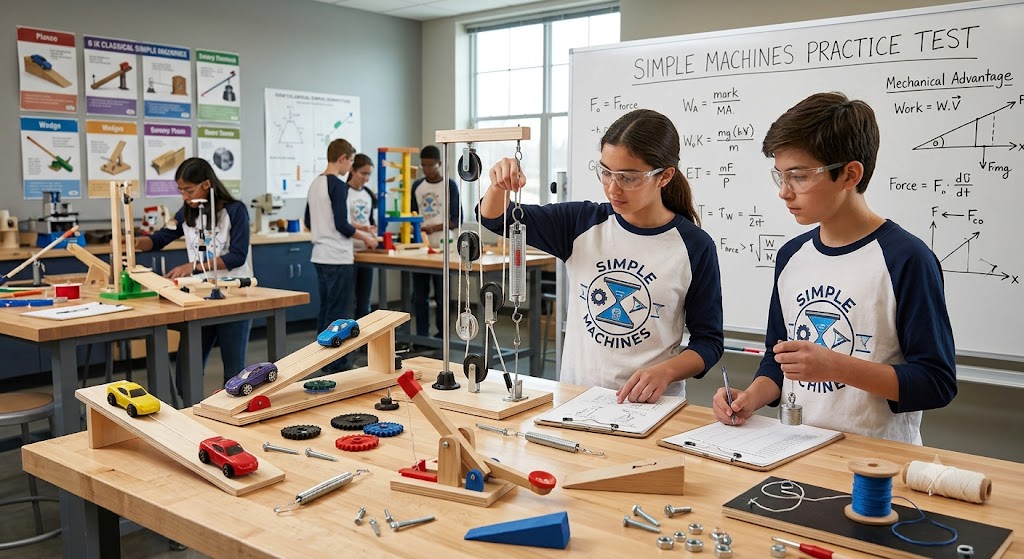
Additional Information
What the Course Entails and Exam Details
The event covers a comprehensive range of topics related to the six classical simple machines: the lever, wheel and axle, pulley, inclined plane, wedge, and screw. Students are expected to understand the definitions, mechanisms, and real-world applications of each. The core focus lies on understanding forces, work, energy, and, most importantly, calculating mechanical advantage (both ideal and actual) and efficiency. The competition syllabus includes complex questions about compound machines, static equilibrium, and the relationship between load, effort, and displacement in different configurations. Participants must also possess the skills to build a specific device that demonstrates principles of simple machines, which is then tested during the competition.
What to Expect in the Final Exam
The format of the Simple Machines event generally involves a dynamic combination of a written test and a practical component. The written portion, which often counts for a significant percentage of the total score, typically features multiple-choice, short-answer, and problem-solving questions. These questions evaluate deep understanding of the concepts and mathematical applications. The practical part requires teams to use a pre-built device to perform specific tasks, such as lifting a known load using various machine configurations. Students may need to make real-time predictions about the required input force or measure output parameters, with points awarded for accuracy. Time limits are strict, making efficiency and effective teamwork crucial factors for success.
How to Study and Exam Centers
Successful preparation for this event requires a balanced approach. Study strategies should include reviewing textbooks on physics and mechanics, utilizing official Science Olympiad resources, and practicing past competition questions available online. Building numerous physical models of simple machines is invaluable for understanding their practical nuances. Create sample problem sets to practice calculating mechanical advantage quickly and accurately. Effective teamwork is paramount, so practice communicating and coordinating tasks with your partner. The 'exam centers' for this competition are the various regional, state, and national Science Olympiad tournament venues, often held at host universities or schools. Consult your team coach or the official Science Olympiad website for specific locations and dates.
Job Opportunities from the Course
Excelling in the Science Olympiad Simple Machines event cultivates foundational skills and analytical thinking that open doors to numerous rewarding career paths in STEM.
Mechanical Engineer
Civil Engineer
Robotics Engineer
Aerospace Engineer
Physics Researcher
STEM Educator
Industrial Designer
Biomechanical Engineer
Manufacturing Engineer
Frequently Asked Questions
Reviews
5.0
Based on 0 reviews
Leave a Review
No reviews yet. Be the first to review!