
Science Olympiad Science Word Practice Test
$69.00
- Buy to unlock unlimited access to all Quiz questions.
- After purchase you can print a PDF of the whole quiz at any point. The PDF will contain the questions and the correct answers.
About this Exam
The Science Olympiad Science Word event is a dynamic and challenging competition designed for middle and high school students across the United States. This event tests participants' breadth and depth of scientific vocabulary knowledge across a wide array of disciplines, including biology, chemistry, physics, earth science, and environmental science. The primary goal is to assess a student's ability to quickly identify and understand scientific terminology and concepts, which is foundational for success in all scientific fields.
This competition is designed for curious and motivated students who have a passion for science and a strong memory for complex terms. It encourages not only rote memorization but also an understanding of root words, prefixes, suffixes, and the interconnectedness of scientific language.
Ready to test your knowledge?
Buy Now to Access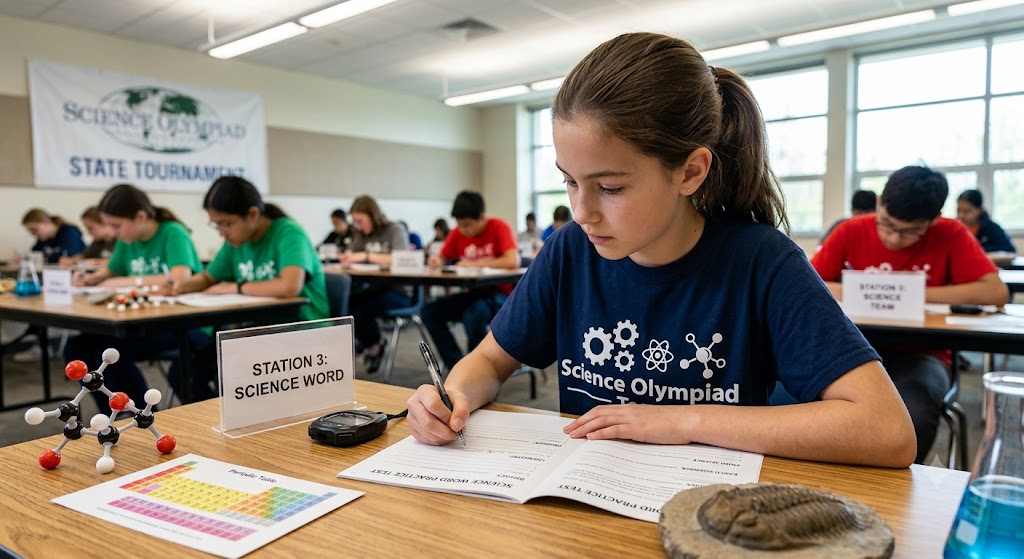
Additional Information
What the Course Entails and Exam Details
Preparing for the Science Olympiad Science Word Practice Test involves mastering an extensive dictionary of scientific vocabulary. While there isn't a fixed "syllabus" in the traditional sense, the competition covers a vast landscape of scientific terminology.
The core topics include:
Biology: Cell structure and function, genetics, evolution, human anatomy, ecology, and taxonomy.
Chemistry: Atomic structure, periodic table trends, chemical reactions, bonding, stoichiometry, and organic chemistry.
Physics: Mechanics, electricity and magnetism, thermodynamics, optics, and quantum theory.
Earth Science: Geology, meteorology, oceanography, astronomy, and planetary science.
Environmental Science: Ecosystems, biodiversity, pollution, conservation, and resource management.
Students are expected to know not just the definitions of words, but also their context, spelling, and relationships to other scientific concepts. The focus is on rapid recall and precise knowledge.
What to Expect in the Final Exam
The final competition for the Science Word event typically adopts a unique and high-paced format, distinct from standard written exams. The most common structure is a write-on, station-based test.
Format: The exam is typically composed of a series of stations that pairs of students rotate through at a fixed pace (e.g., every minute or 90 seconds). Each station may feature a physical object, diagram, visual cue, or written description.
Questions: At each station, students must identify the correct scientific term associated with the prompt and write it down. Some stations might involve multiple-choice questions or matching definitions to terms, but the emphasis is heavily on term identification and proper spelling.
Time Limits: The entire competition is strictly timed. Students must work quickly to analyze the information at each station and write their answers before they are signaled to rotate to the next one.
Rules: Students must be extremely careful with their spelling, as errors are often heavily penalized. Correct and complete terms are required for full credit. Collaboration between the two students in a pair is usually allowed and encouraged.
Unlike professional certification exams, there isn't a single passing score; rather, students compete for high scores that are ranked against other teams in the tournament.
How to Study and Exam Centers
Studying for the Science Word Practice Test requires a strategic approach to large-scale vocabulary acquisition.
Actionable Study Strategies:
Utilize Flashcards: Create comprehensive physical or digital flashcard decks (e.g., using Anki or Quizlet) for each major scientific category. Include the term, its definition, common examples, and potentially a picture.
Focus on Root Words: Analyze prefixes, suffixes, and common roots (e.g., bio-, chem-, -logy, -photo-) to deduce the meaning of unfamiliar terms.
Review Official Resources: Consult the official Science Olympiad website and any division-specific rules and resource lists, which often detail which broad areas are covered for the competition year.
Practice with Past Tests: Locate and complete previous years’ Science Word competition tests to understand the question types, level of difficulty, and speed required.
Simulate Exam Conditions: Set up a "rotation" practice session with a partner, timing each station strictly to build speed and accuracy under pressure.
Read Widely: Broaden scientific understanding by reading textbooks, articles, and reputable science publications beyond the required material.
Exam Centers:
The final competition for Science Olympiad is not held at a standard standardized testing center like Pearson VUE. Instead, they are held at individual school-based tournaments, university campuses, and other educational institutions across the country.
Regional and State Tournaments: Students usually compete in regional tournaments organized by their state’s Science Olympiad chapter. Successful teams advance to state-level championships.
National Tournament: The highest level of competition is the annual National Science Olympiad Tournament, hosted by a rotating university.
How to Take the Exam: To participate, students must be part of an official Science Olympiad team registered through their school. Coaches register the team for specific tournaments and events.
Job Opportunities from the Course
Excelling in the Science Word event and the overall Science Olympiad competition serves as a strong foundation for a variety of future scientific careers. While not a professional certification in itself, the dedication, knowledge, and analytical skills it cultivates are highly sought after by employers in the STEM fields.
Here are specific job titles and career paths that a student excelling in Science Olympiad might pursue in their future:
Research Scientist (Biology, Chemistry, Physics)
Science Educator (Teacher, Professor, Outreach Coordinator)
Environmental Scientist / Ecologist
Data Analyst (specifically in scientific or pharmaceutical research)
Science Writer / Medical Writer
Laboratory Technician / Manager
Bioinformatician
Chemical Engineer / Materials Scientist
Biophysicist
Public Health Specialist
Frequently Asked Questions
Reviews
5.0
Based on 0 reviews
Leave a Review
No reviews yet. Be the first to review!