
Science Olympiad Potions and Poisons Practice Test
$69.00
- Buy to unlock unlimited access to all Quiz questions.
- After purchase you can print a PDF of the whole quiz at any point. The PDF will contain the questions and the correct answers.
About this Exam
The Science Olympiad Potions and Poisons event is a thrilling Division B competition that tests students' knowledge of chemistry, toxicology, and dynamic systems. Designed for middle school participants, this event requires teams to identify various reagents and toxic substances, understand their effects, and apply mathematical models to biological processes. It offers a unique blend of theoretical knowledge and hands-on laboratory application, making it a favorite for students interested in forensic science, chemistry, and medicine.
Ready to test your knowledge?
Buy Now to Access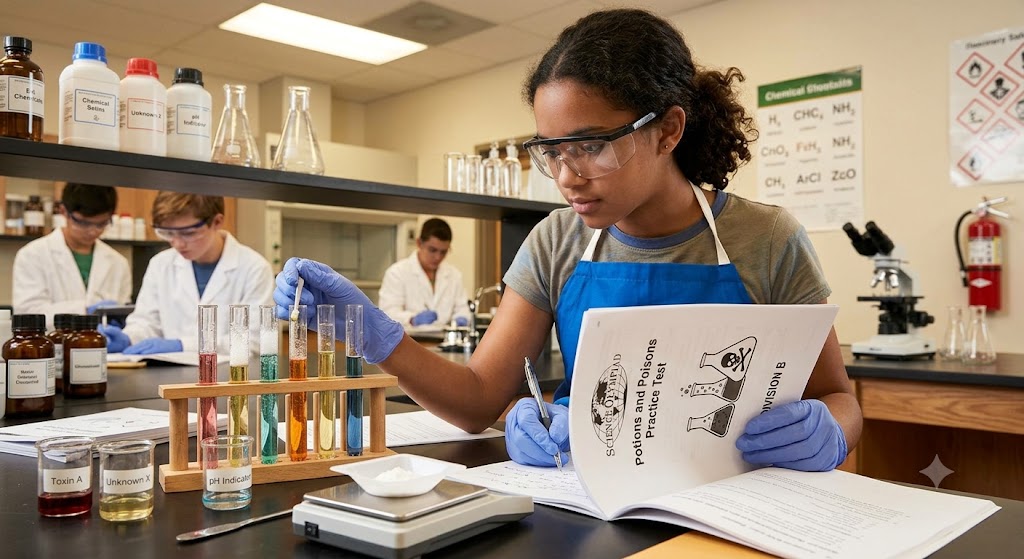
Additional Information
What the Course Entails and Exam Details
This event requires a multifaceted approach to science. The core curriculum covers a wide range of topics, including the identification of common chemicals through qualitative and quantitative analysis, the basic principles of toxicology (including common poisons, their symptoms, and antidotes), and the mathematics of population dynamics or kinetic modeling. Students must learn standard lab safety procedures, the properties of different chemical families, and how to interpret graphical data related to dynamic systems.
The standard exam rules usually allow each team to bring one 8.5" x 11" two-sided sheet of paper with information (notes, diagrams, charts), as well as two calculators. It is crucial to verify the specific, official Science Olympiad rules for the current competition year, as regulations can vary.
What to Expect in the Final Exam
The actual competition event is typically divided into multiple stations that teams must rotate through within a strict time limit (usually 50 minutes total for the entire event). At these stations, students may encounter written questions, hands-on experiments (e.g., performing a chromatography or color-change test to identify an unknown), or data analysis tasks. The practical component often involves classifying different reagents or simulating a toxicological scenario.
Scoring is based on accuracy, completeness, and adherence to safety protocols. A perfect score is rarely achieved, and the competition can be fierce. It’s important to practice time management, as moving quickly between stations and coordinating tasks within the team is essential for success.
How to Study and Exam Centers
Effective preparation for Potions and Poisons involves a mix of self-study and practical lab work. Students should create their official note sheet carefully, focusing on high-priority formulas, chemical formulas, reaction types, and symptoms of key poisons. Practicing qualitative analysis techniques—such as observing flame tests or measuring pH—is critical. Many teams utilize practice tests from past competitions (often available through Scioly.org or official sources) to simulate the time pressure and types of questions they will face.
As this is a competition rather than a traditional exam with centers, participants do not take the test at standard testing facilities like Pearson VUE. Science Olympiad tournaments are hosted by authorized schools, universities, or other educational institutions across the country. Teams typically compete representing their middle school. You should coordinate with your school’s Science Olympiad coach to register and find out the location and date of your regional or state tournament.
Job Opportunities from the Course
While participating in Science Olympiad is not a professional certification, it builds foundational knowledge and a passion for STEM that leads to diverse and rewarding career paths. The skills honed in Potions and Poisons are directly relevant to fields such as:
Toxicologist
Analytical Chemist
Forensic Scientist
Pharmacist
Laboratory Technician
Epidemiologist
Biochemist
Chemical Engineer
Frequently Asked Questions
Reviews
5.0
Based on 0 reviews
Leave a Review
No reviews yet. Be the first to review!