
Science Olympiad Machines Practice Test
$69.00
- Buy to unlock unlimited access to all Quiz questions.
- After purchase you can print a PDF of the whole quiz at any point. The PDF will contain the questions and the correct answers.
About this Exam
The Science Olympiad Machines event is a thrilling, hands-on STEM competition designed for middle and high school students (Divisions B and C). It challenges participants to merge theoretical physics with practical engineering, requiring them to design, construct, and test a device, and complete a comprehensive written test. This event is perfect for aspiring engineers, physicists, and problem-solvers who enjoy deciphering how the physical world works. This specific Science Olympiad Machines Practice Exam is your essential tool to master the academic portion of the competition, ensuring you can calculate mechanical advantage, efficiency, and torque with speed and accuracy.
Ready to test your knowledge?
Buy Now to Access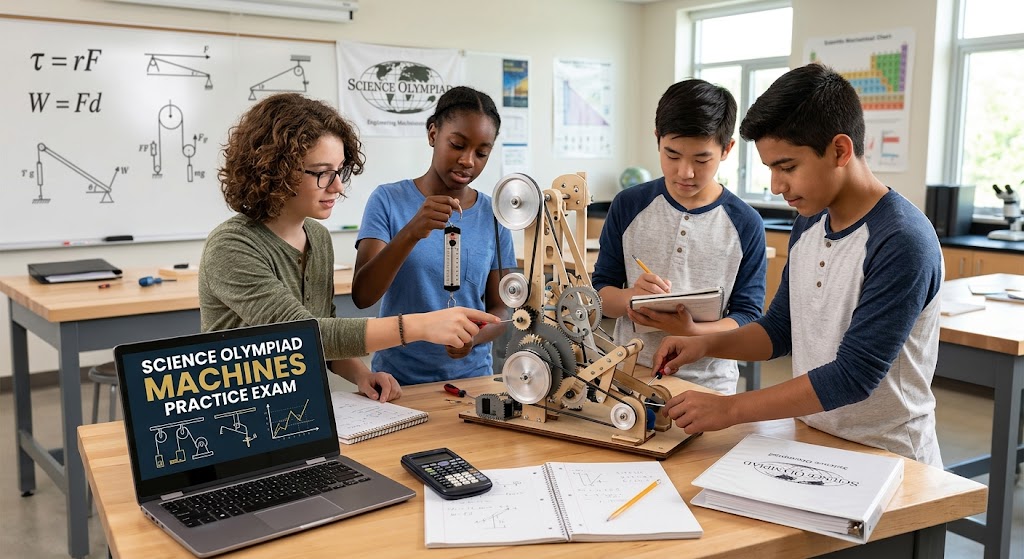
Additional Information
What the Course Entails and Exam Details
The Machines event curriculum covers the fundamental principles of classical mechanics. You must understand the six classical simple machines and their compound forms, alongside core physics concepts. Key topics included in the written portion of the test are:
Simple Machines: Identifying and applying the concepts of the Lever, Inclined Plane, Pulley, Screw, Wheel and Axle, and Wedge.
Compound Machines: Analyzing systems that combine two or more simple machines.
Fundamental Physics Concepts: Mastering concepts such as Force (F = ma), Work (W = Fd), Energy (Kinetic and Potential), Power (P = W/t), Torque (τ = rF sinθ), and Friction (Ff = μN).
Key Calculations: Calculating Ideal Mechanical Advantage (IMA), Actual Mechanical Advantage (AMA), and Efficiency for all machine types.
Units and Significant Figures: Rigorously applying the correct scientific units and maintaining significant figures throughout all calculations.
The actual Science Olympiad event also requires students to build a device (often a lever-based measuring device) to determine the unknown mass of an object, which is then tested against a supervisor’s known masses during the tournament.
What to Expect in the Final Exam
This Science Olympiad Machines Practice Exam simulates the academic environment of the written portion of a regional or state tournament. A standard official written test usually consists of multiple-choice, matching, calculation-based, and free-response questions. Students often move between various stations, each featuring a unique problem or a physical setup to analyze. The official exam is timed, typically lasting 50 minutes. The final tournament score combines your performance on this written test with the accuracy of your built device during the mass-measurement trial.
How to Study and Exam Centers
Preparation is the absolute key to success in Science Olympiad Machines. To excel, follow these proactive study strategies:
Create a Master Binder: Build a dedicated, organized binder with tabbed sections for each of the six simple machines. Include detailed diagrams, all relevant formulas, derived equations, and multiple worked examples.
Practice Calculations: The defining characteristic of top competitors is speed. Repeatedly practice calculating IMA, AMA, efficiency, torque, and work under timed conditions.
Take Multiple Practice Tests: Utilize resources like this Science Olympiad Machines Practice Exam, as well as past tests from online archives, to identify knowledge gaps.
Build Your Device: You must build and calibrate your engineering device (e.g., the lever) well before the competition day, gathering data to ensure its accuracy.
While this practice exam is a self-study tool you can use anywhere, the official Science Olympiad tournaments are held at certified Exam Centers, which are typically host middle schools, high schools, or university campuses.
Job Opportunities from the Course
Mastering the physics and engineering concepts within the Machines event provides a robust foundation for numerous lucrative and impactful career paths in the world of technology and design. This event unlocks the door to careers in:
Mechanical Engineer
Aerospace Engineer
Robotics Engineer
Civil Engineer
Industrial Designer
Biomedical Engineer (Biomechanics)
Physics Researcher
Automotive Engineer
Frequently Asked Questions
Reviews
5.0
Based on 0 reviews
Leave a Review
No reviews yet. Be the first to review!