
Science Olympiad Integumentary System Practice Test
$69.00
- Buy to unlock unlimited access to all Quiz questions.
- After purchase you can print a PDF of the whole quiz at any point. The PDF will contain the questions and the correct answers.
About this Exam
This specific Science Olympiad practice event focuses on the integumentary system, which comprises the skin, hair, nails, and associated glands.
This exam is designed for middle school and high school students participating in Science Olympiad competitions, specifically within the Anatomy and Physiology event category.
It aims to test their comprehensive understanding of this vital organ system.
Ready to test your knowledge?
Buy Now to Access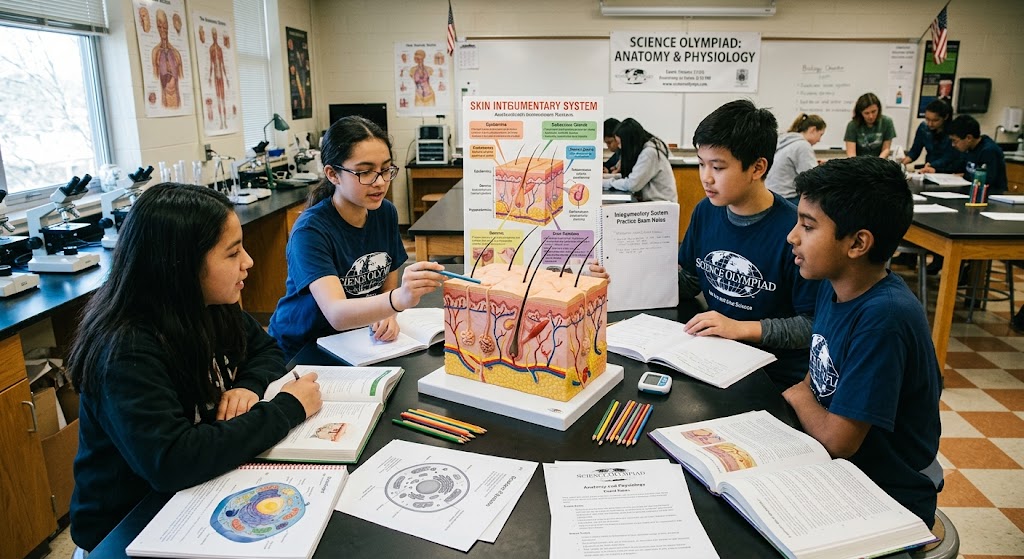
Additional Information
What the Course Entails and Exam Details
The core curriculum and exam syllabus cover a wide spectrum of topics concerning the integumentary system.
Students are expected to master the detailed anatomy of the skin, including the epidermis (and its layers), dermis, and hypodermis.
The exam delves into the structure and function of accessory organs such as hair follicles, sebaceous glands, sweat glands (eccrine and apocrine), and nails.
Beyond basic anatomy, students must understand key physiological processes, including thermoregulation, vitamin D synthesis, sensation (touch, pressure, pain, temperature), and the body’s primary defense mechanisms against pathogens and dehydration.
The content also encompasses common diseases, disorders, and injuries affecting the skin, such as skin cancer (melanoma, basal cell carcinoma), acne, eczema, and burns, along with their underlying causes and effects.
What to Expect in the Final Exam
The final Science Olympiad competition exam for this event typically adopts a hybrid format, combining traditional written testing with a practical, station-based approach.
Students work in teams to navigate various stations within a strict time limit.
These stations frequently feature high-quality anatomical models, diagrams, microscope slides showing histological samples of skin tissue, and even actual biological specimens for identification.
Questions range from multiple-choice and matching (e.g., matching a function to a specific skin layer) to short-answer identification of structures pointed out on a model or slide.
Scoring is competitive, with placement determined by total team points.
The specific rules, permitted materials (such as one double-sided page of notes), and time limits are strictly governed by the official Science Olympiad Division B (middle school) or Division C (high school) event supervisors and rule manuals.
How to Study and Exam Centers
Effective preparation requires a multi-faceted study strategy.
Students should use official Science Olympiad resources, relevant biology and anatomy textbooks (like Marieb's Human Anatomy & Physiology), and reliable academic websites.
Creating detailed diagrams, flashcards for terminology, and practicing with histological images are highly effective methods.
Crucially, teams must take multiple practice exams under timed conditions to improve speed and accuracy in identification and recall.
This exam is not administered in typical commercial centers like Pearson VUE. Instead, Science Olympiad competitions occur at various hierarchical levels: local/invitational tournaments hosted by schools, regional competitions, state tournaments, and the National Science Olympiad Tournament.
Students participate in these designated physical competition locations as part of their school's registered Science Olympiad team.
Job Opportunities from the Course
While this competition event is not a standalone professional certification, excelling in it builds a rigorous foundation of anatomical and physiological knowledge crucial for various medical and health science careers.
The skills and dedication demonstrated are highly attractive to university admissions and can pave the way for future careers such as:
Dermatologist
Dermatopathologist
Plastic Surgeon
Dermatology Nurse Practitioner
Physician Assistant (with a focus on Dermatology or Surgery)
Medical Illustrator
Histotechnician
Biomedical Researcher (Skin Science/Wound Healing)
Esthetician or Cosmetology Specialist (with further licensing)
Anatomy and Physiology Educator
Frequently Asked Questions
Reviews
5.0
Based on 0 reviews
Leave a Review
No reviews yet. Be the first to review!