
Science Olympiad Entry Practice Test
$69.00
- Buy to unlock unlimited access to all Quiz questions.
- After purchase you can print a PDF of the whole quiz at any point. The PDF will contain the questions and the correct answers.
About this Exam
Welcome to your comprehensive guide on preparing for the initial phases of the prestigious Science Olympiad competition. This guide focuses on preparing students for the crucial initial qualification or team selection tests, which are essential for forming competitive teams in schools across the country. Science Olympiad is designed for students from elementary through high school who have a passion for STEM disciplines, encouraging exploration across a wide spectrum of scientific fields. This entry practice exam serves as a valuable diagnostic tool, helping students understand the academic rigor, critical thinking requirements, and time management skills necessary to excel in regional and national level events. Participating in this selection process builds a solid foundation for future success in competitive science and related careers.
Ready to test your knowledge?
Buy Now to Access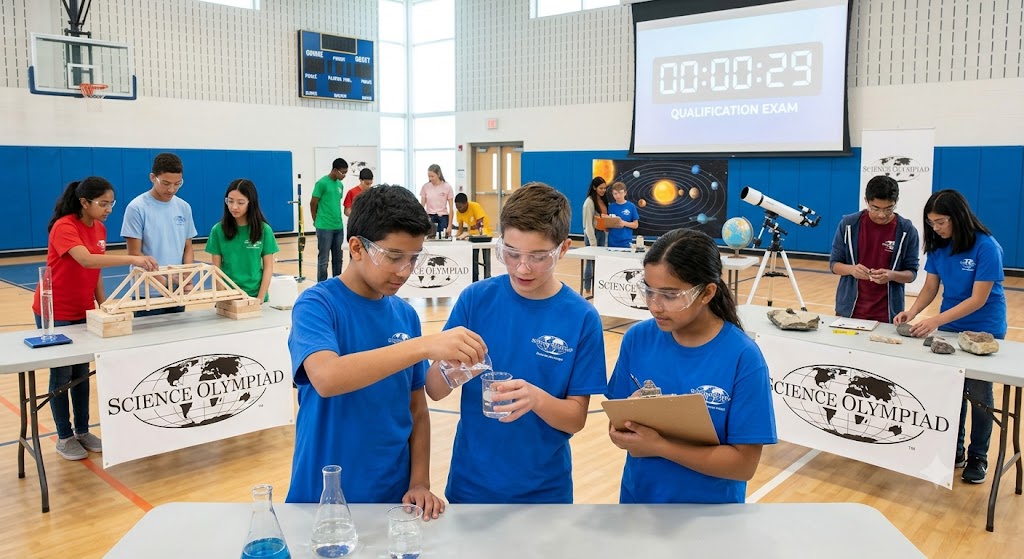
Additional Information
What the Course Entails and Exam Details
Preparing for the Science Olympiad qualification test involves a diverse curriculum that mirrors the competition’s core areas. Students must be proficient in a broad range of subjects, moving beyond simple memorization to conceptual understanding and application. Key areas covered include foundational biology (cells, genetics, ecology), chemistry (periodic table, reactions, atomic structure), earth science (geology, astronomy, weather), and physics (mechanics, electricity, energy principles). Moreover, the qualification often assesses critical skills in inquiry and data analysis, requiring students to interpret complex charts, design theoretical experiments, and solve problems using scientific reasoning. While specific rules vary, most qualification materials require a thorough understanding of the current official Science Olympiad Event Rules for the corresponding year.
What to Expect in the Final Exam
While "final exam" here refers to the actual qualification or team selection test, candidates should expect a challenging format that differs from standard school tests. These entry exams are often time-limited—typically lasting 45 to 60 minutes—designed to test speed and accuracy. The format most frequently utilizes a combination of complex multiple-choice questions, matching, and short-answer questions. Some qualification tests may even include a rotating practical station component, where students must quickly analyze a sample or perform a basic measurement. Success is not usually measured by a minimum passing score, but rather by scoring high enough relative to other candidates to earn a spot on the competitive team or advance to the next level. Specific rules (like the use of calculators or safety goggles) are dictated by the particular rules of the events that the test aims to select for.
How to Study and Exam Centers
Effective preparation for this qualification test requires proactive, consistent effort. Students should start by thoroughly reviewing official Science Olympiad materials and past tests, readily available on the national organization’s website. Utilize reputable science textbooks and online educational resources (like Khan Academy) to deepen knowledge in weak areas. Form study groups with peers and practice taking past tests under timed conditions to improve speed and familiarity with the question types. Engage in hands-on science experiments whenever possible. The examination itself does not use centralized testing hubs like Pearson VUE. Qualifications are typically administered physically at individual host schools or designated school district facilities, or occasionally through supervised online testing portals specifically for team selection. Contact your school's Science Olympiad advisor for exact times and locations.
Job Opportunities from the Course
While Science Olympiad preparation itself is not a professional certification, the deep foundational knowledge and rigorous scientific thinking skills it instills are universally sought after by major universities and STEM employers. Cultivating these competencies through high-level competition dramatically improves readiness for demanding university programs and lucrative, innovative careers in fields such as:
Medical Doctor (MD) or Specialist
Biomedical Engineer
Mechanical or Civil Engineer
Data Scientist or Analyst
Environmental Scientist
Research Chemist
Astronomer or Astrophysicist
Computer Scientist or Programmer
Science Educator
Scientific Journalist or Communicator
Frequently Asked Questions
Reviews
5.0
Based on 0 reviews
Leave a Review
No reviews yet. Be the first to review!