
Science Olympiad Dynamic Planet Oceanography Practice Test
$69.00
- Buy to unlock unlimited access to all Quiz questions.
- After purchase you can print a PDF of the whole quiz at any point. The PDF will contain the questions and the correct answers.
About this Exam
The Science Olympiad Dynamic Planet event, with its specific focus on Oceanography, is a highly challenging and academically rigorous competition designed for middle and high school students across the United States. This event is not merely a test of knowledge but a comprehensive examination of a student's understanding of the complex, interconnected physical, chemical, and biological systems of the world’s oceans. It is specifically created for students who possess a strong interest in marine science, environmental studies, and geology, and who are eager to demonstrate their academic prowess in a competitive, team-based environment. The Oceanography rotation ensures that students dive deep into the mysteries of the blue planet, exploring everything from deep-sea trenches to the dynamics of coastal waves.
Ready to test your knowledge?
Buy Now to Access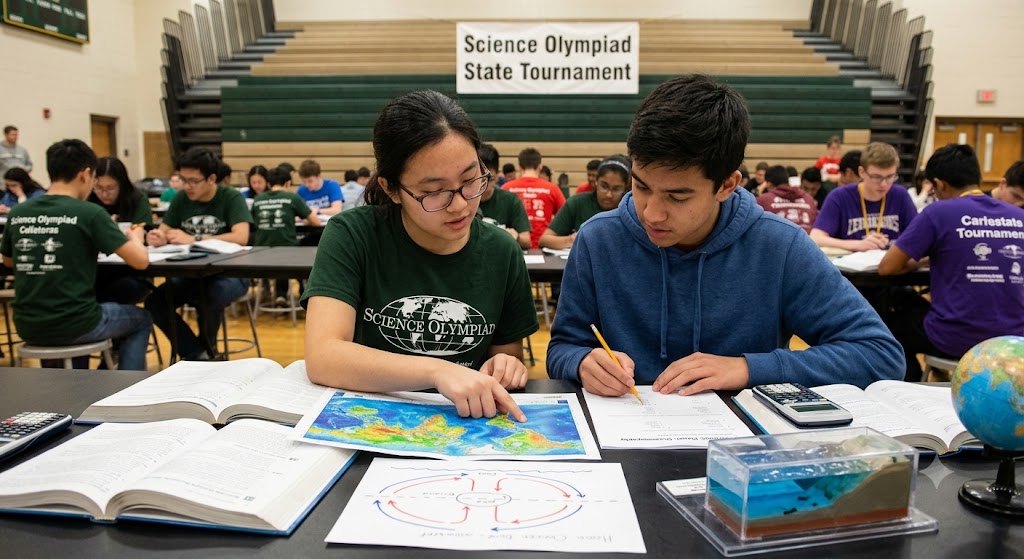
Additional Information
What the Course Entails and Exam Details
This rigorous event entails a deep dive into the foundational principles of oceanography. Students must master a wide-ranging syllabus that typically covers: the history of oceanography; plate tectonics and the topography of the ocean floor (including features like mid-ocean ridges, trenches, and seamounts); the physical and chemical properties of seawater (salinity, temperature, density, and dissolved gases); the dynamics of ocean circulation, including surface currents (driven by wind and the Coriolis effect) and deep-water thermohaline circulation; the mechanics of waves (formation, types, and coastal interaction) and tides (causes, cycles, and types); ocean-atmosphere interactions, including phenomena like El Niño-Southern Oscillation (ENSO); and the diverse marine ecosystems and zones. The exam typically requires a team of two students, who must work collaboratively, often in a station-based format, to apply their theoretical knowledge to practical problems, data analysis, and interpretation of scientific charts and diagrams.
What to Expect in the Final Exam
When competing in the final event, students should expect a multifaceted and demanding examination that moves far beyond simple multiple-choice questions. While multiple-choice questions will likely form a portion of the test, the exam typically features a significant hands-on, practical component, often organized in a rotation of stations. Teams must work under strict time limits (often approximately 50 minutes for the entire event) to complete tasks at each station. These tasks can include identifying seafloor features on topographical maps, interpreting data from scientific buoys or satellite imagery, analyzing water samples (or simulated data) for salinity and density, solving complex problems related to wave mechanics, and answering short-answer questions that test critical thinking and the application of oceanographic concepts. The rules regarding acceptable resources (like a single three-ring binder or a specific type of calculator) are extremely strict and must be reviewed carefully beforehand to avoid disqualification. Scoring is competitive, with placement determined by total points earned, and tie-breakers are often based on specific, designated sections of the exam.
How to Study and Exam Centers
Preparation for the Dynamic Planet Oceanography event must be comprehensive and strategic. Effective study strategies involve far more than just reading a single textbook. Students should begin by thoroughly reviewing the official Science Olympiad rules for the current year, as specific topics and allowed resources can change. Utilizing a high-level oceanography textbook (e.g., introductions by Trujillo, Thurman, or Garrison) is essential, but supplements these with reliable online resources, academic journals, and documentary footage for a deeper understanding. Hands-on practice with map reading, data analysis, and scientific calculations is crucial; teams should practice interpreting NOAA charts, analysis of tide tables, and density calculations. Taking numerous practice tests, including those from past competitions at all levels (regional, state, and national), is perhaps the single most effective study method. Reviewing these with a coach or mentor to understand mistakes is vital. The "exam centers" are the competition venues themselves—local, regional, state, and national tournaments hosted by designated schools, universities, or organizations authorized by Science Olympiad. Information about tournament locations and dates can be found on the official state and national Science Olympiad websites.
Job Opportunities from the Course
A strong performance and continued interest in Dynamic Planet Oceanography can be a major stepping stone, opening doors to diverse and vital career paths in marine and environmental sciences. The knowledge and critical thinking skills developed through preparation can lead to rewarding opportunities in fields such as:
Physical Oceanographer
Chemical Oceanographer
Marine Biologist
Marine Geologist
Marine Geophysicist
Coastal Zone Manager
Hydrologist
Climatologist/Paleoclimatologist
Environmental Scientist/Consultant
Cartographer/Hydrographer
Aquaculture Manager
Conservationist
Scientific Researcher (Academic or Government)
Science Educator/Museum Curator
Environmental Policy Analyst
Frequently Asked Questions
Reviews
5.0
Based on 0 reviews
Leave a Review
No reviews yet. Be the first to review!