
Science Olympiad Disease Detectives Practice Test
$69.00
- Buy to unlock unlimited access to all Quiz questions.
- After purchase you can print a PDF of the whole quiz at any point. The PDF will contain the questions and the correct answers.
About this Exam
The Science Olympiad Disease Detectives event is a challenging competition designed for students in middle school and high school (Science Olympiad Divisions B and C). It tests participants' knowledge and skills in epidemiology, the study of disease distribution and determinants in populations. Students must analyze data, evaluate public health problems, and apply critical thinking to solve complex epidemiological cases, much like real-world disease detectives investigating outbreaks.
This event is ideal for students with a keen interest in biology, public health, statistics, and solving real-world puzzles. It encourages team collaboration, as students usually work in pairs to tackle the competition’s scenarios. Successful participation requires a combination of strong theoretical knowledge, practical data analysis skills, and a logical approach to problem-solving.
Ready to test your knowledge?
Buy Now to Access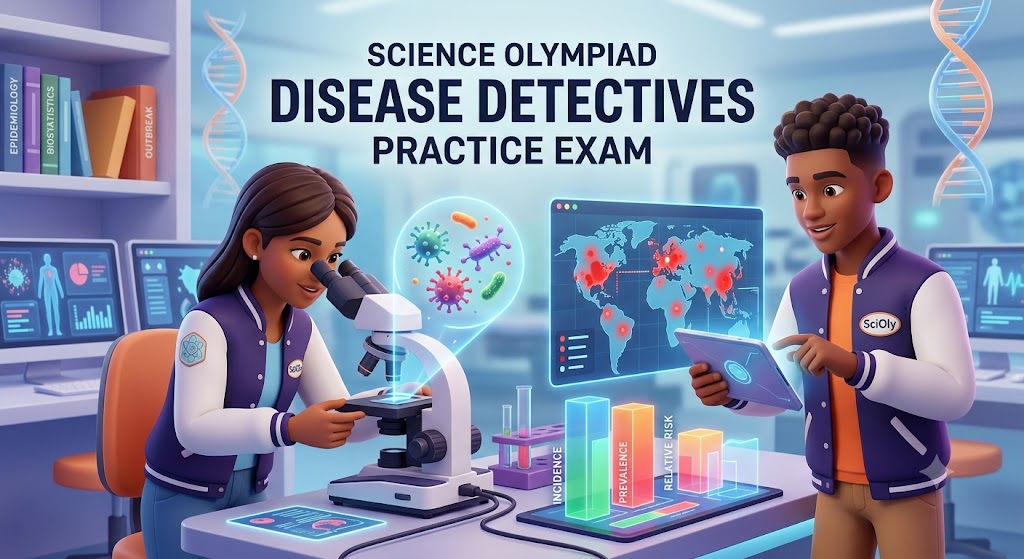
Additional Information
What the Course Entails and Exam Details
The Science Olympiad Disease Detectives event does not have a set syllabus like a traditional course, but rather a curriculum outline provided by the national Science Olympiad organization. Key topics covered generally include:
Fundamentals of Epidemiology: Understanding basic concepts, historical figures, and the scientific method as applied to public health.
Disease Surveillance and Outbreak Investigation: Methods for detecting, monitoring, and responding to disease outbreaks, including identifying sources, transmission routes, and implementing control measures.
Epidemiological Study Designs: Familiarity with various study types, such as cohort studies, case-control studies, cross-sectional studies, and their applications.
Biostatistics and Data Analysis: Ability to interpret data from tables, graphs, and maps, calculate epidemiological measures (like incidence, prevalence, relative risk, and odds ratios), and apply statistical tests.
Disease Prevention and Control: Knowledge of public health strategies, vaccinations, health education, and policy interventions.
Specific Diseases and Agents: While not requiring exhaustive knowledge of all diseases, participants should be familiar with major infectious diseases, non-communicable diseases, and environmental health issues commonly encountered in epidemiological contexts.
The competition typically involves a written test, but it is often structured as a series of problems or case studies. Students must apply their knowledge to specific scenarios, analyze data, and provide evidence-based conclusions.
What to Expect in the Final Exam
The culmination of the Disease Detectives event is the Science Olympiad competition, which takes place at regional, state, and national levels. The "exam" format and specific rules are as follows:
Format: The competition commonly takes the form of a written test. This test may feature multiple-choice questions, short-answer questions, data analysis problems (calculating and interpreting rates/ratios), and detailed case study analyses. At higher levels of competition, practical applications, simulations, and interpretation of complex datasets are frequently included.
Team Event: Disease Detectives is primarily a team event, usually involving two students working together. Strong communication and collaboration skills are essential.
Allowed Resources: Science Olympiad rules generally allow teams to bring a single two-sided page (or sometimes a designated binder at state/national levels) containing handwritten or typed notes, which functions as a "cheat sheet" during the competition. Mastery of this resource is a key strategy for success.
Time Limit: Competitions typically adhere to strict time constraints, often 50 minutes at regional and state levels, and sometimes up to 90 minutes at Nationals.
Scoring: Teams are scored based on the total number of correct answers and the quality of their data analysis. At most tournaments, there isn't a "passing score" in the conventional sense, as rankings are determined relative to other competing teams.
How to Study and Exam Centers
Preparation for Disease Detectives involves a multi-faceted approach, emphasizing both knowledge acquisition and practical application. Here are key study strategies:
Master the Science Olympiad Rules: Download and carefully review the official event rules from the Science Olympiad website for your division (B or C). These rules outline the event parameters, topics, and resource allowances.
Create an Effective Cheat Sheet: Dedicate significant effort to developing a concise and comprehensive reference page. Include key epidemiological definitions, formulas (with clear examples), steps for outbreak investigation, common disease vectors and transmission modes, and quick-reference data interpretation guides. Practice using your cheat sheet with practice tests.
Utilize Official Resources: Explore resources provided by the national Science Olympiad website, including previous years’ event wikis, recommended textbooks, and online resources.
Practice with Real-World Data: Analyze epidemiological studies and public health data from organizations like the CDC (Centers for Disease Control and Prevention) and the WHO (World Health Organization). Understand how they identify and track disease outbreaks.
Review Past Science Olympiad Exams: Practice with actual or simulated exams from previous Science Olympiad competitions. Focus on solving the data-driven problems and understanding the structure of the scenarios. There are various online communities and wikis where teams share past tests.
Develop Strong Biostatistics Skills: Ensure proficiency in calculating and interpreting fundamental epidemiological statistics, including incidence, prevalence, attack rates, relative risk, and odds ratios.
Enhance Data Interpretation and Graphing: Practice interpreting complex charts, tables, and maps. Develop skills in visualizing data effectively to identify patterns and trends.
Exam Centers:
It's crucial to understand that there is no single "exam center" like Pearson VUE for Science Olympiad events. The competitions take place at designated tournament locations, which are typically high schools, universities, or other large public venues.
Regional Tournaments: Held at various locations within a state, typically hosted by participating schools or local universities.
State Tournaments: Bring together top teams from across the state, often held at a central university or large venue.
National Tournaments: The final championship event for the highest-performing teams in each division, hosted at a major university each year.
Students must register through their school to participate in the Science Olympiad organization and will be assigned to a specific regional tournament based on their location. Successful teams then advance to the state and potentially national levels.
Job Opportunities from the Course
While the Disease Detectives event is a competitive activity rather than a career-granting certification, the skills and knowledge students develop are highly relevant to numerous exciting career paths in public health and beyond. Here are just a few specific job opportunities and career fields that this foundation can unlock:
Epidemiologist: (Investigates causes and patterns of diseases in populations).
Public Health Official: (Develops and implements policies and programs to improve community health).
Disease Modeler: (Uses statistical and mathematical models to predict the spread of infectious diseases).
Biostatistician: (Applies statistical methods to analyze data from medical and public health research).
Infectious Disease Specialist: (A medical doctor focusing on the diagnosis and treatment of infectious diseases).
Microbiologist/Virologist: (Studies microorganisms, including pathogens that cause disease).
Global Health Analyst: (Analyzes and addresses health issues on an international scale).
Clinical Research Coordinator: (Oversees and coordinates clinical trials for new drugs or treatments).
Environmental Health Scientist: (Identifies and mitigates environmental hazards impacting public health).
Health Policy Analyst: (Evaluates health-related policies and advocates for evidence-based change).
Health Educator: (Provides information and education to promote healthy behaviors).
Emergency Response Coordinator: (Plans and manages responses to public health emergencies, such as outbreaks or natural disasters).
Participants who excel in Disease Detectives develop invaluable skills in critical thinking, data analysis, teamwork, and problem-solving, all of which are highly transferable and sought after in these fulfilling and vital public health professions.
Frequently Asked Questions
Reviews
5.0
Based on 0 reviews
Leave a Review
No reviews yet. Be the first to review!