
School Resource Officer (SRO) Certification Practice Exam
$69.00
- Buy to unlock unlimited access to all Quiz questions.
- After purchase you can print a PDF of the whole quiz at any point. The PDF will contain the questions and the correct answers.
About this Exam
The School Resource Officer (SRO) Certification is a specialized credential designed for sworn law enforcement officers who work within educational environments. This certification validates that officers possess the specific knowledge, skills, and understanding necessary to effectively serve as a bridge between law enforcement and the school community.
The SRO’s role goes beyond traditional policing; it encompasses acting as a mentor, educator, and unofficial counselor while maintaining school safety. The exam, and this practice resource, are designed for officers assigned to schools, school administrators responsible for safety programs, and law enforcement supervisors overseeing SRO units.
This practice exam serves as a crucial study tool, helping candidates familiarize themselves with the types of questions and subject matter they will encounter on the official certification test.
Ready to test your knowledge?
Buy Now to Access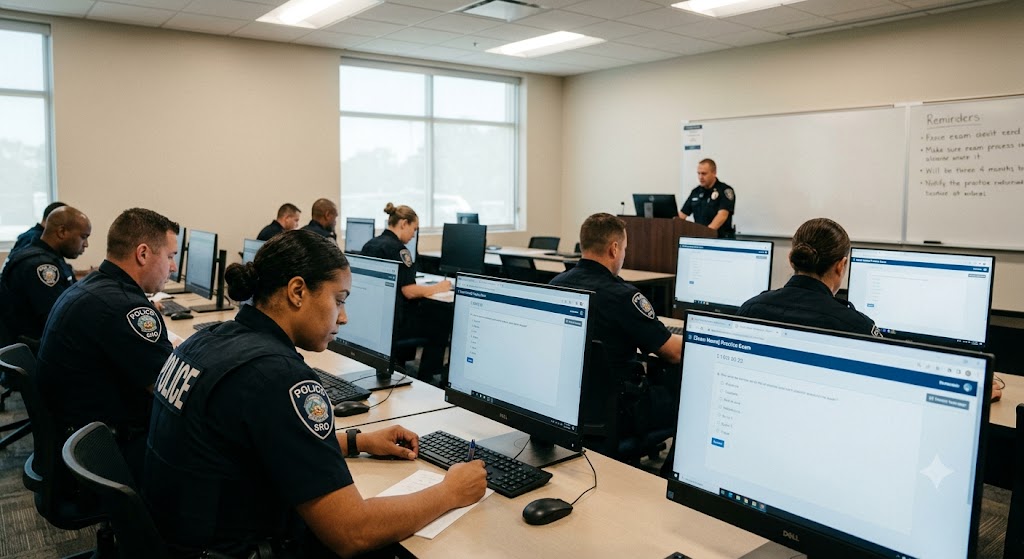
Additional Information
What the Course Entails and Exam Details
The certification curriculum focuses on the unique challenges and responsibilities of working in a school setting. The core topics covered in SRO training and assessed on the exam typically include:
The SRO Triad Concept: Understanding the three primary roles of an SRO: Law Enforcement Officer, Teacher/Guest Speaker, and Informal Counselor/Mentor.
School Law and Legal Issues: In-depth knowledge of laws specific to the educational environment, including search and seizure (Fourth Amendment) in schools, student rights, mandatory reporting, and understanding Individualized Education Programs (IEPs) and 504 plans.
Child and Adolescent Development: Understanding the cognitive, emotional, and social development of students to facilitate effective communication and conflict resolution.
De-escalation and Crisis Intervention: Strategies for defusing conflict situations, handling mental health crises, and managing incidents involving special needs students.
School Safety and Emergency Preparedness: Familiarity with National Incident Management System (NIMS), comprehensive school safety plans, and active threat/shooter response protocols within a school environment.
Problem-Oriented Policing in Schools: Utilizing data and community resources to address underlying issues affecting school safety, such as bullying, cyberbullying, or substance abuse.
The actual training course is typically an intensive, multi-day program (e.g., the NASRO Basic SRO Course is usually 40 hours). This practice exam is designed to reinforce these concepts.
What to Expect in the Final Exam
The final SRO certification exam is typically a comprehensive written test designed to assess the candidate's understanding of the training curriculum. While the exact details may vary slightly by state or certifying organization (such as NASRO), here is what candidates can generally expect:
Format: The exam is usually comprised of 50 to 100 multiple-choice questions. These questions are often scenario-based, requiring the application of knowledge to real-world school situations rather than simple rote memorization.
Time Limit: Candidates are usually allotted a specific timeframe to complete the exam, often between 90 minutes to two hours.
Passing Score: A passing score is required to obtain certification, typically ranging from 70% to 80%.
Administration: The exam is usually administered at the conclusion of the SRO training course by the authorized training organization or state police academy. It may be offered online through a secure portal or as a proctored, paper-based test.
How to Study and Exam Centers
Preparation is key to succeeding on the SRO certification exam. Effective study strategies include:
Review Official Curriculum Material: Thoroughly review all materials provided during your SRO training course, including manuals, presentation slides, and notes.
Utilize Practice Exams: Take advantage of practice tests, like this resource, to identify knowledge gaps and get comfortable with the exam format and question style. Focus heavily on scenario-based questions.
Form Study Groups: Collaborating with colleagues who are also preparing for the exam can provide different perspectives on complex topics like school law and de-escalation.
Focus on Key Concepts: Pay close attention to the SRO Triad concept, key legal principles (such as in loco parentis and reasonable suspicion vs. probable cause in schools), and emergency response protocols.
Exam Centers: SRO certification exams are usually not offered through public testing centers like Pearson VUE. Instead, they are typically administered by:
State Peace Officer Standards and Training (P.O.S.T.) Commissions: Many states manage SRO certification directly through their regulatory bodies for law enforcement training.
Authorized Law Enforcement Training Academies: State, regional, or local police academies that host the SRO training courses often proctor the exam immediately following the training.
Professional Organizations: Organizations like the National Association of School Resource Officers (NASRO) conduct testing in conjunction with their training courses held nationally.
Candidates should consult their department or state training coordinator to determine the specific organization responsible for administering the exam in their jurisdiction.
Job Opportunities from the Course
Earning SRO certification significantly enhances a law enforcement officer's qualifications for assignments within educational environments and specialized units. This certification is often required or highly preferred for several career paths, including:
School Resource Officer (SRO): The primary and most direct application of the certification, working daily in elementary, middle, or high schools.
School Safety Coordinator: A specialized role within a police department or school district focused on developing, implementing, and overseeing safety protocols and emergency planning.
Juvenile Officer/Detective: Certification provides valuable background for officers investigating crimes involving minors or working within juvenile justice divisions.
Community Liaison Officer/Community-Oriented Policing Unit: The skills learned are highly applicable to broader community engagement and problem-solving initiatives.
SRO Unit Supervisor/Program Manager: Advancement opportunities to supervise and train teams of School Resource Officers.
Frequently Asked Questions
Reviews
5.0
Based on 0 reviews
Leave a Review
No reviews yet. Be the first to review!