
SBE Certified TV Operator (CTO) Practice Test
$69.00
- Buy to unlock unlimited access to all Quiz questions.
- After purchase you can print a PDF of the whole quiz at any point. The PDF will contain the questions and the correct answers.
About this Exam
The Certified TV Operator (CTO) certification, offered by the Society of Broadcast Engineers (SBE), is a foundational credential designed for individuals seeking to establish a solid grasp of television station operations.
This certification is ideal for new hires, technical staff, operators, and individuals aspiring to enter the field of television broadcasting.
It validates the fundamental knowledge required to handle everyday responsibilities within a TV facility, ensuring safe and efficient operation.
The exam focuses heavily on the basic technical and operational aspects, providing a benchmark of competence for employers and a stepping stone for further professional advancement.
Ready to test your knowledge?
Buy Now to Access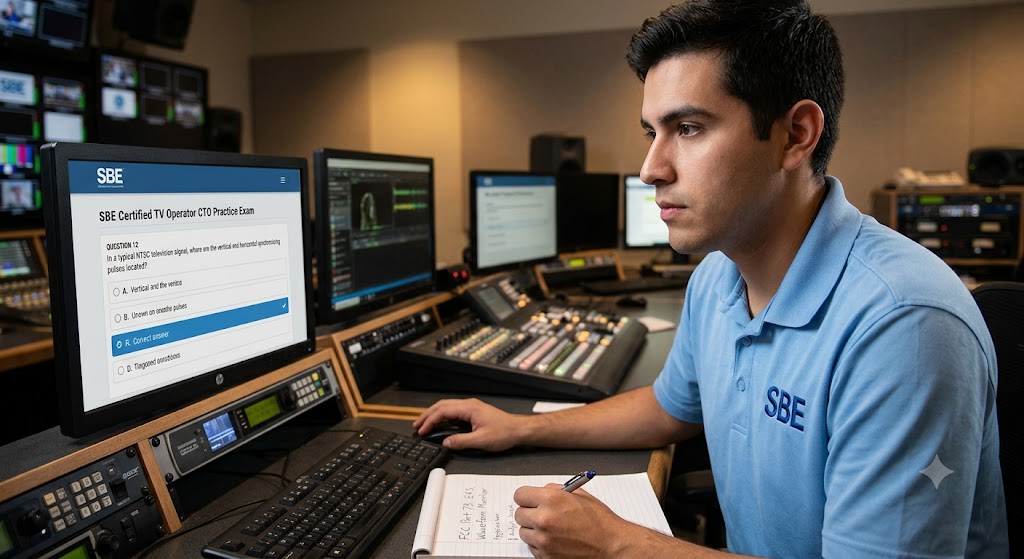
Additional Information
What the Course Entails and Exam Details
This examination focuses on the operational knowledge and practical skills essential for a entry-level TV operator. It covers a broad spectrum of fundamental concepts.
The content includes, but is not limited to: Basic electronics, AC power concepts, FCC rules and regulations relevant to television operations (Part 73 and 74), video and audio signal fundamentals, measurement and monitoring equipment like waveform monitors and vectorscopes.
It also assesses your understanding of studio equipment operation, including cameras, switchers, servers, graphics, and the procedures for properly setting levels and ensuring compliance.
You should be prepared to address topics related to transmitter operation, emergency alert systems (EAS), and essential safety practices within the broadcast environment.
This exam serves as a comprehensive validation of your readiness to contribute effectively to a television production or operational team.
What to Expect in the Final Exam
The final SBE Certified TV Operator (CTO) exam is a computerized, multiple-choice assessment designed to challenge your theoretical and practical understanding of television broadcasting.
The total number of questions can vary slightly but is typically around 50 to 100 questions.
There is a defined time limit, which usually ranges from 1 hour and 30 minutes to 2 hours, to complete the exam.
A passing score of 70% or higher is required to achieve the CTO designation.
Questions will present realistic scenarios and direct technical inquiries across all the operational domains listed above.
There is no physical component or practical test; rather, your situational judgment is tested through application-based questions.
How to Study and Exam Centers
Preparation for the CTO exam requires a mix of theoretical study and practical experience.
Start by thoroughly reviewing the SBE Certified TV Operator (CTO) handbook and study materials available through the SBE website. This resource outlines the exact knowledge domains.
Complement this by working with a mentor or senior engineer in an active TV station. Practical hands-on experience in a master control or production environment is invaluable for understanding the how behind the what.
Focus on learning the "what to do" and "why we do it" for all operational procedures, especially regarding FCC regulations and emergency procedures.
Utilize the practice exams, like this one, to gauge your readiness, identify weak points, and get accustomed to the multiple-choice format and time constraints.
Regarding examination centers, SBE exams are proctored. You can choose from several options:
Local SBE Chapters: Many local chapters hold organized test days.
Approved SBE Proctors: An authorized SBE certified engineer can proctor you at your workplace or a public location.
Certain Educational Institutions: Accredited broadcast technology programs may offer SBE exams.
Review the SBE certification website for a full list of approved proctors in your region. Online proctoring is not currently an official option, ensuring the exam's integrity is strictly maintained.
Job Opportunities from the Course
A Certified TV Operator (CTO) credential significantly enhances your resume by signaling a strong baseline of competence and dedication to your craft. This opens doors to several key entry and mid-level roles:
Master Control Operator (MCO)
Production Assistant
Studio Camera Operator
Graphics Operator
Field Camera Operator
Live Sound Engineer (Entry Level)
Technical Director (Small Market/Entry Level)
News Editor (Entry Level)
Broadcast Technician (Entry Level)
Frequently Asked Questions
Reviews
5.0
Based on 0 reviews
Leave a Review
No reviews yet. Be the first to review!