
Santillana Preliminary Practice Test
$69.00
- Buy to unlock unlimited access to all Quiz questions.
- After purchase you can print a PDF of the whole quiz at any point. The PDF will contain the questions and the correct answers.
About this Exam
The Santillana Preliminary Practice Test is an invaluable resource designed for students aiming to benchmark their Spanish language proficiency, specifically preparing for formal certification. Developed by Santillana, a leader in Spanish language education, this practice exam simulates the structure and difficulty of authentic standardized assessments. It is tailored for beginning to intermediate learners who have completed foundational courses and are looking to validate their skills. Whether you are a high school student, a college learner, or a professional seeking basic communication competency, this practice test offers a realistic evaluation. Its purpose is to build test-taking confidence and highlight areas that require further review before registering for the official certification exam.
Ready to test your knowledge?
Buy Now to Access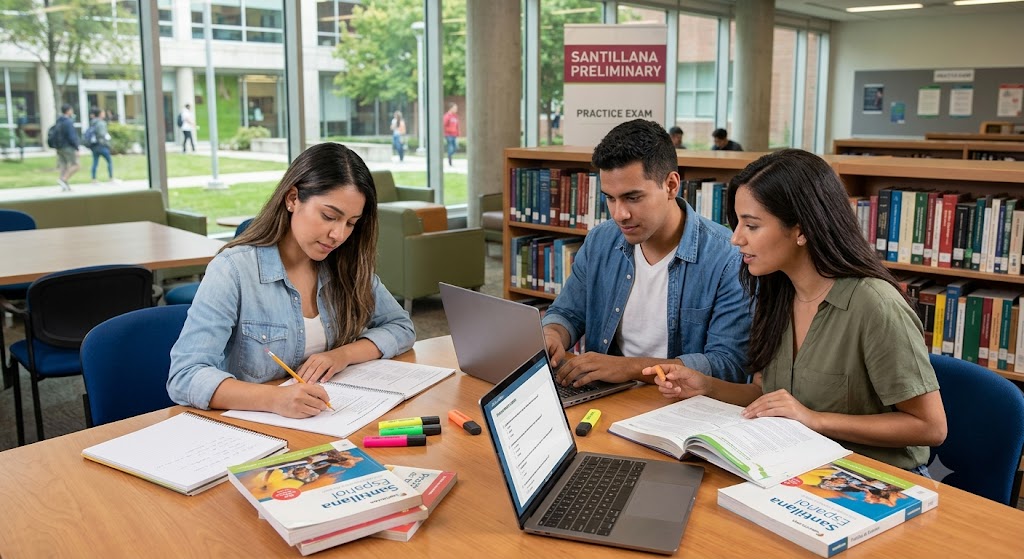
Additional Information
What the Course Entails and Exam Details
While this is a practice test and not a full instruction course, it focuses heavily on the essential communicative competencies required at the preliminary level. Students utilizing this resource should have exposure to the core syllabus of foundational Spanish. The material covered includes:
Vocabulary: Common topics like introductions, family, daily routines, hobbies, food, and basic travel.
Grammar: Present tense conjugations of regular and irregular verbs, basic past tenses, gender and number agreement for nouns and adjectives, and common prepositions.
Reading Comprehension: Understanding short, straightforward texts such as announcements, emails, or basic news descriptions.
Listening Comprehension: Grasping the main idea and key details in slow, clear recordings of everyday conversations and instructions.
Basic Writing: The ability to compose simple sentences or short paragraphs on familiar topics.
What to Expect in the Final Exam
When sitting for the Santillana Preliminary Practice Exam, you can expect a structure that mirrors many international Spanish certifications. The format typically includes multiple components, often delivered online:
Format: Primarily multiple-choice questions for reading and listening comprehension. Some practice formats might include short-answer questions or a brief writing prompt to simulate productive skills.
Time Limit: Usually a fixed duration of approximately 60 to 90 minutes. This helps you practice managing your time, a critical skill for the official exam.
Passing Score: A passing grade on the practice test is often set around 60% to 70%. Achieving this benchmark indicates that you have a solid grasp of the preliminary curriculum.
Immediate Feedback: A major benefit of this practice tool is often receiving immediate scoring upon completion, often with explanations of the correct answers, allowing for instant review.
How to Study and Exam Centers
Effective preparation is the key to success. Here are actionable strategies to study for the Santillana Preliminary Practice Exam:
Review Santillana Materials: If you are already using Santillana textbooks, revisit the grammar summaries and vocabulary lists at the end of each foundational unit.
Take the Practice Test Under Real Conditions: When you use this practice test, take it seriously. Sit in a quiet room, time yourself strictly, and avoid using dictionaries or notes. This builds actual test-taking stamina.
Analyze Your Mistakes: The most crucial step. Review every question you answered incorrectly. Understand why the correct answer is correct and which grammar point or vocabulary word you missed.
Daily Immersion: Complement your study with 15 minutes of daily immersion—listen to a Spanish podcast, read a children’s book in Spanish, or use a language learning app.
As this is a practice exam, it is not administered at formal, physical, proctored centers like Pearson VUE. Instead, you can typically access the Santillana Preliminary Practice Test through authorized online platforms, your school's learning management system, or the Santillana website itself, allowing you to take it from the comfort of your own home at any convenient time.
Job Opportunities from the Course
A strong performance on the Santillana Preliminary Practice Exam demonstrates a foundational level of Spanish competency (roughly equivalent to A1/A2 on the CEFR scale). While it is a stepping stone to higher certifications, this level of Spanish proficiency, validated by the upcoming official exam, unlocks various roles where basic communication is an asset:
Retail Sales Associate: Assisting Spanish-speaking customers in diverse retail environments.
Hotel Front Desk Clerk: Checking in international guests and providing basic local information.
Bilingual Customer Service Representative: Handling basic inquiries and simple troubleshooting.
Restaurant Server: Serving in establishments frequent by Spanish-speaking clientele.
Call Center Support (Entry Level): Assisting with basic account information and support.
Medical Receptionist: Helping to manage appointments and check-ins in bilingual clinics.
Administrative Assistant: Providing support in multinational companies with Hispanic market connections.
Frequently Asked Questions
Reviews
5.0
Based on 0 reviews
Leave a Review
No reviews yet. Be the first to review!