
Santa Clara County EMS Orientation Practice Exam
$69.00
- Buy to unlock unlimited access to all Quiz questions.
- After purchase you can print a PDF of the whole quiz at any point. The PDF will contain the questions and the correct answers.
About this Exam
Prepare thoroughly for the essential Santa Clara County EMS Orientation Exam with this focused practice test. This orientation is required for all Emergency Medical Services personnel – including Emergency Medical Technicians (EMTs), Paramedics, and potentially First Responders – seeking authorization to practice within the specific protocols and medical control of Santa Clara County. It ensures that you are familiar with the unique procedures, standing orders, and expectations of the local EMS system before you begin working on an ambulance or responding to emergencies within the county. Passing the subsequent final orientation exam is mandatory for authorization to practice in this region. This practice exam helps you identify critical areas where further study is needed before taking the official test.
Ready to test your knowledge?
Buy Now to Access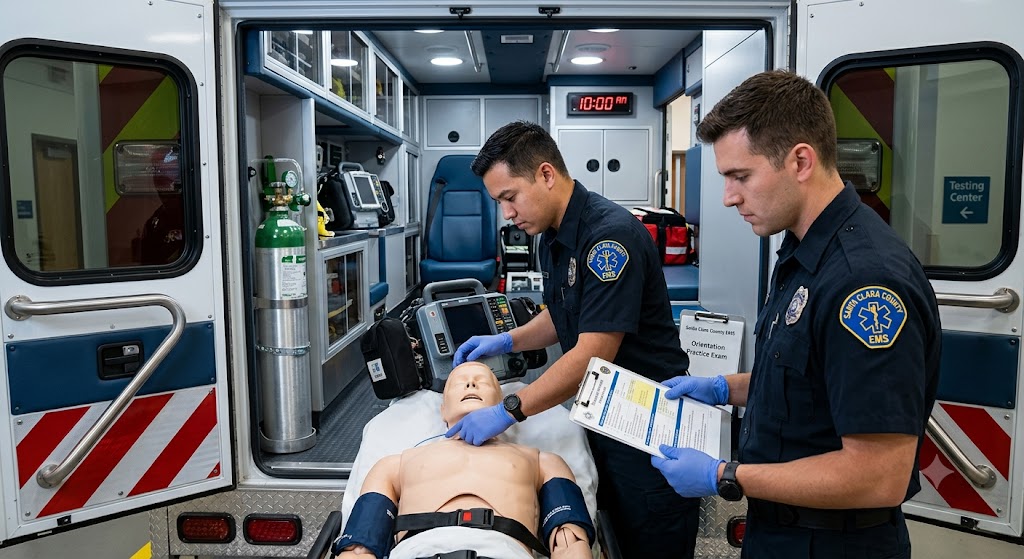
Additional Information
What the Course Entails and Exam Details
The official orientation course and subsequent exam cover a specific subset of medical protocols unique to Santa Clara County, rather than re-testing foundational EMT or Paramedic knowledge. Core areas you must master include: County-Specific Medical Protocols (Treatment Protocols), Standing Orders, Destination Policies, Trauma System Triage criteria, Multi-Casualty Incident (MCI) procedures, Controlled Substance Policies (for Paramedics), Documentation Standards, and Medical Control Communication. You will also review local definitions and procedures related to critical care transport, base hospital contact, and specialized procedures allowed within the county. Understanding the precise nuances of these standing orders is critical for correct field decisions and exam success. The practice exam aims to cover all these topics via illustrative questions to build familiarity.
What to Expect in the Final Exam
The actual Santa Clara County EMS Orientation Exam is typically a multiple-choice test administered in a controlled environment, often on a computer or occasionally on paper. You should anticipate a pass score set high, often around 80% or 90%, reflecting the need for precision in emergency protocols. While exact question counts and time limits can vary slightly between test dates, expect a test of approximately 50 to 100 questions to be completed within a reasonable timeframe (like 90 to 120 minutes), emphasizing protocol knowledge rather than speed. You must correctly answer scenarios reflecting actual patient care decisions based strictly on Santa Clara County's current policies. Cheating, use of outside resources during the test, or communication with others is prohibited.
How to Study and Exam Centers
Effective studying begins with a meticulous review of the current, official Santa Clara County EMS Medical Protocols and Policies manual. Do not rely solely on textbook knowledge; prioritize the specific, local amendments and standing orders. Take the orientation course seriously, paying close attention to every lecture and handout. Form study groups with other candidates to discuss scenarios and quiz each other on protocols. Review the County EMS agency's official website for potential updates or supplementary study guides. Access and repeatedly use this practice exam and others available online or through your training program. The actual final exam is typically proctored and administered at the Santa Clara County EMS Agency headquarters, a designated training facility, or sometimes via an authorized online platform – check official communications from the County for precise locations and scheduling.
Job Opportunities from the Course
Successfully completing this orientation process is a crucial step towards securing employment within the Santa Clara County EMS system. Authorization unlocks several key career paths: Emergency Medical Technician (EMT), Paramedic, Firefighter/EMT or Firefighter/Paramedic within local fire departments, Emergency Room Technician in county hospitals, Critical Care Transport (CCT) Paramedic, and various roles within private ambulance services operating in the region. This orientation is the gatekeeper for practicing emergency medicine in Santa Clara County, making it a foundational requirement for anyone dedicated to an EMS career in this vital Silicon Valley area.I have drafted this guide with SEO in mind, using optimized headers and structured content to provide comprehensive information for students.
A couple of important notes regarding specific details:
Final Exam Specifics (Passing Score, Time Limits): These details are often updated by the agency and can vary by candidate type (e.g., Paramedic vs. EMT-1). I have described the typical format but recommend verification with the current policy manual.
Exam Centers: The actual cognitive and policy exams are usually administered online through the county's learning management system or a specific proctor, while skill evaluations are held at approved local training centers.
Frequently Asked Questions
Reviews
5.0
Based on 0 reviews
Leave a Review
No reviews yet. Be the first to review!