
Safety Trained Supervisor (STS) Practice Exam
$69.00
- Buy to unlock unlimited access to all Quiz questions.
- After purchase you can print a PDF of the whole quiz at any point. The PDF will contain the questions and the correct answers.
About this Exam
The Safety Trained Supervisor (STS) certification is a prestigious credential designed for individuals with supervisory responsibilities in any industry, emphasizing that safety leadership is a core function of management. Administered by the Board of Certified Safety Professionals (BCSP), it is not for full-time safety professionals, but rather for frontline supervisors, managers, and crew leaders who direct the work of others. This certification validates your knowledge of essential safety practices, enabling you to create a safer, healthier workplace while reducing risks and ensuring regulatory compliance. Earning your STS shows a commitment to your team's well-being and a proactive approach to operational excellence.
Ready to test your knowledge?
Buy Now to Access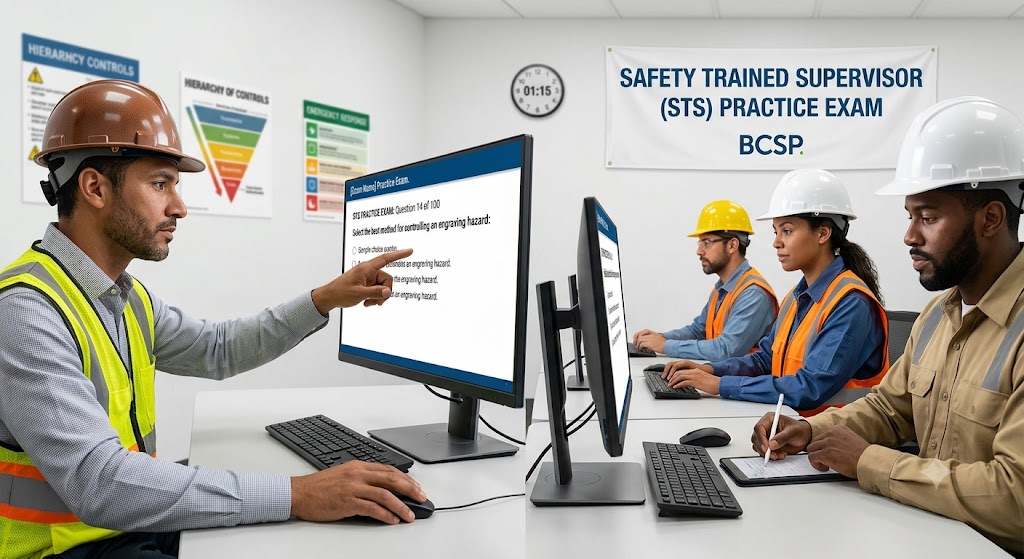
Additional Information
What the Course Entails and Exam Details
Preparing for the STS exam involves mastering a comprehensive range of topics divided into six core domains. These domains focus on practical application and leadership in safety, not just theoretical knowledge. Key areas include:
Safety Program Implementation and Management: Covering leadership, communication, and the motivation of employees towards safety; conducting incident investigations and reporting; performing job safety analysis (JSA).
Hazard Awareness: Developing the skills to proactively identify, evaluate, and prioritize workplace hazards through inspections and audits.
Hazard Controls: Implementing the hierarchy of controls (elimination, substitution, engineering, administrative, PPE) and managing risks effectively.
Basic Industrial Hygiene: Understanding health hazards like chemicals, noise, and ventilation, and managing exposures.
Emergency Preparedness and Management: Planning for emergencies, conducting drills, and inspecting emergency equipment.
Life Critical Activities: Mastering safety protocols for high-risk operations, including lockout/tagout, confined spaces, fall protection, and electrical safety.
The exam itself is a computer-based test that assesses your ability to apply these concepts in real-world supervisory scenarios.
What to Expect in the Final Exam
The final STS exam is a formal, proctored assessment. Here is a breakdown of what to expect:
Format: The exam consists of 100 multiple-choice questions, which may include scenario-based items where you must choose the best course of action as a supervisor.
Time Limit: You are given exactly two hours (120 minutes) to complete the test.
Passing Score: The BCSP uses a statistical method to determine the minimum passing score. While not a fixed number, candidates generally need to achieve approximately 70% to pass. Your official, instant results will be provided as a simple Pass or Fail.
Rules: The exam is closed-book. You are not permitted to use any external resources, including books, notes, or electronic devices, other than a BCSP-approved calculator if one is provided on-screen.
How to Study and Exam Centers
Effective preparation is key to success. Here are actionable study strategies:
Use the BCSP Exam Blueprint: This is your definitive guide, detailing the exact percentage of questions from each domain. Prioritize your study time based on these weights.
Take Practice Exams: Utilize the official BCSP STS Practice Exam and reputable third-party resources. Practice exams are the best way to become familiar with the question format, identify weak areas, and manage your time.
Study the Reference Materials: The BCSP provides a list of reference materials upon which the exam is based. Review these core texts.
Engage in a Study Group or Course: Many organizations offer STS prep courses, and study groups can provide mutual support and diverse perspectives on problem-solving.
Exam Centers and How to Take the Exam
The STS exam is administered via computer at authorized testing centers worldwide by Pearson VUE. Once your application is approved by the BCSP, you will receive an "Authorization to Test" (ATT) email, allowing you to schedule your exam at a convenient location and time. Pearson VUE has hundreds of centers, often located in Pearson Professional Centers or at authorized partner sites like community colleges and military bases. You must schedule your appointment in advance.
Job Opportunities from the Course
Earning your STS certification can significantly enhance your career trajectory, leading to roles with increased responsibility and compensation. Key job titles and career paths unlocked by this certification include:
Frontline Supervisor
Crew Leader
Construction Foreman
Maintenance Supervisor
Production Manager
Warehouse Manager
Team Lead
Field Supervisor
Site Superintendent
Operational Manager
This credential distinguishes you as a supervisor who leads with safety, making you a highly valuable asset to any organization. Good luck with your preparation!
Frequently Asked Questions
Reviews
5.0
Based on 0 reviews
Leave a Review
No reviews yet. Be the first to review!