
Safety and Emissions Practice Test
$69.00
- Buy to unlock unlimited access to all Quiz questions.
- After purchase you can print a PDF of the whole quiz at any point. The PDF will contain the questions and the correct answers.
About this Exam
The Safety and Emissions certification is a vital credential for automotive professionals dedicated to ensuring vehicle safety and environmental compliance. This exam is designed for automotive technicians, service writers, and inspectors who want to legally perform state-mandated vehicle inspections, demonstrating their competence in analyzing emissions and verifying the safe operation of crucial vehicle components. By earning this certification, you prove your commitment to both passenger safety and air quality standards in your jurisdiction.
Ready to test your knowledge?
Buy Now to Access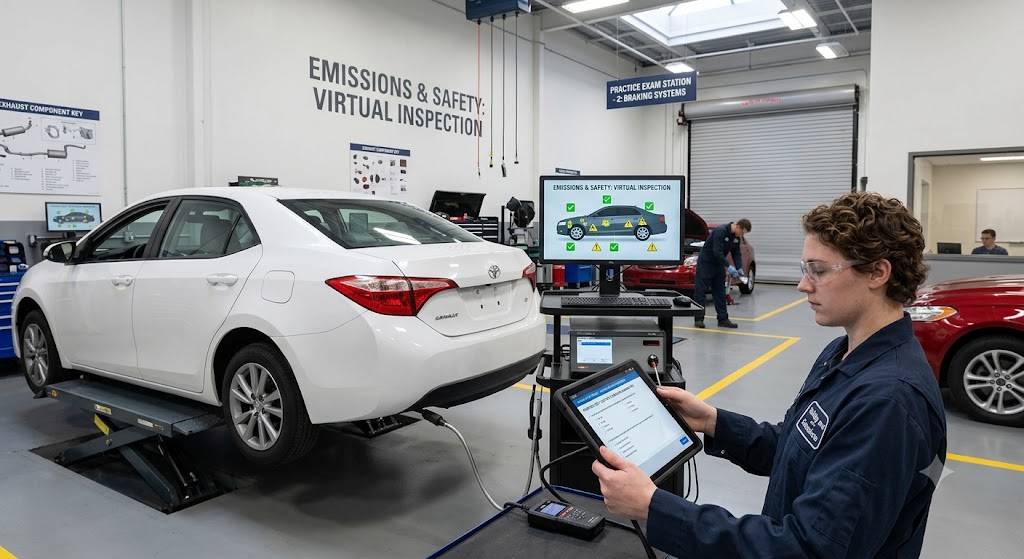
Additional Information
What the Course Entails and Exam Details
This practice exam will test your knowledge on a wide range of critical subjects relevant to safety and emissions protocols. Key topics include:
Comprehensive understanding of state or local vehicle safety regulations and inspection procedures.
The principles of exhaust emissions control and detailed inspection methodologies for various engine types (e.g., gasoline, diesel, hybrid).
Operation, maintenance, and regular calibration of emissions testing equipment, such as gas analyzers.
Correct procedures for visually and mechanically inspecting essential vehicle safety components, including:
Brake systems and components
Steering and suspension mechanisms
Tires and wheels
Lighting systems (headlights, brake lights, indicators)
Windshields and mirrors
Accurate interpretation and recording of inspection data and results.
Ethical and legal responsibilities associated with conducting state-mandated inspections.
Understanding and complying with occupational health and safety standards within the automotive workshop setting.
What to Expect in the Final Exam
The actual final exam format may vary slightly based on your specific state or licensing body, but typical components include:
Written Exam: A comprehensive test, often featuring multiple-choice questions, that evaluates your theoretical knowledge of regulations, technical procedures, and equipment operation. The time limit for this section can range from 60 to 120 minutes.
Practical Exam: A hands-on evaluation where a designated instructor or proctor observes you performing actual safety and emissions inspections on a vehicle. You must demonstrate the correct use of testing tools and equipment, accurately identify any potential safety or emissions failures, and document your findings precisely.
Passing Score: The minimum required score is generally between 70% and 80%, both for the written and practical components. Be sure to check the specific requirements of your licensing authority.
How to Study and Exam Centers
Effective preparation is key to succeeding on the Safety and Emissions exam. Here are some actionable strategies:
Review Official Documentation: Begin by thoroughly studying the inspection manual, study guide, and any official state or local regulations provided by your certifying authority.
Enroll in Authorized Training: Participate in safety and emissions training courses offered by community colleges, technical schools, or specialized training centers. These courses provide hands-on practice and targeted instruction.
Utilize Practice Tests: Practice with sample questions and simulated exams, such as the ones provided here, to familiarize yourself with the question formats, timing, and areas where you need further review.
Gain Hands-on Experience: Work alongside experienced and certified inspectors in a registered inspection station to observe real-world scenarios and get practical, supervised experience.
Maintain Equipment: Practice setting up, calibrating, and troubleshooting the emissions and safety testing equipment you will use during the practical exam.
Where and How to Take the Exam
You can typically register for and take the Safety and Emissions exam through several channels:
Authorized Training Providers: Many community colleges, technical schools, and private training institutions that offer preparatory courses also serve as authorized testing centers for both the written and practical exams.
State or Local Agencies: Your state's Department of Motor Vehicles (DMV), Department of Environmental Quality, or equivalent regulatory body often oversees the examination process and provides a list of approved testing sites.
Third-Party Testing Centers: In some jurisdictions, written exams may be administered at dedicated testing facilities like Pearson VUE or other computerized testing centers.
Job Opportunities from the Course
Upon earning your Safety and Emissions Certification, you will qualify for various rewarding positions within the automotive industry, including:
Certified Vehicle Safety Inspector
State Emissions Inspector
Automotive Service Technician (with inspector endorsement)
Fleet Maintenance Technician (requiring inspector duties)
Service Writer / Service Advisor (leveraging inspector knowledge)
Quality Control Inspector in automotive manufacturing or repair
Department of Motor Vehicles (DMV) Technical Specialist
Automotive Shop Foreman (leading a team of certified inspectors)
Frequently Asked Questions
Reviews
5.0
Based on 0 reviews
Leave a Review
No reviews yet. Be the first to review!