
Safe Lifting, Moving, and Positioning of Patients Practice Test
$69.00
- Buy to unlock unlimited access to all Quiz questions.
- After purchase you can print a PDF of the whole quiz at any point. The PDF will contain the questions and the correct answers.
About this Exam
The Safe Patient Handling Practice Exam is an essential tool designed for healthcare providers, nursing students, and professional caregivers who seek to validate their knowledge of ergonomic principles and injury prevention techniques. This practice test focuses on the critical skills needed to move and position patients safely while minimizing physical strain. It is ideal for individuals preparing for facility-specific competency assessments, nursing school exams, or those simply wishing to reinforce best practices in clinical care. By using this practice resource, candidates ensure they are equipped with the knowledge to maintain both their own health and the safety of the individuals in their care.
Ready to test your knowledge?
Buy Now to Access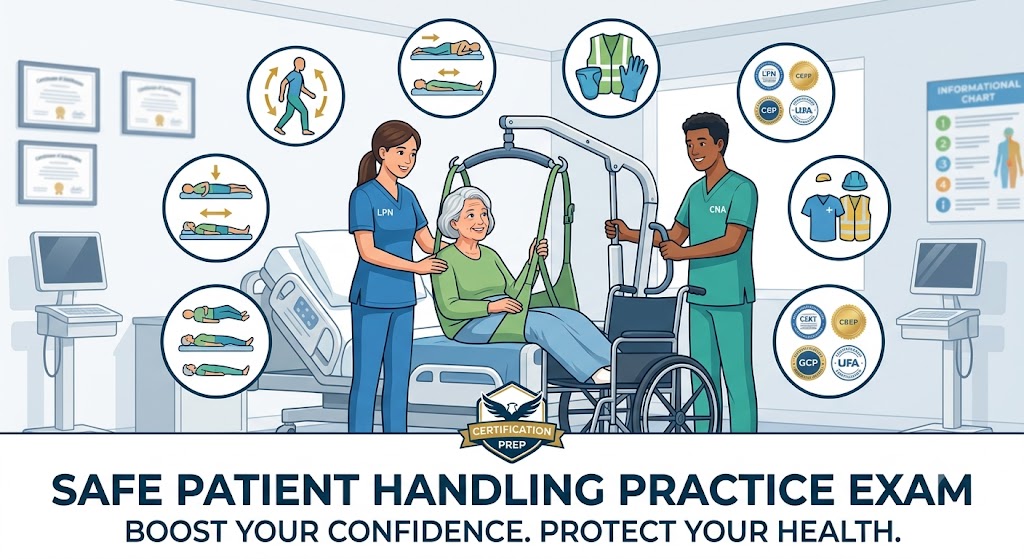
Additional Information
What the Course Entails and Exam Details
This examination covers the fundamental principles and practical application of ergonomics in healthcare. Topics include identifying risk factors for musculoskeletal disorders, conducting pre-transfer mobility assessments, and selecting the correct assistive technology for specific tasks. Candidates must understand the correct use of sliding boards, mechanical lifts, gait belts, and transfer sheets. Furthermore, the exam evaluates expertise in repositioning patients to prevent pressure injuries, and it reviews essential institutional policies regarding "no-lift" or minimal-manual-handling practices.
What to Expect in the Final Exam
The final practice exam is structured to closely mimic a formal certification assessment. It consists of 50 to 100 multiple-choice questions that require the critical application of clinical knowledge to real-world scenarios. Students may have to analyze illustrations to determine correct positioning or select the best device based on a patient’s unique mobility profile. The final exam typically has a time limit of 60 to 90 minutes. A passing score of 80% or higher is often required, ensuring that individuals can confidently apply safe handling techniques immediately upon entering the field.
How to Study and Exam Centers
Effective study strategies involve a blend of theoretical review and practical observation. Start by thoroughly reviewing the guidelines provided by safety organizations and healthcare institutions. Supplement your reading by utilizing detailed diagrams of ergonomic posture and reviewing video modules of correct lift usage. This online practice test is a crucial component of your preparation, helping you identify areas where you need additional study.
While this study guide is a digital resource, final, officially recognized competency exams are often administered through accredited nursing schools, clinical training facilities, or large professional testing organizations like Pearson VUE. Ensure you check with your local state licensing board or facility administrator to locate an authorized physical or proctored online testing center nearest to you.
Job Opportunities from the Course
Earning a certification in this crucial area drastically improves your employability across the medical field. Employers strongly prefer candidates who are proactively certified in safe handling practices, as it reduces workplace injury costs. This certification directly supports career paths as a:
Certified Nursing Assistant (CNA)
Licensed Practical Nurse (LPN/LVN)
Registered Nurse (RN)
Patient Care Technician (PCT)
Physical Therapist Assistant (PTA)
Home Health Aide
Occupational Therapy Assistant (COTA)
Healthcare Ergonomics Coordinator
Frequently Asked Questions
Reviews
5.0
Based on 0 reviews
Leave a Review
No reviews yet. Be the first to review!