
Safe Crisis Management (SCM) Practice Exam
$69.00
- Buy to unlock unlimited access to all Quiz questions.
- After purchase you can print a PDF of the whole quiz at any point. The PDF will contain the questions and the correct answers.
About this Exam
Safe Crisis Management (SCM) is a specialized training program designed to provide professionals with the essential skills to prevent, minimize, and manage behavioral crises. This certification is particularly crucial for individuals working in education, healthcare, human services, and youth care settings.
The SCM certification exam validates that staff can effectively utilize de-escalation techniques, perform accurate risk assessments, and, when necessary as a last resort, implement emergency safety interventions safely and legally. The goal is always to prioritize the safety, dignity, and well-being of all individuals involved.
Ready to test your knowledge?
Buy Now to Access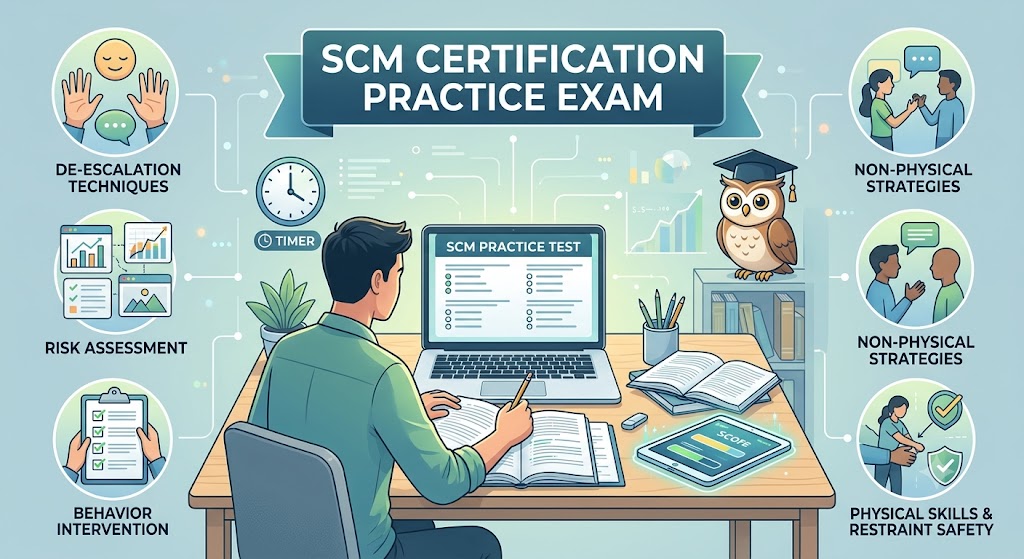
Additional Information
What the Course Entails and Exam Details
The SCM course provides a multi-layered approach to crisis intervention. While the exact syllabus can vary slightly by provider, core topics typically include:
Understanding the Cycle of Tension: Recognizing the sequential stages of escalating behavior and intervention points.
Verbal and Non-Verbal De-escalation: Utilizing communication skills, active listening, body language, and tone to diffuse tension.
Risk and Behavior Assessment: Evaluating the severity of behaviors and determining the appropriate level of response.
Trauma-Informed Care: Understanding how past experiences influence behavior and responding with empathy.
Preventative Strategies: Implementing proactive environmental and relationship-building techniques.
Emergency Safety Interventions: Learning professional, non-harmful physical restraint techniques and escape maneuvers, always taught in compliance with legal and ethical standards.
Post-Crisis Debriefing: Strategies for documenting incidents and facilitating recovery for both staff and individuals.
What to Expect in the Final Exam
The final SCM certification exam is a rigorous assessment consisting of two main parts: a written component and a practical, skills-based component.
Written Exam:
Format: Typically includes multiple-choice, true/false, or matching questions focusing on theory, protocols, and legal considerations.
Passing Score: Most programs require a high passing score, often around 80% to 85%, emphasizing the critical nature of the material.
Time Limit: You will usually have a set time limit, such as 60 to 90 minutes.
Practical Skills Assessment:
Format: You must demonstrate proficiency in specific non-physical and physical intervention techniques to an authorized instructor. This includes verbal de-escalation role-plays and the application of standardized, safe restraint holds (if included in your program level).
Passing Requirement: Demonstration must be accurate, safe, and adhere strictly to the taught protocols. Errors in physical technique that compromise safety are often grounds for automatic failure of this section.
How to Study and Exam Centers
Preparing effectively requires a mix of theoretical review and physical practice.
Study Strategies:
Thoroughly Review Course Manuals: Your primary resource is the official workbook or manual provided during training. Know it inside and out.
Participate Actively in Training: SCM is highly interactive. The knowledge gained during lectures and role-plays is essential.
Utilize Practice Scenarios: Practice applying de-escalation techniques in mock scenarios with colleagues.
Practice Physical Techniques (Safely): If your certification involves physical components, practice the holds and releases only as taught and never with people not part of the training. Focus on proper form and control.
Exam Centers and Access:
SCM training and testing are rarely available through public testing centers like Pearson VUE. Instead, they are accessed through:
Authorized Employers: Many organizations (schools, hospitals, residential facilities) provide the training and initial testing to their staff on-site using internal certified instructors.
Authorized Training Providers: Specific companies are licensed to provide SCM training (such as JBI International or similar regional bodies). You would register for a course through their official channels, and the exam is conducted as part of the scheduled training workshop. The written component may sometimes be facilitated via their private online portals.
Job Opportunities from the Course
An SCM certification is a powerful asset that makes you a preferred candidate in many fields. It demonstrates your commitment to safety and professional development.
Here is a list of job titles and career paths where this certification is highly valued:
Special Education Teacher
Behavioral Technician / Registered Behavior Technician (RBT)
Direct Support Professional (DSP)
Youth Counselor
Residential Care Worker
Psychiatric Aide / Nurse Aide
Healthcare Security Officer
Mental Health Technician
Juvenile Justice Officer / Correctional Officer
Social Worker (especially in child welfare or crisis response)
Paraprofessional / Teaching Assistant
Camp Counselor / After-School Program Coordinator
Frequently Asked Questions
Reviews
5.0
Based on 0 reviews
Leave a Review
No reviews yet. Be the first to review!