
SACE Stage 2 Personality Practice Exam
$69.00
- Buy to unlock unlimited access to all Quiz questions.
- After purchase you can print a PDF of the whole quiz at any point. The PDF will contain the questions and the correct answers.
About this Exam
The SACE Stage 2 Personality unit is a fundamental component of the South Australian Certificate of Education (SACE) Stage 2 Psychology course. It is designed for Year 12 students in South Australia who have an interest in human behavior, individual differences, and the scientific study of the mind. This unit examines the diverse theories that explain why individuals think, feel, and behave the way they do, providing students with critical insights into the structure of human personality. A SACE Stage 2 Personality Practice Exam is an invaluable resource for revision, allowing students to simulate a test environment, assess their comprehension, and pinpoint areas that require further dedication before the final SACE external assessment.
Ready to test your knowledge?
Buy Now to Access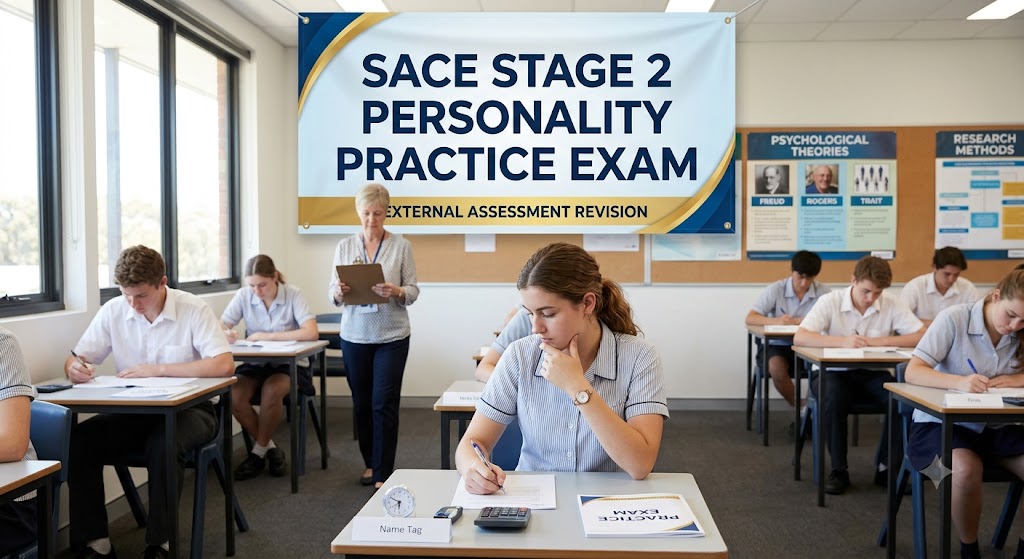
Additional Information
What the Course Entails and Exam Details
This unit deepens student knowledge of the major theoretical perspectives on personality, including psychodynamic, trait, humanistic, and social cognitive approaches. Core topics typically covered in the SACE Stage 2 Personality unit and its assessments include:
Key Personality Theories: In-depth analysis of Sigmund Freud's psychodynamic theory, Carl Rogers' and Abraham Maslow's humanistic theories, Gordon Allport's and the Big Five trait theories, and Albert Bandura's social cognitive perspective.
Personality Measurement and Assessment: Evaluation of various tools used to measure personality, such as self-report inventories (e.g., NEO-PI, MMPI), projective tests (e.g., Rorschach, TAT), and behavioral observations, including their strengths, limitations, and ethical considerations.
Research Methodologies in Personality: Understanding how psychologists use quantitative and qualitative research methods, including experimental designs, correlational studies, case studies, and naturalistic observation, to investigate personality.
Understanding Individual Differences: Exploring how factors like genetics, environment, culture, and life experiences contribute to the development of unique personality structures.
Applications to Real-World Scenarios: Applying personality theories and principles to explain human behavior in diverse contexts, such as education, workplace dynamics, relationships, and psychological health.
The SACE Stage 2 Psychology course involves both school-based assessment and a single external assessment, which is a final three-hour examination. The Personality unit itself is primarily assessed through a series of internal assessment tasks, which may include investigations, skills and application tasks, and a practice exam. While there is not a separate external exam just for personality, a student's performance in this unit can significantly influence their final SACE grade in Psychology. Therefore, a comprehensive practice exam for this unit is crucial to measure your progress and readiness for both internal and relevant sections of the final external examination.
What to Expect in the Final Exam
As the SACE Stage 2 Psychology final assessment is a broad examination, it does not consist solely of a "Personality" exam. However, multiple-choice questions, short-answer questions, and potentially an extended response in the final exam will draw directly from the concepts learned in the Personality unit. The final exam typically includes:
Format: A written, external examination consisting of multiple sections. Students can expect a mix of multiple-choice questions designed to test knowledge and recall of core concepts, and short-answer questions requiring explanations, data analysis, and the application of psychological principles. There is often an extended response or structured essay question requiring synthesis of information.
Time Limit: The total exam time is three hours, plus a brief reading time. Students must manage their time effectively across all units, including Personality. A unit practice exam would be structured to reflect a portion of this, typically 1.5 to 2 hours of focused assessment.
Marking and Passing Score: The external exam is externally marked by the SACE Board of South Australia. There is no predetermined "passing score" for this single exam to obtain SACE; instead, a student's final grade (from A+ to E-) is determined by combining the results of their internal and external assessments, with a C grade or better required in 20 credits of a Stage 2 subject for a student's SACE to be completed.
Specific Rules: Students are expected to adhere to all official SACE examination rules, including rules regarding academic integrity and the use of authorized materials, which are provided on the exam booklet.
A SACE Stage 2 Personality Practice Exam simulates this environment. Students should expect a structure with multi-choice and short-answer questions specifically focused on testing all topics from the personality unit outline.
How to Study and Exam Centers
Preparation is key to succeeding in any SACE assessment. Effective study strategies include:
Utilize Past SACE Exam Papers: Practicing with previous SACE Psychology exams, focusing on personality-related questions, is essential. Reviewing the provided solutions and examiner reports can help students understand what markers are looking for.
Engage with a SACE Stage 2 Personality Practice Exam: Using a simulated practice exam allows you to experience the types of questions and time constraints. This helps with time management and identifies knowledge gaps.
Organize Comprehensive Revision Notes: Create detailed notes that summarize each personality theory, define key terms, comparison points between different theories, and detail the methods and ethics of assessment. Use visual aids like mind maps and tables to link concepts.
Apply Theories to Real-World Examples: Practice applying psychological concepts to explain behaviors in case studies or everyday scenarios. This moves beyond simple recall and deepens understanding.
Collaborate with Peers: Group study sessions can be highly effective for discussing complex theories, testing each other, and gaining new perspectives.
Maintain Well-being: A balanced study routine that includes regular breaks, adequate sleep, and physical activity is crucial for cognitive function and reducing exam stress.
All final external SACE Stage 2 examinations are held in physical, designated locations. For the majority of students, this will be at their enrolled high school under external supervision on the dates and times specified in the SACE exam timetable. It is important to confirm your specific exam center and schedule with your school's SACE coordinator. These are not taken at external online portals or physical centers like Pearson VUE; they are formal, school-based assessments overseen by the SACE Board.
Job Opportunities from the Course
A strong foundation in SACE Stage 2 Psychology, and the understanding of individual differences from the Personality unit, provides a versatile set of skills highly valued in various career paths. While further tertiary education is often necessary to become a registered psychologist or specialist, this qualification serves as a critical first step towards careers such as:
Psychologist (Clinical, Forensic, Organisational, Educational)
Counselor
Social Worker
Human Resources Specialist
Recruitment Consultant
Market Research Analyst
Public Relations Officer
Youth Worker
Community Services Officer
Disability Support Worker
Teacher (Psychology or Special Education)
Criminologist
Correctional Services Officer
A deep understanding of personality is a considerable asset in any role that requires interaction, management, empathy, and a nuanced understanding of why people behave in the ways they do.
Frequently Asked Questions
Reviews
5.0
Based on 0 reviews
Leave a Review
No reviews yet. Be the first to review!