
SACAA Practice Test & Exam Prep | South Africa
$69.00
- Buy to unlock unlimited access to all Quiz questions.
- After purchase you can print a PDF of the whole quiz at any point. The PDF will contain the questions and the correct answers.
About this Exam
The South African Civil Aviation Authority (SACAA) licensing exams are the gateway for anyone aspiring to a career in the dynamic world of aviation in South Africa. This comprehensive set of examinations is designed to ensure that every aviation professional possesses the rigorous theoretical knowledge required to operate safely and effectively within the complex national and international airspace. Whether your dream is to captain a commercial airliner, manage aircraft maintenance, or guide flights safely from a control tower, mastering these exams is your essential first step.
These exams are tailored for a broad spectrum of candidates, including student pilots (aiming for Private, Commercial, or Airline Transport Pilot Licenses), prospective cabin crew members, aircraft maintenance engineers, flight instructors, and air traffic controllers.
Ready to test your knowledge?
Buy Now to Access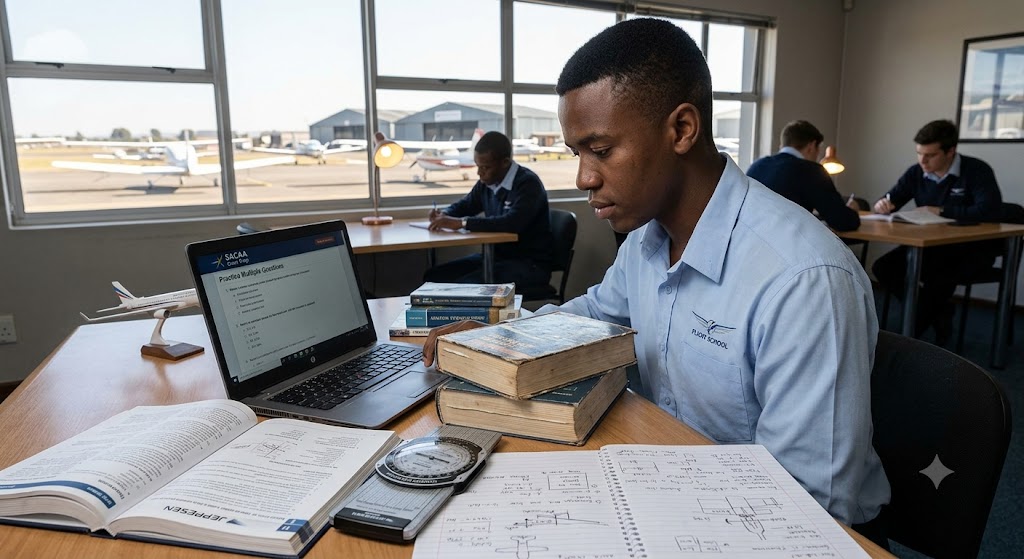
Additional Information
What the Course Entails and Exam Details
It is crucial to understand that "the SACAA Exam" is not a single test; it is a series of specialized examinations that correspond to the specific license you are pursuing. Each license has its own unique, detailed syllabus as mandated by the South African Civil Aviation Regulations (CARS) and Technical Standards (SA-CATS). The depth and breadth of topics increase with the level of license complexity.
For aspiring pilots, the theoretical knowledge required covers multiple, independent subjects. While a Private Pilot License (PPL) might cover basic meteorology and navigation, an Airline Transport Pilot License (ATPL) includes highly advanced studies. The core subjects generally include:
Air Law and Operational Procedures
Aircraft General Knowledge (including systems, structures, and powerplants)
Flight Performance and Planning
Human Performance and Limitations
Meteorology
Navigation (General Navigation and Radio Navigation)
Principles of Flight
VFR and IFR Communications
For other roles, such as Cabin Crew or Air Traffic Control, the syllabus is focused on their specialized duties, covering safety regulations, emergency procedures, aviation medicine, air traffic management principles, and standard operating procedures unique to their function.
What to Expect in the Final Exam
Prepare yourself for a modern, computer-based testing environment. While specific details can vary by subject and license type, almost all SACAA theoretical examinations follow a strict standardized format:
Format: Multiple-choice questions. You will be presented with a question and multiple potential answers, of which only one is correct.
Scoring: A very high standard of knowledge is required, with a typical passing score of 75?ross most subjects.
Time Limits: Each exam subject has a predetermined time limit, which can range from 30 minutes for a short specialized subject to 2 hours or more for a comprehensive navigation or flight planning paper. Efficient time management is crucial.
Rules: The exams are invigilated, meaning you are supervised. Personal items like mobile phones and study notes are strictly prohibited in the examination room. You will generally only be allowed to bring a government-issued photo ID (such as a passport or South African ID).
How to Study and Exam Centers
Success in SACAA exams requires a dedicated, structured approach. You are not just learning to pass a test; you are gaining knowledge to ensure safety in a high-stakes environment. Here are actionable strategies:
How to Study Effectively:
Master the Official Syllabus: Start by downloading and thoroughly reviewing the current SA-CATS for your specific license. This is your definitive roadmap for what can be tested.
Use accredited Training Materials: Enroll with an accredited Aviation Training Organization (ATO) or ground school. They provide structured courses and materials that align directly with the SACAA requirements.
Leverage Practice Exam Question Banks: This is perhaps the single most effective tool. Numerous online platforms and flight schools offer extensive databases of past SACAA exam questions. Using these to simulate a timed exam environment helps you understand the phrasing, manage your time, and identify knowledge gaps.
Form Study Groups: Collaborating with fellow students can help clarify complex concepts and keep you motivated.
Where to Take the Exam (Exam Centers):
You do not take the final official exam at your school. You must register to write your official exams through authorized centers.
SACAA Accredited ATOs: Many large flight schools and aviation academies across South Africa are accredited to host official SACAA computer-based examinations. You will need to check with your flight school for a list of these centers.
Online Testing Portals: SACAA utilizes specific online testing portals that can be accessed from authorized, secure computer terminals within these accredited centers. Ensure your chosen center uses the official, up-to-date testing system.
Job Opportunities from the Course
A SACAA qualification is highly respected internationally and unlocks numerous prestigious and rewarding career paths within the flourishing South African aviation sector. The jobs listed below are directly unlocked upon successful completion of the relevant license and theoretical exams.
Commercial Pilot: Flying for charter companies, cargo carriers, or domestic airlines.
Airline Transport Pilot (ATPL): Captaining or first officer on multi-crew airline operations.
Cabin Crew Member: Ensuring passenger safety and comfort on airline flights.
Air Traffic Controller (ATC): Guiding aircraft safely through domestic and international airspace.
Aircraft Maintenance Engineer (AME): Maintaining and certifying the airworthiness of aircraft systems and structures.
Private Pilot: Operating aircraft for personal use or business.
Flight Instructor: Training the next generation of aviation professionals.
Aviation Safety Inspector: Working with regulatory bodies like SACAA to enforce safety standards.
Frequently Asked Questions
Reviews
5.0
Based on 0 reviews
Leave a Review
No reviews yet. Be the first to review!