
SACA Pneumatic Troubleshooting (C-304) Practice Test
$69.00
- Buy to unlock unlimited access to all Quiz questions.
- After purchase you can print a PDF of the whole quiz at any point. The PDF will contain the questions and the correct answers.
About this Exam
The SACA Pneumatic Troubleshooting (C-304) certification is a vital micro-credential for professionals seeking to prove advanced expertise in maintaining and repairing complex fluid power systems. SACA, the Smart Automation Certification Alliance, is at the forefront of setting global standards for Industry 4.0 technical skills, and this specific module focuses intensely on logical diagnosis and remedy. It is designed for multi-skilled maintenance technicians, automation specialists, field service engineers, and any professional working with automated production lines where pneumatic systems are a core component. Earning this certification validates your ability to go beyond basic operations and apply a structured, efficient troubleshooting methodology to minimize downtime in a modern, connected manufacturing environment.
Ready to test your knowledge?
Buy Now to Access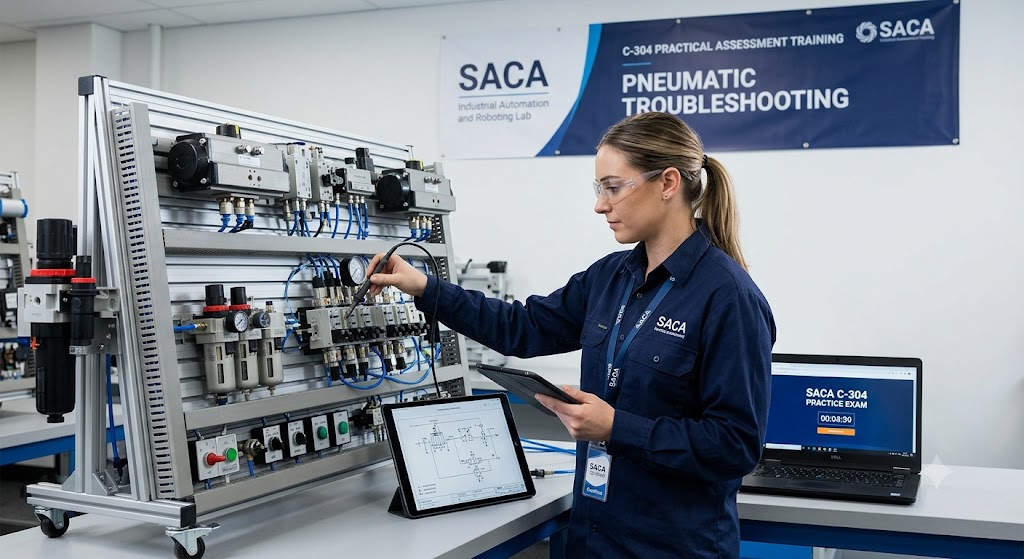
Additional Information
What the Course Entails and Exam Details
The C-304 course and subsequent exam are comprehensive, moving past fundamental pneumatic principles to focus on system-level performance, logical fault isolation, and root cause analysis. The content typically builds on lower-level SACA pneumatic certifications (like C-104 or C-209). Key competencies covered include the deep interpretation of advanced pneumatic schematics and documentation, precise pressure and flow measurement to identify system inefficiencies, and the systematic isolation of logical, component, and control-level faults. Technicians learn to diagnose issues within directional control valves (including pilot-operated and solenoid types), various actuators, air preparation systems (FRLs), and vacuum generators. The course and exam are structured to ensure you can analyze complex interactions within an automated system and implement effective, safe, and lasting repairs.
What to Expect in the Final Exam
The SACA Pneumatic Troubleshooting (C-304) Final Exam is a demanding assessment designed to test practical analytical skills. The SACA Specialist level certifications generally consist of two parts: a hands-on practical assessment administered at an authorized training center and a written, online knowledge assessment. This online, written exam, for which you are practicing, is computer-based and highly scenario-driven. Rather than simple recall, expect questions that present schematics, operational data, or specific equipment symptoms and ask you to determine the next logical step in the troubleshooting sequence, identify the faulty component, or explain the root cause. The exam is typically proctored, and a passing score is required—often in the range of 70% to 80%—to demonstrate your readiness for the field. You should check the specific details with your SACA member institution.
How to Study and Exam Centers
Effective preparation for the C-304 exam requires a blend of deep study and hands-on experience. First, obtain the official SACA study guide or syllabus from an authorized SACA Member Institution. Spend significant time analyzing complex pneumatic circuits and practicing schematic reading every day. The single most important study method is to gain actual, hands-on troubleshooting experience with industrial pneumatic equipment, applying logical procedures to isolate induced faults. Supplement this with taking comprehensive practice exams, like the one this page promotes, which are designed to mimic the complexity and format of the final test. To take the official exam, you must register through a SACA Member Institution. These institutions are typically technical colleges, universities, and industrial training organizations. They are the authorized centers for both the written online test and the crucial hands-on practical assessment. Proctored remote testing may also be an option for some candidates.
Job Opportunities from the Course
A SACA Certified Pneumatic Troubleshooting (C-304) Specialist is highly valued across diverse manufacturing and industrial sectors. This certification can significantly boost your employability for roles such as:
Industrial Maintenance Technician: Troubleshoot and repair complex pneumatic, mechanical, and electrical systems on automated production lines to keep operations running at peak efficiency.
Automation Technician: Integrate and maintain advanced pneumatic controls within smart automation systems, using sophisticated diagnostics to resolve logical and component-level issues.
Pneumatics Specialist: Act as the subject matter expert for all pneumatic equipment within a facility, leading predictive maintenance programs and solving the most challenging repair scenarios.
Field Service Engineer: Travel to customer sites to install, commission, and repair large-scale pneumatic and fluid power systems, providing expert technical support.
Mechatronics Technician: Work at the intersection of mechanics, electronics, and control systems, requiring a strong capability to diagnose complex issues across multiple disciplines, with a focus on fluid power.
Production Mechanic: Focus specifically on repairing and maintaining the mechanical and pneumatic aspects of manufacturing machinery in a fast-paced environment.
Plant Electrician with Fluid Power: Leverage your certification to support industrial systems where electric and pneumatic components work together in advanced control sequences.
Frequently Asked Questions
Reviews
5.0
Based on 0 reviews
Leave a Review
No reviews yet. Be the first to review!