
SACA 201 Silver Practice Exam
$69.00
- Buy to unlock unlimited access to all Quiz questions.
- After purchase you can print a PDF of the whole quiz at any point. The PDF will contain the questions and the correct answers.
About this Exam
The Smart Automation Certification Alliance (SACA) 201 Silver certification, formally known as Electrical Systems 1, is a foundational micro-credential for individuals starting their journey in the world of Industry 4.0 and advanced manufacturing. This certification validates essential knowledge in electrical principles, safety, and component operations, serving as a critical building block for more complex automation systems. It is ideally suited for entry-level automation and mechatronics technicians, industrial maintenance personnel, production operators, and students in technical programs who need to demonstrate competence in basic electrical concepts before advancing to specialized certifications.
Ready to test your knowledge?
Buy Now to Access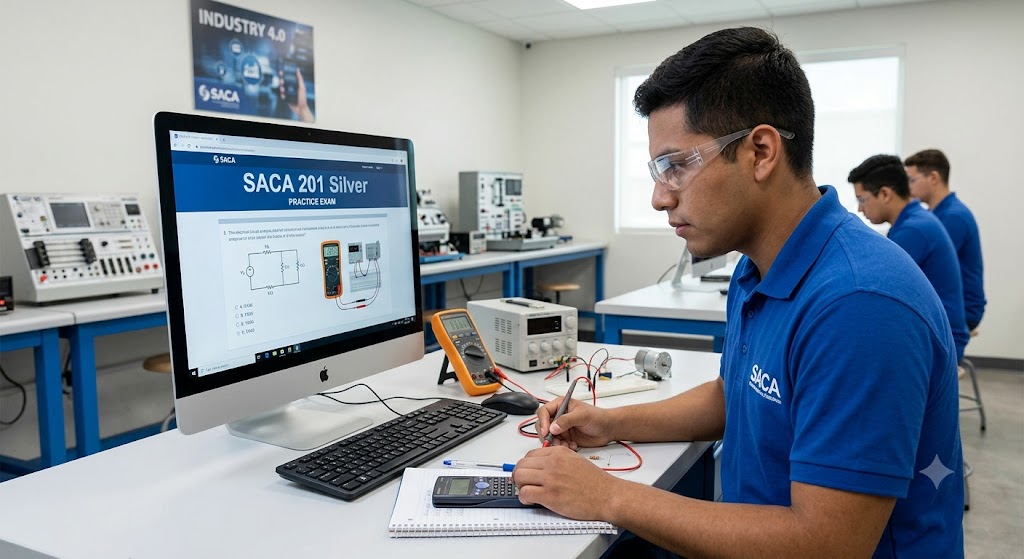
Additional Information
What the Course Entails and Exam Details
The SACA 201 Silver exam assesses understanding across a comprehensive spectrum of fundamental electrical topics, aligning closely with typical 'Electrical Systems 1' courses. Core technical areas include, but are not limited to:
Electrical Safety: Adherence to safety protocols, lockout/tagout (LOTO), personal protective equipment (PPE), and safe work practices around energized and de-energized circuits.
Fundamental Laws: Application and understanding of Ohm’s Law and Kirchhoff’s Laws to calculate voltage, current, resistance, and power in DC and basic AC circuits.
Circuit Analysis: Interpretation and analysis of series, parallel, and combination electrical circuits.
Schematic Interpretation: Ability to read and understand basic electrical schematics, symbols, and ladder logic diagrams.
Components and Operations: Identifying and describing the function and testing of resistors, capacitors, inductors, transformers, DC motors, solenoids, relays, fuses, circuit breakers, and manual switches.
Measurement: Using a digital multimeter (DMM) and clamp-on ammeter to measure voltage, current, resistance, and continuity, and interpreting the readings within a practical context.
What to Expect in the Final Exam
It is essential to understand that the "Silver" designation from SACA specifically identifies this as a written, knowledge-based assessment delivered entirely online. Unlike a SACA "Gold" certification, which requires a separate, hands-on performance assessment on approved equipment, the Silver level solely evaluates your conceptual understanding and ability to apply knowledge. The exam is administered through the SACA online testing portal and primarily consists of multiple-choice and complex problem-solving questions. The time limit and precise passing score can vary depending on the specific curriculum and testing center, but typical exams range from 60 to 90 minutes with a passing threshold often between 70% and 80%. Consult with your instructor or test administrator for the exact requirements of your session.
How to Study and Exam Centers
Effective preparation is key to success on the SACA 201 Silver exam. Actionable study strategies include:
Utilize SACA-Aligned Curriculum: Leverage the e-learning courses provided by your authorized testing center. Many SACA partners use curriculum from companies like Amatrol, which is designed to match the certification's skill standards.
Hands-on Practice is Key: Although the Silver exam is online, you cannot learn electrical systems through theory alone. Use basic circuit building kits, breadboards, power supplies, and, most importantly, a multimeter to build, measure, and troubleshoot the circuits and components covered in the syllabus. Connect concepts to physical components.
Study the Standards: Review the specific SACA skill standards for C-201 Electrical Systems 1 to understand exactly what is required for each task and topic.
Practice with Formulas: Become fluent in using all variations of Ohm's Law and Kirchhoff's Laws and practice calculating circuit parameters.
SACA examinations and hands-on testing are performed at SACA Authorized Testing Centers. These centers are typically educational institutions like community colleges, technical schools, and high schools, as well as companies that have met SACA’s requirements and have certified instructors. There are hundreds of these centers across the United States. While the Silver exam is taken online, you must do so through a computer that is proctored or authorized by one of these centers. You cannot register or take the exam independently outside of an authorized organization.
Job Opportunities from the Course
A SACA 201 Silver certification in Electrical Systems 1 provides a clear signal to employers that you possess verified, foundational electrical skills required in modern industry. While it is often combined with other SACA micro-credentials to form a complete Specialist or Professional certification (e.g., Automation Systems Specialist), this standalone credential opens doors to entry-level positions such as:
Electrical Technician: Installing, maintaining, and repairing basic electrical systems and equipment.
Industrial Maintenance Technician (Entry Level): Performing preventive maintenance and basic troubleshooting on factory floor machinery.
Mechatronics Technician (Entry Level): Working with integrated mechanical and electrical systems.
Automation Operator: Operating and providing basic support for automated production lines.
Production Associate: Working in roles that require an understanding of safe electrical system interaction.
Field Service Technician (Entry Level): Providing basic on-site support for equipment manufacturers.
Frequently Asked Questions
Reviews
5.0
Based on 0 reviews
Leave a Review
No reviews yet. Be the first to review!