
Sabalauski Air Assault School Phase 2 Practice Test
$69.00
- Buy to unlock unlimited access to all Quiz questions.
- After purchase you can print a PDF of the whole quiz at any point. The PDF will contain the questions and the correct answers.
About this Exam
The Sabalauski Air Assault School (TSAAS) Phase 2 Practice Test is a crucial resource for U.S. Army soldiers and authorized personnel preparing for one of the most physically and mentally challenging weeks of their military careers.
This comprehensive exam is designed to validate a candidate's mastery of Phase 2 of the Air Assault Course, focusing intensely on sling load operations. Successfully navigating this phase is mandatory for any Soldier seeking to earn the coveted Air Assault Badge and become a qualified asset in air assault, air supply, and rapid deployment operations.
Ready to test your knowledge?
Buy Now to Access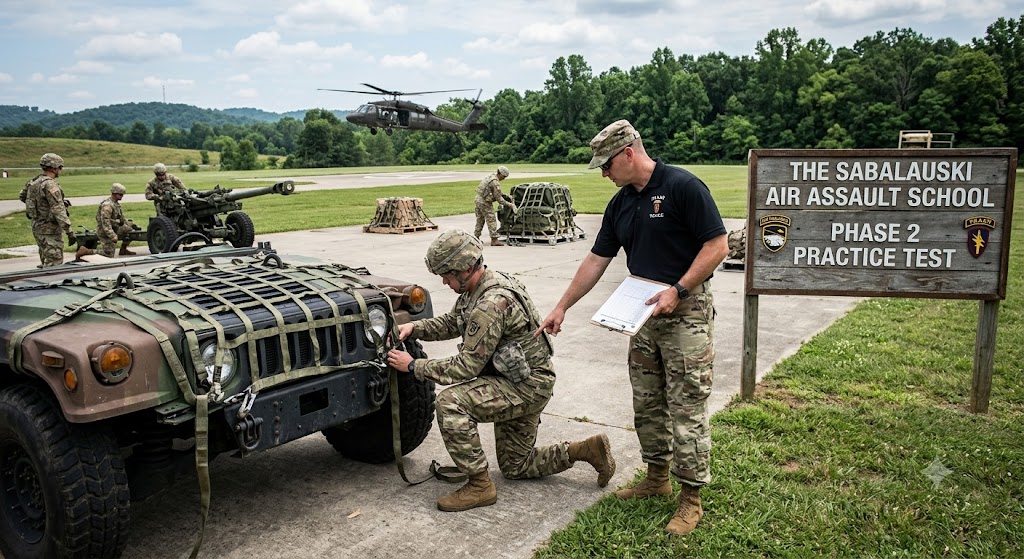
Additional Information
WHAT THE COURSE ENTAILS AND EXAM DETAILS
Phase 2 of the Air Assault School transitions students from pure physical conditioning and rappelling into the technical and logistical demands of helicopter external load operations.
The course entails deep immersion into the principles, equipment, and sequencing required for safe sling load operations. Key topics covered include:
Comprehensive knowledge of all standard sling load equipment, including A-22 cargo bags, various nets, and specialized hooks.
The exact specifications and capabilities of primary Air Assault aircraft, such as the UH-60 Black Hawk, CH-47 Chinook, and LUH-72 Lakota.
The precise, seven-step inspection sequence that must be flawlessly executed for every sling load.
The proper preparation, rigging, and inspection of common military loads, such as the M119 Howitzer, HMMWV, and standardized cargo trailers.
Rigorous safety protocols for both hook-up teams and the inspection personnel on the ground.
WHAT TO EXPECT IN THE FINAL EXAM
The Phase 2 Final Exam is a combination of written and practical evaluations, with the practical phase being the critical filter for graduation.
Written Examination: Students must first pass a multiple-choice written exam. This test challenges their understanding of aircraft capabilities, sling load equipment specifications, and the regulatory requirements found in relevant Army publications. A minimum passing score of 70% is required.
Practical Examination (The Gauntlet): The practical exam is the core of Phase 2 and is often the leading cause of attrition. Students must inspect four distinct sling loads: a HMMWV, an M119 Howitzer, a cargo net, and an A-22 cargo bag.
During this hands-on test, students have exactly two minutes per load to inspect the rigging for deficiency. To pass, a candidate must successfully identify a specific number of critical deficiencies (often three) pre-installed on the loads, while failing to identify fewer than the maximum allowed 'missed deficiencies.' The order and speed of the seven-step inspection sequence must be perfect. Failing to execute the sequence in order or within the time limit results in automatic failure of that load and potentially the entire phase.
HOW TO STUDY AND EXAM CENTERS
Preparation for Phase 2 demands a strategic blend of intense memorization and physical practice.
Study Strategies:
Sequence, Sequence, Sequence: The key to success is reflexive recall of the inspection sequence. Recite it daily, visualized with a physical object, until it is automatic.
Master the Nomenclature: Know every piece of equipment by its exact military name and specifications.
Physical Mock-ups: Utilize the 'Sling Load Pit' if available on your installation. If not, improvise with ropes, nets, and physical mock-ups of loads to simulate inspection under time pressure.
Practice with Deficiencies: Use visual aids and study guides that show incorrect rigging. Challenge yourself to spot flaws rather than just verifying correct setup.
Work with a Partner: Practice timing each other through inspections. A study partner is essential for mocking up loads and calling out deficiencies.
Exam Centers: The Air Assault Course and its associated exams are conducted primarily at:
The Sabalauski Air Assault School (TSAAS), located at Fort Campbell, Kentucky.
The Army National Guard Warrior Training Center (WTC), which often hosts courses at various installations throughout the United States.
Occasionally via Mobile Training Teams (MTTs) dispatched to units globally.
You must be in an active military status and hold a current physical to attend. Check with your unit training NCO or S-3 for slots and prerequisite physical training standards.
JOB OPPORTUNITIES FROM THE COURSE
Graduating from Air Assault School and earning the badge does not guarantee a new Job Series (MOS), but it unlocks critical roles and enhances career progression within the combat arms and logistical fields. Common opportunities include:
Air Assault Instructor (at TSAAS or WTC)
Sling Load Inspector (in any unit conducting air mobility operations)
Sling Load Hook-up Team NCOIC
Pathway to Pathfinder School
Assignment to specialized specialized units (e.g., 101st Airborne Division)
Enhanced selection for specialized operations and specialized leadership roles
Complete this course, and you become the invaluable "Air Assault Qualified" professional that command teams rely on during complex air insertion and rapid resupply missions. Get practicing today!
Frequently Asked Questions
Reviews
5.0
Based on 0 reviews
Leave a Review
No reviews yet. Be the first to review!