
Sabalauski Air Assault School Phase 1 Practice Test
$69.00
- Buy to unlock unlimited access to all Quiz questions.
- After purchase you can print a PDF of the whole quiz at any point. The PDF will contain the questions and the correct answers.
About this Exam
Welcome to the ultimate resource for preparing for the rigorous Sabalauski Air Assault School (TSAAS) Phase 1! The Sabalauski Air Assault School, located at Fort Campbell, Kentucky, is one of the toughest, most respected training institutions in the United States Army. Phase 1 is the foundational and arguably the most demanding phase, specifically designed to introduce soldiers to the physical, academic, and practical standards required for air assault operations. This initial phase sets the stage for everything to follow, and successfully navigating it is essential to proceed to Phases 2 and 3 and ultimately earn your Air Assault wings. This practice exam and comprehensive guide are designed for all motivated Army service members, whether active duty, National Guard, or Reserve, who aim to master the fundamental skills, knowledge, and physical demands necessary to conquer TSAAS Phase 1. Passing this phase proves your commitment, physical stamina, and attention to detail.
Ready to test your knowledge?
Buy Now to Access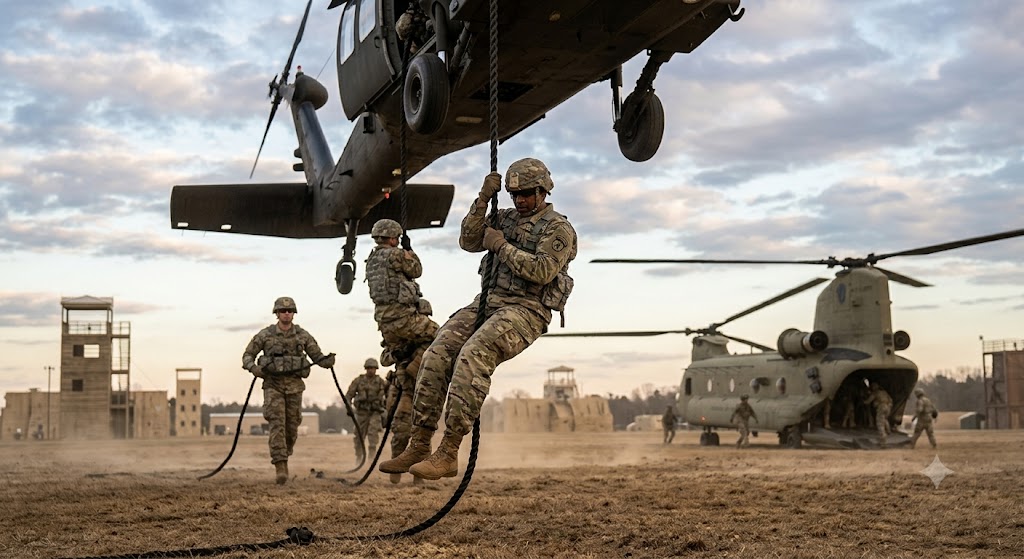
Additional Information
What the Course Entails and Exam Details
TSAAS Phase 1 involves a intense curriculum that blend physically grueling challenges with fundamental academic knowledge and critical practical application.
Physical Demands: Phase 1 immediately tests and builds physical stamina. Soldiers must conquer difficult obstacle courses, demanding ability group runs (3 to 4 miles, increasing distance), a 6-mile ruck march, and consistent, challenging physical training (PT) sessions from Day Zero. Your body will be pushed to the limit from the very start.
Academic & Practical Topics: The academic portion of Phase 1 covers core air assault principles. Key subjects you must master include:
Aircraft Safety and Orientation: Understanding different rotary-wing aircraft (UH-60, CH-47, AH-64, etc.), safety procedures, and capabilities.
Aero-Medical Evacuation (MEDEVAC): Procedures, equipment, and protocols for helicopter-based medical assistance.
Pathfinder Operations: The basics of selecting, marking, and controlling helicopter landing and pickup zones.
Combat Assault Operations: Principles and execution of multi-service air assault missions, and simulated combat assault drills.
Sling Load Procedures (Fundamentals): Initial introduction to the equipment and requirements for attaching external loads to helicopters, though the extensive testing is in Phase 2.
Rappelling Fundamentals: Basic safety and seat tying procedures, preparing you for the rappelling phase (Phase 3).
Hand-and-Arm Signals: Precise communication techniques used in helicopter operations.
The assessments within Phase 1 directly evaluate these components:
Written Exam: You must pass a written test, typically with 50 multiple-choice questions on these foundational academic topics, requiring a minimum score of 70%.
Hands-On Assessment: Evaluation on 10 crucial hand-and-arm signals, needing correct execution of at least 7 to proceed.
Physical Benchmarks: Satisfactorily completing ability runs, the 6-mile ruck march in full gear, and successfully negotiating obstacle courses.
What to Expect in the Final Exam
While not a single "final" exam, the multiple assessments within TSAAS Phase 1 serve as cumulative tests for both academic and physical knowledge. Mastering each assessment is critical to prevent a potential drop from the course and ensure your progression.
Academic Assessment: You will take a written exam containing multiple-choice and possibly true/false questions. Be prepared for:
Topic Coverage: All materials covered in the instructional periods up to the test date, including aircraft data, safety regulations, Pathfinder basics, and hand-and-arm signal knowledge.
Format: Typically administered with paper or a basic electronic system under supervision, focusing on factual recall and simple application of procedures.
Passing Score: You must achieve at least 70% to continue in the course. One retest per exam might be offered but shouldn't be relied upon.
Time Limit: Expect a strict time limit, requiring efficient information processing and decision-making.
Practical Assessment: Your ability to execute hand-and-arm signals will be directly observed.
Format: A hands-on evaluation where an instructor will prompt you with specific signals to perform.
Score: You must perfectly execute 7 out of the 10 requested signals.
Attention to Detail: The standard is exacting; slight deviations or incorrect timing can result in a failing grade.
Physical Benchmarks: Your performance on ability runs and the ruck march is continuously evaluated and is a requirement to stay enrolled. A full equipment inspection (packing list) with a lay-out as worn is also a critical part of Phase 1 and occurs on Day Zero/Day One. Missing items are a failure and an immediate drop from the course.
How to Study and Exam Centers
Preparation for TSAAS Phase 1 is a dual effort of physical training and academic study.
How to Study:
Master the Packing List: This is non-negotiable. Memorize every single item, its specific description, condition requirements, and how to lay it out. Practice doing the lay-out repeatedly. Failure here can happen before the course truly begins.
Physical Training: Your physical condition must be exceptional. Prioritize:
Running: Consistent ability to run at a good pace for 3-4 miles. Incorporate faster paces.
Ruck Marches: Train with a significant load (at least 25-35 lbs) and increase distances towards 6 miles at a pace suitable for the course (typically 15 min/mile).
Bodyweight & Functional Strength: Perform exercises that build upper body and core strength, essential for obstacle courses and handling heavy gear (push-ups, pull-ups, sit-ups, climbing, etc.). Practice with the specific gear you will wear in the course.
Regulatory & Manual Study: Familiarize yourself with relevant Army Regulations (e.g., regarding uniforms, physical standards), and especially the specific TSAAS Phase 1 materials or student handbooks if available. Search for officially recognized study guides or manuals online (e.g., on official Army sites). While this practice exam is a tool, use authentic documents for deepest knowledge.
Practice Signals & Tying Seats: If possible, obtain the specific hand-and-arm signals and practice them until they are muscle memory. If you can access ropes and a replica tower/surface, practice the Swiss seat rappelling tie (though rappelling itself is later, seat tying is in Phase 3, learning it early can't hurt and builds fundamental rope confidence).
Mental Toughness: The entire course is designed to stress and push you. Cultivate a positive, resilient mindset. Study with peers if possible for accountability and practice.
Exam Centers: The actual TSAAS Phase 1 is conducted at authorized United States Army locations:
Fort Campbell, Kentucky: The primary home of the Sabalauski Air Assault School. Most Soldiers attend here.
Mobile Training Teams (MTTs): Authorized teams may conduct the school at various Army installations globally, based on operational need and selection.
Specific Authorized Military Schools/Locations: Certain major Army training sites (like specific installations or regional centers for National Guard/Reserve) may be approved to run the course.
You do not take this exam online, through Pearson VUE, or via a typical certification portal. Attendance is through selection within your military chain of command and requires your command's sponsorship. The physical location of your school is the only place you will take these assessments.
Job Opportunities from the Course
Earning your Air Assault wings is not just a badge; it is a critical qualification that significantly enhances your professionalism, versatility, and desirability within the United States Army.
Successful completion of the Sabalauski Air Assault School opens diverse career paths and strengthens a soldier's profile:
Air Assault Qualified Soldier: The immediate qualification on your record, identifying you as capable of participating and planning for air assault operations. This badge is a sign of extreme dedication and makes you a visible leader in your unit.
Airborne, Light Infantry, and Specialized Positions: Many light infantry, airborne, and other combat-related roles prioritize or require Air Assault qualification for advanced duties, leadership positions, and specialized mission profiles.
Increased Promotion Potential: Having specialized, high-demand qualifications like Air Assault makes a service member stand out for promotion considerations, especially in competitive fields.
Leadership and Training Roles: Experienced Air Assault qualified personnel are often sought after for roles as trainers, mentors, and eventually, instructors at the school itself. It demonstrates your ability to teach complex skills and lead in high-stress environments.
Participation in Complex Operations: Units look for Air Assault-qualified individuals to spearhead missions involving helicopter insertion, resupply, and dynamic ground assault strategies. You become a crucial asset in tactical planning and execution.
Rappel Master & Sling Load Inspector Qualifications: While requiring additional courses, completing Air Assault school is a prerequisite for becoming a certified Rappel Master (leading and safetying rappelling operations) and a Sling Load Inspector (responsible for the safe rigging and inspection of external loads).
Frequently Asked Questions
Reviews
5.0
Based on 0 reviews
Leave a Review
No reviews yet. Be the first to review!