
SA Airside Vehicle Operator's Permit (AVOP) Practice Test
$69.00
- Buy to unlock unlimited access to all Quiz questions.
- After purchase you can print a PDF of the whole quiz at any point. The PDF will contain the questions and the correct answers.
About this Exam
The South African (SA) Airside Vehicle Operator's Permit (AVOP) is a critical certification required for any personnel whose duties involve operating motorized vehicles on the airside of an airport.
This area includes taxiways, runways, aprons, and other restricted zones where aircraft operate.
The primary goal of the AVOP program is to ensure the safety of ground operations, passenger movements, and aircraft by guaranteeing that all vehicle operators possess the necessary knowledge, skills, and understanding of airport geography, rules, and procedures.
This permit is essential for a wide range of airport staff, from ground handling crews and maintenance technicians to security personnel and fueling agents.
Ready to test your knowledge?
Buy Now to Access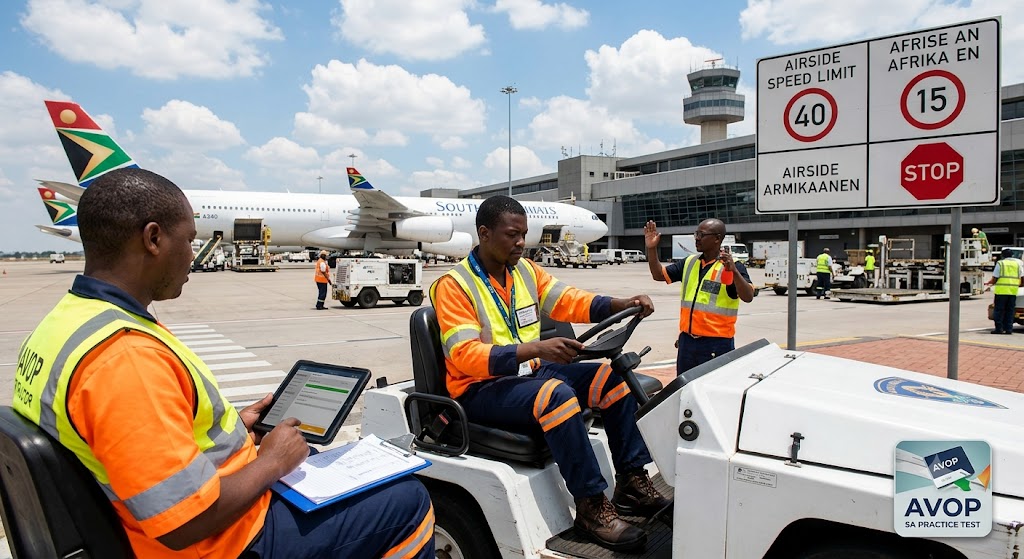
Additional Information
What the Course Entails and Exam Details
The path to obtaining your SA AVOP involves comprehensive training designed to equip you for safe airside operation.
The training course typically covers the following core topics:
Airport Geography and Layout: Detailed knowledge of runway and taxiway designations, holding points, aprons, and critical areas.
Airside Rules and Regulations: Understanding mandatory safety protocols, speed limits, right-of-way rules, and standard operating procedures (SOPs).
Signage, Markings, and Lighting: Interpretation of all visual aids used to guide ground traffic and prevent runway incursions.
Radio Communication Procedures: Correct terminology, phraseology, and protocols for communicating effectively with Air Traffic Control (ATC) or the Airport Control Centre.
Aircraft Marshalling and Hand Signals: Understanding visual communication between aircraft and ground crews.
Emergency Procedures: Protocol for responding to accidents, spillages, and other emergency situations on the airside.
What to Expect in the Final Exam
The final AVOP assessment is usually composed of two distinct parts: a theoretical exam and a practical evaluation.
Theoretical Exam
Format: Typically administered as a multiple-choice exam, either on a computer or paper-based.
Passing Score: Requirements vary by airport, but a high passing score (often 80-90%) is standard to demonstrate proficiency.
Time Limits: A set time limit (e.g., 60-90 minutes) is usually provided.
Content: Questions focus on regulations, signage, geography, and safety protocols covered in the training.
Practical Evaluation
Format: A hands-on driving assessment conducted on the airside with a certified examiner.
Requirements: Candidates must demonstrate their ability to operate a vehicle safely, obey all signs and markings, communicate correctly on the radio (if applicable), and navigate complex airport environments without error.
Rules: Any major safety violation (e.g., runway incursion) during the practical test results in an immediate failure.
How to Study and Exam Centers
Preparation is paramount for success in the AVOP exam.
Here are actionable study strategies:
Official Manuals: Thoroughly study the latest revision of the specific airport's Airside Driver Permit Manual or relevant regulatory documents (e.g., those issued by the South African Civil Aviation Authority or the specific airport operator).
Mock Tests: Utilize practice tests, such as this SA AVOP Practice Exam, to familiarize yourself with the question format, identify weak areas, and build confidence.
Airport Familiarization: Spend time studying the airport map, understanding key terminology, and observing ground traffic flow when possible.
Radio Practice: If radio communication is required, practice the standard NATO alphabet and phraseology.
Exam Centers and Booking
The theoretical and practical exams are usually managed directly by the specific airport operator (e.g., ACSA - Airports Company South Africa) or accredited ground handling agencies authorized to conduct training.
Candidates must typically book their exams through their employer’s training department or the specific airport’s AVOP office after successfully completing the required training course.
Job Opportunities from the Course
Earning an SA AVOP opens numerous career paths within the dynamic aviation environment.
This permit is either a requirement or a significant advantage for the following roles:
Ground Handling Agent: Includes roles like tug operator (towing aircraft), baggage handler, and passenger service driver.
Airport Maintenance Technician: For staff maintaining airside infrastructure, lighting, and specialized equipment.
Refueling Operator: Personnel responsible for fueling aircraft safely on the apron.
Airside Security Officer: For security patrols operating vehicles within the airside boundary.
Cargo and Ramp Handler: Focused on loading and unloading cargo, and operating specialized ramp vehicles.
Fire and Rescue Personnel: Essential for operating emergency vehicles on the airfield.
Frequently Asked Questions
Reviews
5.0
Based on 0 reviews
Leave a Review
No reviews yet. Be the first to review!