
Rules and Regulations for Child Care Facilities (RNRF) DCF Practice Test
$69.00
- Buy to unlock unlimited access to all Quiz questions.
- After purchase you can print a PDF of the whole quiz at any point. The PDF will contain the questions and the correct answers.
About this Exam
The DCF Rules and Regulations for Child Care Facilities (RNRF) certification is a vital competency exam, particularly relevant to child care professionals in the state of Florida. Administered by the Department of Children and Families (DCF), this certification ensures that individuals working in child care settings have a robust understanding of the laws, rules, and standards that govern their facilities.
Designed for aspiring and current child care personnel, including facility directors, teachers, assistants, and family day care home operators, the RNRF certification is often a mandatory component of introductory training. It aims to promote a safe, healthy, and developmentally appropriate environment for children by standardizing knowledge among providers. A practice test serves as an essential stepping stone, helping you prepare effectively to demonstrate your mastery of these critical regulations.
Ready to test your knowledge?
Buy Now to Access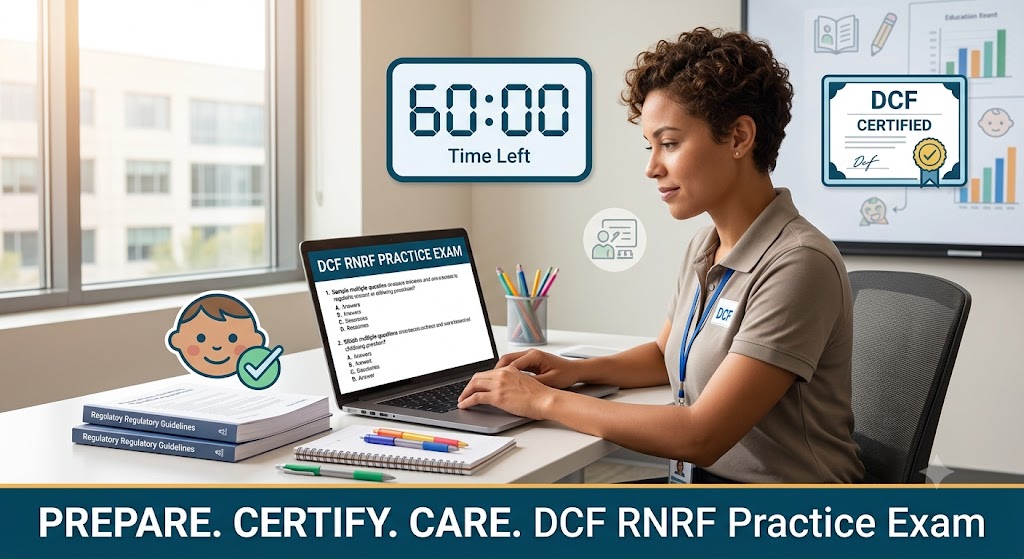
Additional Information
What the Course Entails and Exam Details
The comprehensive coursework leading to the RNRF DCF exam covers a range of essential topics crucial for professional child care operation:
Florida Child Care Laws and Rules: Detailed exploration of Chapter 402, Florida Statutes, and Chapter 65C-22, Florida Administrative Code.
Health and Safety Standards: Guidelines for handwashing, sanitation, diapering, illness management, and maintaining a healthy environment.
Nutrition and Food Service: Specifics on meal patterns, safe food handling, and children’s dietary needs.
Staff-to-Child Ratios and Supervision: Mandatory requirements for the number of staff members per group of children based on age and guidelines for active supervision.
Facility Requirements: Standards for indoor and outdoor space, equipment safety, and first aid provisions.
Child Growth and Development: Basic milestones, observational skills, and screening procedures to track child progress.
Recognizing and Reporting Child Abuse: Understanding your role as a mandated reporter and identifying signs of abuse and neglect.
Administrative and Professional Standards: Regulations on record-keeping, personnel training, ethics, and legal responsibilities.
The RNRF DCF is a foundational training module, and passage is typically part of a mandatory 40- or 45-hour introductory training track for child care professionals. The exact course structure may vary by local training providers and state guidelines, but always centers on these core competency areas.
What to Expect in the Final Exam
The final competency exam is designed to test your understanding and application of the DCF Rules and Regulations. You can generally expect:
Format: The exam typically consists of multiple-choice questions, which may include scenario-based items where you must apply your knowledge to specific child care situations.
Time Limit: The exam is timed, requiring efficient time management and a good grasp of the material to complete within the allocated period.
Passing Score: While specific passing score requirements can vary, it is generally essential to achieve a score (often 70% or higher) that demonstrates competency in all key areas. Always check the official DCF portal or your training coordinator for the exact current passing standard.
Proctored Environment: The exam is usually proctored at approved testing locations or through authorized testing software.
Rules: Standard testing protocols apply, including showing valid photo identification, no use of unauthorized aids, and adhering to strict anti-cheating policies.
Retakes: If you do not pass on your first attempt, retake options are available, typically requiring re-registration and a new testing fee.
How to Study and Exam Centers
Preparation is key to succeeding on the DCF RNRF exam. Here are some actionable study strategies:
Utilize Official DCF Resources: Access online modules, study guides, and all training materials available through the state’s official child care training portal or local training providers.
Take Practice Tests: Actively engage with a high-quality [DCF RNRF Practice Test]. Repeatedly testing yourself identifies knowledge gaps and familiarizes you with the exam format.
Join Study Groups: Discussing concepts with peers or colleagues can reinforce your understanding and provide different perspectives on scenario-based questions.
Focus on Key Terms and Ratios: Pay special attention to precise definitions and mandatory staff-to-child ratios for various age groups, as these are frequently tested.
Create Flashcards: Use flashcards for key regulations, numbers (like capacity and ratios), and essential vocabulary.
Review Scenario Examples: Practice applying rules to real-world child care scenarios.
Exam Centers: For Florida, the final exam is typically proctored and taken at approved physical testing centers or authorized training schools located throughout the state. You can schedule your exam through your official student account on the DCF child care training portal. Note: For national credentials like the CDA, different organizations (such as Pearson VUE) may be involved in testing, but the standard DCF competency exams like RNRF are primarily managed through the DCF’s own approved network.
Job Opportunities from the Course
Earning your RNRF DCF certification is a significant achievement that opens the door to numerous fulfilling job opportunities in the early childhood education and care sector. Successful completion is a prerequisite for many career paths and enhances your qualifications for diverse positions, including:
Child Care Facility Director
Child Care Facility Teacher
Child Care Facility Teacher Assistant
Family Day Care Home Provider
Large Family Child Care Home Operator
School-Age Child Care Staff
Specialized Mildly Ill Child Care Provider
Early Childhood Education Specialist (potentially with further education/credentials)
Paths towards broader roles in Child Welfare and Social Services
Frequently Asked Questions
Reviews
5.0
Based on 0 reviews
Leave a Review
No reviews yet. Be the first to review!