
Router and Routing Basics Practice Test
$69.00
- Buy to unlock unlimited access to all Quiz questions.
- After purchase you can print a PDF of the whole quiz at any point. The PDF will contain the questions and the correct answers.
About this Exam
The Router and Routing Basics credential is a fundamental certification designed to validate essential knowledge of networking fundamentals and practical routing concepts.
This exam targets aspiring network professionals, IT support technicians, and students who wish to solidify their understanding of how routers connect networks and direct data traffic efficiently. It serves as an entry point for those aiming for more advanced certifications like CCNA or Network+.
It covers critical concepts including router hardware, operating systems, configuration basics, and common routing protocols, ensuring candidates possess a functional grasp of modern network architecture and operations.
Ready to test your knowledge?
Buy Now to Access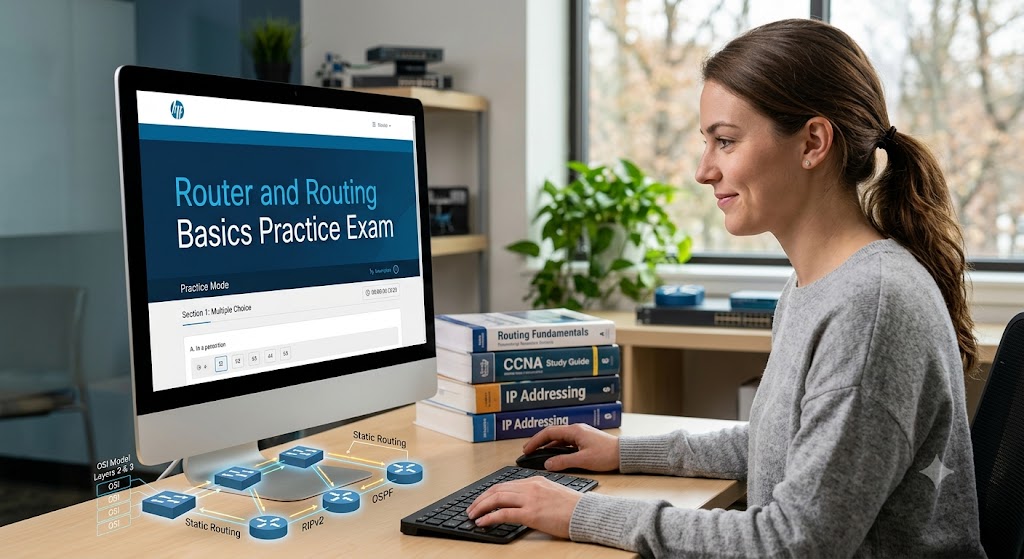
Additional Information
What the Course Entails and Exam Details
The syllabus for the Router and Routing Basics exam typically includes a range of foundational topics that prepare you for real-world networking tasks. Candidates will be tested on their understanding of the OSI model and how routers function at Layers 2 and 3.
Expect to see detailed questions on initial router setup and basic CLI (Command Line Interface) configuration. This includes navigating different command modes and understanding essential setup commands. You will explore IP addressing fundamentals, including IPv4 and basic IPv6, subnetting techniques, and dynamic vs. static IP addressing.
A major portion of the course focuses on the core principles of routing. This includes distinguishing between static routing and dynamic routing protocols like RIPv2, OSPF, or EIGRP. You will cover how routers build routing tables and make packet forwarding decisions. Additionally, fundamental concepts like Network Address Translation (NAT) and Access Control Lists (ACLs) are also covered to understand basic security and address conservation.
What to Expect in the Final Exam
The final certification exam is a structured assessment designed to measure both theoretical understanding and practical application skills. Candidates should prepare for a professional proctored environment.
The exam usually consists of 50 to 70 questions and has a time limit varying between 60 and 90 minutes. You can expect a variety of question formats. These commonly include standard multiple-choice (single correct answer) and multiple-response questions.
In addition to these formats, the exam often utilizes drag-and-drop questions to test sequence knowledge or categorization, as well as scenario-based simulation tasks. These simulations assess your ability to apply concepts in practical situations, such as configuring basic interfaces or resolving simple connectivity issues. While passing scores vary by specific vendor, they typically fall around 700 to 800 out of 1000 points. The exact requirements are detailed by the issuing body.
How to Study and Exam Centers
Effectively preparing for this exam requires a combination of self-study, practical application, and strategic review. Start by reviewing the official exam objectives or study guide provided by the certification body. Building a solid conceptual foundation is key.
Complement your theoretical knowledge with hands-on practice. Utilize simulation tools like Cisco Packet Tracer, GNS3, or virtual machine labs to practice common router configuration commands and simple network setups. Building small virtual networks is invaluable for reinforcing core routing principles and subnetting skills.
Taking reputable practice tests multiple times is crucial for identifying knowledge gaps and becoming familiar with the question formats and time constraints. Focus heavily on mastering subnetting and basic CLI configuration until they are second nature. Online forums, community study groups, and YouTube tutorials are also excellent resources for clarification and shared experiences.
Once you are confident in your preparation, register for the official exam through recognized channels. Most standard IT certifications use specialized testing centers such as Pearson VUE or Prometric. You can typically find authorized testing locations globally. Alternatively, many vendors offer remote online proctoring options, allowing you to take the exam from your own home under specific supervision conditions. Check the official certification website for detailed instructions and authorized testing center finders in your region.
Job Opportunities from the Course
Achieving the Router and Routing Basics certification can open various career paths in the IT and networking fields. It is an ideal starting point that provides tangible proof of your foundational networking skills to employers.
Below is a list of common job titles and career opportunities that this certification can unlock or help you secure:
Help Desk Technician: Provides initial technical support for hardware, software, and basic network issues.
Junior Network Administrator: Assists with the ongoing maintenance and optimization of an organization's network infrastructure.
IT Support Specialist: Troubleshoots and resolves diverse technical problems for internal and external clients.
Network Operations Center (NOC) Technician: Monitors and manages network stability and performance within a large environment.
Technical Support Representative: Offers expert support for specific networking products or services.
Field Service Technician: Installs, maintains, and repairs network equipment directly at client sites.
Data Center Technician: Manages physical and virtual network components within a data center environment.
Frequently Asked Questions
Reviews
5.0
Based on 0 reviews
Leave a Review
No reviews yet. Be the first to review!