
Round Robin First Responder and Command Leadership Practice Test
$69.00
- Buy to unlock unlimited access to all Quiz questions.
- After purchase you can print a PDF of the whole quiz at any point. The PDF will contain the questions and the correct answers.
About this Exam
The Round Robin First Responder and Command Leadership certification is a cutting-edge program designed to validate the critical leadership, decision-making, and coordination skills essential for those managing complex incidents. This certification is specifically tailored for experienced first responders, incident commanders, and individuals aspiring to leadership roles within emergency services, public safety, and disaster management. It ensures that leaders can effectively direct resources, maintain situational awareness, and make high-stakes decisions under pressure in a dynamic, rapidly evolving environment.
Ready to test your knowledge?
Buy Now to Access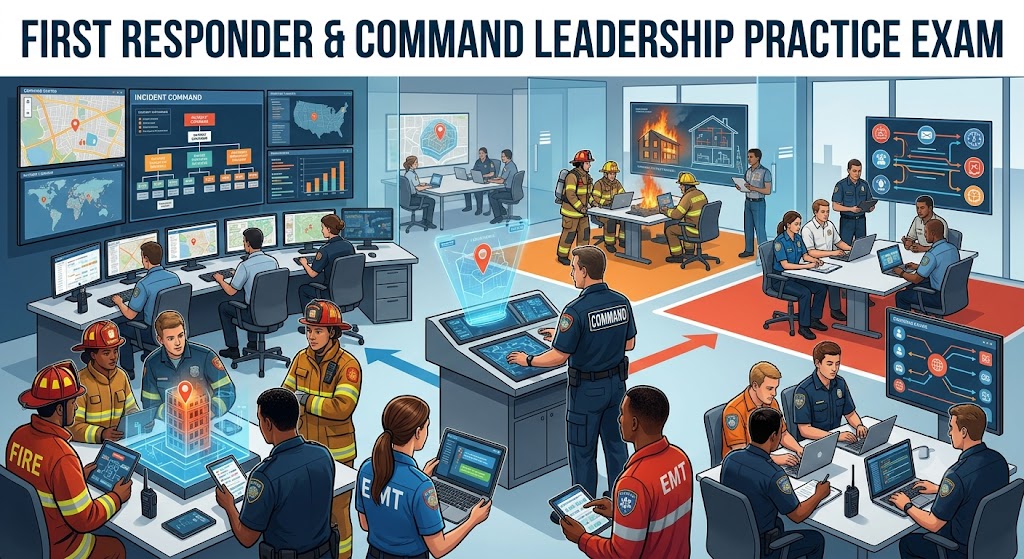
Additional Information
What the Course Entails and Exam Details
This practice exam covers the essential skills and knowledge required for effective leadership in emergency services. While not a formal course itself, it simulates the types of scenarios candidates encounter in command leadership assessments. The content focuses on key domains, including: incident command systems (ICS), strategic and tactical planning, public safety ethics, dynamic risk assessment, multi-agency coordination, and personnel management under stress. Specific skill assessments include critical incident size-up, resource allocation, formulating strategic objectives, delegation of authority, and effective operational communication. The practice exam helps candidates synthesize these complex concepts into cohesive leadership actions.
What to Expect in the Final Exam
The final leadership and command assessments are generally practical, multi-phased evaluations rather than purely theoretical tests. Candidates can anticipate a series of structured, dynamic scenarios, often organized in a round robin format where they assume different leadership or support roles in quick succession (e.g., Incident Commander, Operations Chief, Planning Section Chief, Safety Officer). Evaluations often take place over one or several days. The format focuses on practical performance, leadership presence, verbal command skills, and real-time decision-making abilities, rather than multiple-choice questions alone. Scoring is typically based on rubrics that assess adherence to protocols, the quality of decisions, and overall command effectiveness. Time limits are strictly enforced for each scenario.
How to Study and Exam Centers
Studying for a command leadership exam requires dedicated, hands-on practice. Review existing incident management material (like ICS and NIMS) and doctrine. Beyond self-study, practical simulation is key. Engage in tabletop exercises or full-scale drills with a team to practice leading under pressure. This practice exam is an excellent initial tool for knowledge application and self-assessment. To participate in actual command assessments, candidates should typically contact their local fire or police departments, regional public safety academies, or state emergency management offices. These organizations are responsible for administering or authorizing these specialized evaluations. Some comprehensive training programs may offer physical testing centers, while others may utilize field scenarios in controlled training environments. Look for programs with authorized testing credentials in your specific field.
Job Opportunities from the Course
Successfully demonstrating command leadership through certifications and assessments opens doors to numerous promotional opportunities in the emergency services sector. This certification is often necessary for those aiming for positions of high responsibility and strategic leadership. Specific job titles that benefit from this specialized training include:
Fire Captain
Battalion Chief
Fire Chief or Deputy Chief
Police Sergeant
Police Lieutenant
Police Captain or Commander
Emergency Medical Services (EMS) Supervisor
Public Safety Director
Emergency Management Coordinator
Incident Commander
Field Training Officer (FTO) with Leadership Emphasis
Search and Rescue Coordinator
Frequently Asked Questions
Reviews
5.0
Based on 0 reviews
Leave a Review
No reviews yet. Be the first to review!