
Rosh Women's Health Practice Exam
$69.00
- Buy to unlock unlimited access to all Quiz questions.
- After purchase you can print a PDF of the whole quiz at any point. The PDF will contain the questions and the correct answers.
About this Exam
The Rosh Women’s Health Practice Exam is a comprehensive preparatory tool designed for healthcare professionals specializing in obstetrics and gynecology (OB/GYN).
This practice exam is specifically engineered for Nurse Practitioners (NPs), Physician Assistants (PAs), and certified nurse-midwives (CNMs) pursuing their Women’s Health Care Nurse Practitioner (WHNP-BC) certification, or other specialized women's health credentials.
It provides a realistic simulation of the rigorous licensing exams required for advanced practice in this field.
Ready to test your knowledge?
Buy Now to Access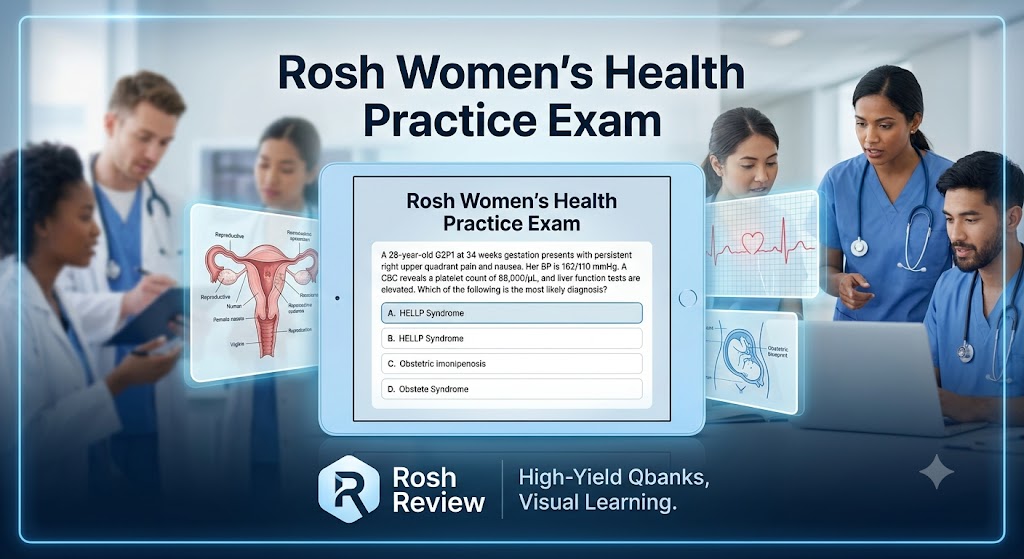
Additional Information
What the Course Entails and Exam Details
This preparatory course covers the entire spectrum of women's reproductive health. The core topics are meticulously structured to align with official certification blueprints, ensuring comprehensive coverage. The syllabus and practice content focus heavily on the following domain areas:
Gynecologic Care: Management of common and complex gynecological conditions, preventative screenings (like Pap tests and mammograms), and contraceptive counseling.
Obstetric Care: Comprehensive prenatal care, management of normal and high-risk pregnancies, labor and delivery principles, and postpartum management.
Primary Care for Women: Diagnosis and management of common primary care conditions in female patients, including endocrine disorders and cardiovascular health.
Menopause and Gerontology: Addressing the unique physiological and psychological changes in aging women.
Professional Issues: Legal, ethical, and professional considerations inherent in women's health practice.
What to Expect in the Final Exam
While the exact structure depends on the specific certifying body (such as the NCC for WHNP-BC), the final exam is generally a robust, computer-based test (CBT).
You should expect the final examination to follow a multiple-choice format, often with hundreds of questions. Candidates must answer approximately 150 to 175 scored questions within a strictly timed window, usually around 3 to 4 hours.
Passing scores are determined based on a scaled score model, which can vary, but generally corresponds to correctly answering a significant majority of the questions. Specific details regarding weighted domains are usually provided by the governing certification board.
How to Study and Exam Centers
Preparation for the actual licensing exam demands rigorous, dedicated study. Actionable strategies include utilizing a variety of study methods and materials, with a primary focus on systematic review and practice:
Active Recall and Spaced Repetition: Use specialized Qbank resources (like Rosh Review) and digital flashcards to repeatedly test yourself on core concepts over a prolonged period. This strengthens long-term memory.
Simulated Practice: Dedicate time to taking full-length, timed practice exams. This is crucial for building stamina, mastering time management, and acclimating to the CBT environment.
Regarding exam centers, the actual certification exams (e.g., NCC exams) are administered through standardized, secure testing centers such as Pearson VUE. Candidates must register through the official certification board's portal and select a physical testing location or, where permitted, opt for a secure live remote proctoring option.
Job Opportunities from the Course
Earning a specialized women’s health certification significantly expands career horizons and increases earning potential. Successful completion and licensure unlock diverse advanced practice roles across various settings. Key job opportunities and career paths include:
Women's Health Nurse Practitioner (WHNP-BC) in private OB/GYN clinics, community health centers, and hospital outpatient departments.
Certified Nurse-Midwife (CNM) providing comprehensive maternal and newborn care.
Advanced Practice Provider in specialized fertility and reproductive endocrinology clinics.
Clinical Leader or Coordinator in breast health and gynecologic oncology units.
Faculty member or clinical instructor in nursing or physician assistant programs.
Frequently Asked Questions
Reviews
5.0
Based on 0 reviews
Leave a Review
No reviews yet. Be the first to review!