
Rosdahl’s Basic Nursing Practice Test
$69.00
- Buy to unlock unlimited access to all Quiz questions.
- After purchase you can print a PDF of the whole quiz at any point. The PDF will contain the questions and the correct answers.
About this Exam
Welcome to your essential resource for conquering the material found in Rosdahl’s Basic Nursing. This comprehensive practice resource is designed to guide aspiring Practical Nursing (PN) and Vocational Nursing (VN) students through the foundational concepts and practical skills detailed in the gold standard textbook by Rosdahl & Kowalski. Mastering this content is a crucial milestone for anyone enrolled in a PN/VN program, as these foundational principles are central to successful nursing practice and passing the NCLEX-PN licensure exam.
Ready to test your knowledge?
Buy Now to Access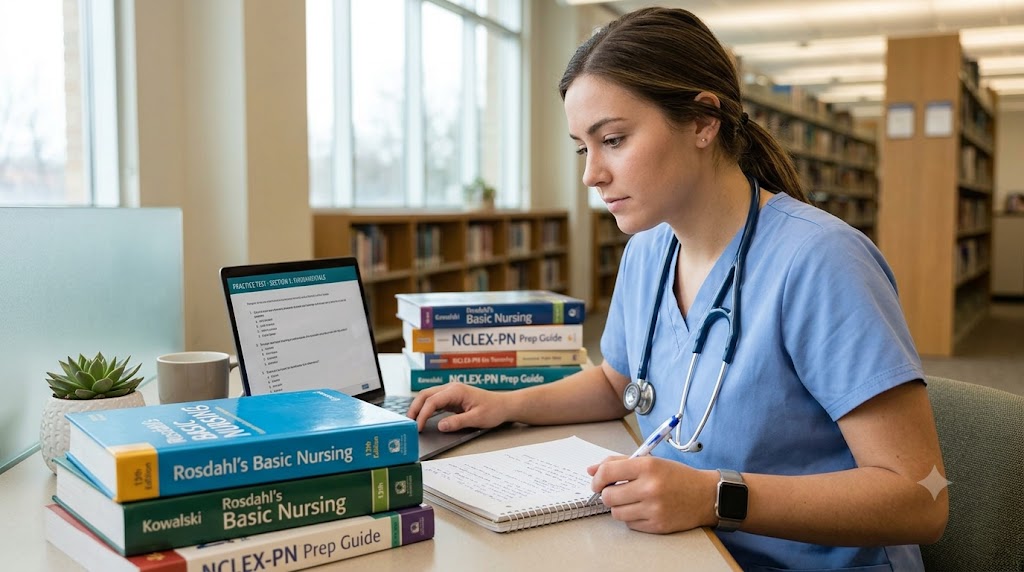
Additional Information
What the Course Entails and Exam Details
Rosdahl's Basic Nursing provides a thorough introduction to the core topics necessary for practical nursing. This study resource reflects that content, structured into key domains:
Nursing Fundamentals: Essential skills, client hygiene, infection control, wound care, and medication administration.
Anatomy and Physiology Review: A foundational understanding of body systems required for recognizing normal and abnormal findings.
Nutrition: Principles of diet therapy and nutritional care throughout the lifespan.
Pharmacology for Practical Nursing: Basic principles, medication classification, dosage calculations, and safe administration.
Medical-Surgical Nursing: Systems-based nursing care for adult clients, including respiratory, cardiovascular, endocrine, and musculoskeletal disorders.
Gerontological Nursing: Addressing the unique needs and challenges of the aging population.
Maternal-Child Health: Care of the dynamic family unit, including prenatal care, labor and delivery, postpartum, and pediatric nursing fundamentals.
Mental Health Concepts: Basic principles of psychiatric care and communication in nursing.
Successful completion of a Practical/Vocational Nursing program using this textbook material qualifies you to take the national licensure examination.
What to Expect in the Final Exam
While studying Rosdahl's material is fundamental to your coursework, the final, external licensure exam you are preparing for is the NCLEX-PN (National Council Licensure Examination for Practical Nurses). Here is what you must expect:
Exam Format: The NCLEX-PN is a computerized adaptive test (CAT). This means the difficulty of the questions adjusts based on your performance, providing a highly precise measure of competence.
Question Types: While primarily four-option, single-response multiple-choice questions, the exam includes alternate format questions. These may include select-all-that-apply (SATA), fill-in-the-blank calculation, drag-and-drop ordering, and hot-spot items.
Number of Questions: The exam length varies between 85 and 205 questions. The test ends once the CAT system determines with 95?rtainty whether your ability level is above or below the passing standard, or when the maximum number of questions or time limit is reached.
Time Limit: You will have a maximum of 5 hours to complete the examination, which includes a short orientation and two optional breaks.
Passing Score: There is no numerical passing score like "70%" or "80%." Passing is determined by demonstrating knowledge and skills significantly above a predetermined national standard for entry-level practice.
Rules: Extensive security measures are in place at Pearson VUE testing centers. No personal belongings or unauthorized materials are allowed.
How to Study and Exam Centers
Effective Study Strategies for Rosdahl and the NCLEX-PN
Systematic Chapter Review: Read each chapter of Rosdahl's Basic Nursing carefully. Take detailed notes, focusing on rationale rather than just facts.
Utilize Textbook Resources: Complete every critical thinking exercise, study guide question, and practice query provided in the textbook or its associated digital resources (e.g., PrepU, CoursePoint+).
Practice with NCLEX-Style Questions: Incorporate external practice questions daily. Focus heavily on mastering SATA questions, which are common on the NCLEX-PN and assess higher-level clinical judgment.
Identify Weak Areas: Use the results of your practice quizzes to identify content domains where you consistently struggle. Dedicate extra study time to those specific systems or concepts.
Group Study: Review complex rationales with peers. Explaining a concept aloud reinforces your own understanding.
Locating Exam Centers
The formal "final exam" (the NCLEX-PN) is administered exclusively at Pearson VUE professional testing centers. To schedule your exam:
Register with your State Board of Nursing: You must first apply for licensure through your state's Board of Nursing (BON) or Regulatory Body.
Wait for the Authorization to Test (ATT): Once the BON approves your application, you will receive an ATT letter.
Schedule at Pearson VUE: With your ATT, you can register and select a time and a specific Pearson VUE location near you using their online portal. Centers are located in major cities throughout the United States, Canada, and select international locations.
Job Opportunities from the Course
Passing the NCLEX-PN after studying this essential content opens doors to numerous rewarding career paths in the healthcare field. Common job titles and opportunities for Licensed Practical Nurses (LPNs) or Licensed Vocational Nurses (LVNs) include:
Licensed Practical Nurse (LPN) in Skilled Nursing Facilities
Licensed Vocational Nurse (LVN) in Long-Term Care (LTC)
Staff Nurse in Hospital Units (e.g., Med-Surg, Rehabilitation)
Clinic Nurse in Physician Offices and Outpatient Centers
Home Health Nurse
Hospice Nurse Assistant
Corrections Nurse (working in state/federal facilities)
Community Health Nurse Assistant
Dialysis LPN/LVN
Occupational Health Nurse Assistant
Private Duty Nurse
Nurse Educator (LPN/LVN level)
Frequently Asked Questions
Reviews
5.0
Based on 0 reviews
Leave a Review
No reviews yet. Be the first to review!