
Roadway Worker Protection (RWP) Program Guide (PG) Practice Test
$69.00
- Buy to unlock unlimited access to all Quiz questions.
- After purchase you can print a PDF of the whole quiz at any point. The PDF will contain the questions and the correct answers.
About this Exam
The Roadway Worker Protection (RWP) Program Guide (PG) qualification is the single most critical safety requirement for anyone whose duties involve working on or near active railroad tracks. Mandated by the Federal Railroad Administration (FRA) under 49 CFR Part 214, this program is designed to prevent accidents and save lives by ensuring every roadway worker understands how to stay safe in a dynamic and hazardous environment. This practice guide and its corresponding practice test are tailored specifically for railroad employees, contractors, engineering staff, signal maintainers, and track maintenance crews who must obtain or renew their RWP certification. Our guide provides a comprehensive overview of the essential information you will be tested on, helping you build confidence and ensure compliance.
Ready to test your knowledge?
Buy Now to Access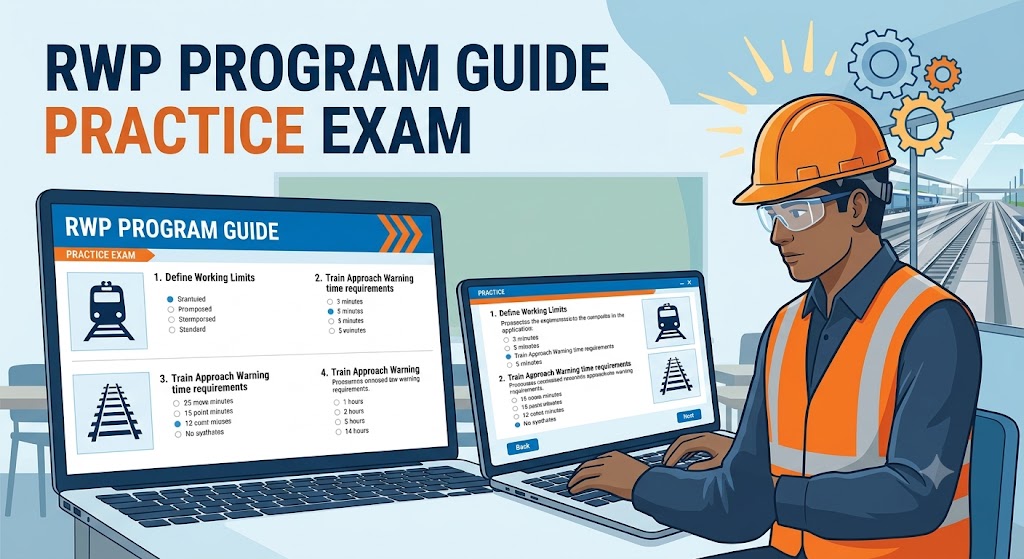
Additional Information
What the Course Entails and Exam Details
The RWP course provides a deep dive into the complex web of safety protocols required when operating in the "fouling space"—the area where you can be struck by a train. The core of the program focuses on On-Track Safety (OTS) procedures. You will learn the critical definitions of "working limits," "exclusive track occupancy," and the roles and responsibilities of key personnel, such as the Employee In Charge (EIC), Lookout, and Flagman. The curriculum covers the proper methods for conducting job briefings, establishing communication with train dispatchers, and recognizing the "Train Approach Warning" system, which mandates a minimum of 15 seconds of warning before a train arrives. Mastering these concepts is essential to pass the practice exam and the official certification test.
What to Expect in the Final Exam
The final RWP qualification exam is designed to be rigorous, ensuring that only those with a full grasp of safety regulations are permitted to work on the tracks. It is typically a closed-book, proctored exam. The structure is a mix of multiple-choice and true/false questions, focusing on applying regulations to real-world scenarios. A typical practice or final exam might consist of 50 to 100 questions. The required passing score is very high, often set between 80% and 100%, depending on the specific railroad or training program; some critical safety sections may require a perfect 100% score. You should expect a timed assessment, usually requiring completion within 60 to 90 minutes.
How to Study and Exam Centers
Effective preparation for the RWP exam requires active study and practical application of the rules. Your primary resource is the standard RWP manual and FRA 49 CFR Part 214. Break down complex regulations into smaller, manageable sections and create flashcards for key definitions and procedures. The most effective strategy is to take mock practice tests that simulate the official exam environment, such as the one described in this guide. Practice scenario-based questions with colleagues or supervisors, focusing on job briefings and defining working limits. RWP certification is usually managed directly by your employer (Class I, regional, or commuter railroads), specialized railroad contractors, or authorized training schools. Exams are held at dedicated internal training facilities or specific authorized physical testing centers.
Job Opportunities from the Course
Successfully obtaining your RWP qualification is the essential key to unlocked career paths within the railroad industry. Almost every physical role on the right-of-way requires this certification. Here is a list of specific job titles and career paths that require RWP compliance:
Track Maintainer / Track Laborer
Signal Maintainer / Signal Technician
Employee In Charge (EIC) / Roadway Worker In Charge (RWIC)
Lookout / Watchman
Bridge and Building (B&B) Mechanic / Carpenter
Equipment Operator (on track)
Catenary/Electric Traction Technician
Communications Technician
Track Inspector
Railroad Safety Officer / Compliance Inspector
Engineering Project Manager (field roles)
Frequently Asked Questions
Reviews
5.0
Based on 0 reviews
Leave a Review
No reviews yet. Be the first to review!