
Road Safety Professional Level 1 (RSP1) Practice Test
$69.00
- Buy to unlock unlimited access to all Quiz questions.
- After purchase you can print a PDF of the whole quiz at any point. The PDF will contain the questions and the correct answers.
About this Exam
The Road Safety Professional Level 1 (RSP1) certification is a landmark credential, validating the fundamental knowledge required by anyone dedicating their career to making roadways safer. This professional-level certification is designed for engineers, planners, data analysts, law enforcement officers, and safety advocates who aim to achieve a standardized foundation in evidence-based safety principles. It signals a recognized commitment to reducing traffic fatalities and severe injuries through data-driven and proactive safety strategies.
Ready to test your knowledge?
Buy Now to Access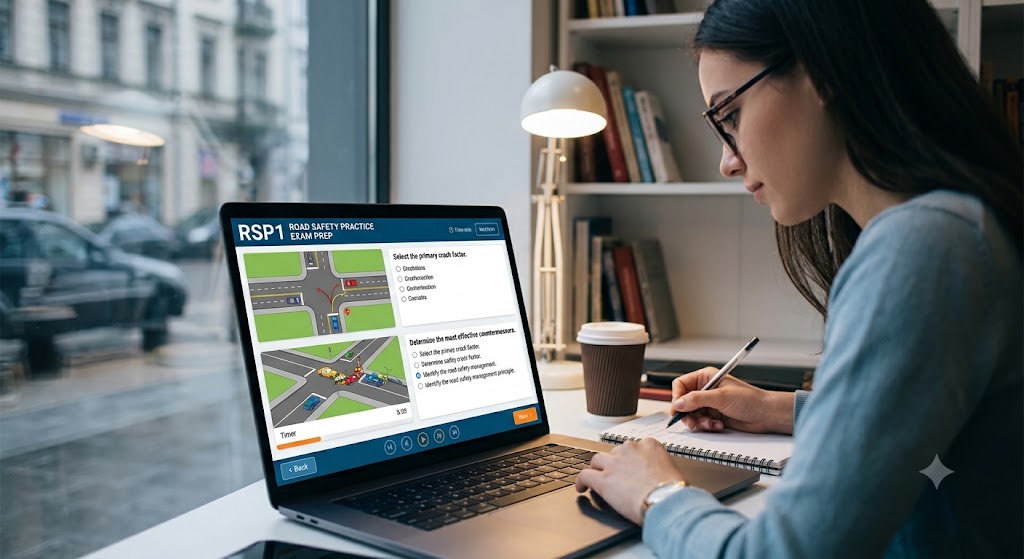
Additional Information
What the Course Entails and Exam Details
This examination does not follow a strict, single "course" but rather assesses the core competencies necessary to work effectively in road safety. Candidates will need to demonstrate deep knowledge across three primary domains: foundation safety concepts (such as human factors and crash causation models), safety data analysis (calculating crash frequencies and interpreting crash diagrams), and safety program management (implementing countermeasures, speed management, and vulnerable road user safety). The exam tests both theoretical understanding and practical problem-solving.
What to Expect in the Final Exam
The final RSP1 exam is a comprehensive computerized test administered by the Transportation Professional Certification Board (TPCB). It consists of 100 multiple-choice questions, which candidates are expected to complete within a strict three-hour time limit. The passing score varies slightly per exam instance based on difficulty, but it generally targets high-performing professionals. The exam is typically proctored online or taken at official testing centers. Candidates are expected to analyze diagrams, interpret statistics, and select the best intervention strategies.
How to Study and Exam Centers
Effective preparation is the key to passing this challenging exam. A strong foundation begins with thorough study of the official TPCB/ITE Road Safety Professional (RSP1) applicant handbook. Utilizing practice tests like this one is invaluable for managing time and familiarizing yourself with the complex question formats, often involving diagrams and data scenarios. The actual exam must be registered through the TPCB website and is typically administered through secure online proctoring services or recognized testing partners such as Pearson VUE, allowing candidates to take the test in most major global locations or remotely.
Job Opportunities from the Course
Earning your RSP1 certification significantly boosts your credibility and opens doors to exciting career paths in both public transportation and private consulting firms. Professionals who hold this designation find themselves highly valued in roles where evidence-based safety decisions are critical. Common job titles and career paths include:
Road Safety Engineer: Designing safer infrastructure and analyzing intersection risk.
Transportation Planner: Incorporating safety metrics into long-term city transit goals.
Traffic Data Analyst: Identifying crash trends and predicting high-risk locations.
Vision Zero Coordinator: Leading regional public-sector strategies to eliminate traffic deaths.
Private Safety Consultant: Advising developers on the safety impacts of new projects.
Government Safety Program Manager: Overseeing large-scale highway safety grants.
Public Works Director: Ensuring safety is prioritized across all municipal maintenance.
Frequently Asked Questions
Reviews
5.0
Based on 0 reviews
Leave a Review
No reviews yet. Be the first to review!