
Risk Management and SOP Practice Test
$69.00
- Buy to unlock unlimited access to all Quiz questions.
- After purchase you can print a PDF of the whole quiz at any point. The PDF will contain the questions and the correct answers.
About this Exam
Are you seeking to validate your ability to identify, analyze, and manage operational risks, as well as design and implement effective Standard Operating Procedures?
Our comprehensive Risk Management & SOP Practice Exam is your critical final step toward ensuring you are fully prepared for your certification.
This certification is intended for professionals from all sectors—ranging from entry-level quality specialists and safety officers to seasoned operations managers and department heads—who want to prove their mastery of these fundamental organizational principles.
By demonstrating this expertise, you show current and future employers that you have the knowledge and practical skills required to create a safer, more efficient, and compliant workplace.
This practice test is an invaluable asset in your study arsenal, mimicking the structure and difficulty of the final exam to build confidence and refine your knowledge.
Ready to test your knowledge?
Buy Now to Access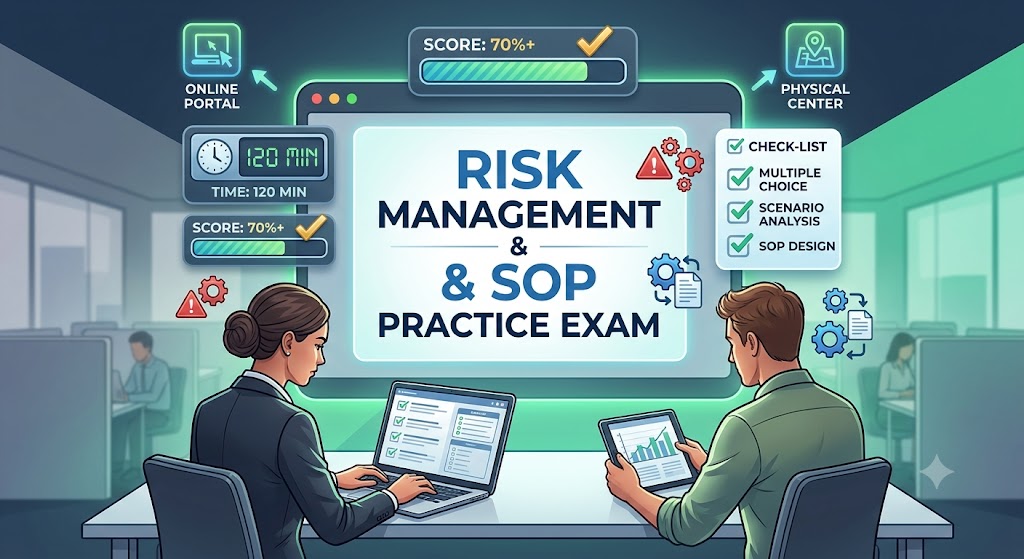
Additional Information
What the Course Entails and Exam Details
The core curriculum leading to this certification provides an in-depth understanding of essential operational risk frameworks and procedural design.
While specific course content can vary slightly between institutions, you can expect to master these foundational areas:
Risk Management Principles: A thorough grounding in risk theory, defining different types of risk (operational, financial, strategic, reputational) and understanding risk tolerance.
Risk Identification and Assessment: Methods and tools for systematically identifying potential risks, analyzing their likelihood and potential impact, and prioritizing actions using matrices and heat maps.
Risk Mitigation and Monitoring: Strategies for developing, implementing, and monitoring controls to reduce risk to acceptable levels. This includes risk response planning and continuous review.
SOP Fundamentals: Understanding the purpose, structure, and essential components of standard operating procedures, including clarity, consistency, and alignment with organizational goals.
SOP Development and Implementation: Step-by-step guidance on writing, reviewing, approving, and effectively rolling out SOPs, including training personnel and managing procedural changes.
Compliance and Auditing: Integrating risk assessment with procedural compliance and conducting regular internal audits to ensure adherence and effectiveness.
The real certification exam typically consists of a combination of:
Multiple-Choice Questions: Assessing core definitions, processes, and standard terminology.
Scenario-Based Questions: Testing your ability to apply risk management principles and procedural decisions in real-world contexts, requiring critical thinking and analytical skills.
Short-Answer or Case Study Analysis: Deeply evaluating your comprehension of integrated concepts, requiring you to explain your reasoning or propose a full plan of action.
Be prepared to have your theoretical knowledge and practical application thoroughly tested to earn this designation.
What to Expect in the Final Exam
Entering the examination room with clear expectations is vital for peak performance. Here’s a typical breakdown of what to anticipate:
Format: As detailed above, expect a challenging mix of predominantly multiple-choice and scenario-based questions. The exam is often structured to balance foundational knowledge checks with complex problem-solving.
Time Limit: You will face a specific time constraint, often ranging from 90 minutes to two hours, so effective time management during the test is critical.
Passing Score: Most reputable certifications set a passing threshold, typically around 70% or higher. Your practice scores on this exam should consistently meet or exceed this goal.
Delivery: Most exams are proctored. This means they will be supervised, either in person at a physical testing center or virtually through online proctoring services using a webcam and secure browser settings.
Materials: Unless explicitly stated otherwise, the exam will be closed book. You must rely solely on your knowledge. Familiarize yourself with all permitted and restricted materials.
How to Study and Exam Centers
Achieving certification success requires a dedicated and multifaceted approach. Use these proven strategies:
Review Official Curriculum: Your primary study resource should be the official materials provided by your certifying body or training program. Read every section thoroughly.
Engage with Practice Exams: Take our Risk Management & SOP Practice Exam and any others you can find. Critically review why you got answers right and, more importantly, why you got them wrong. Identify your weak areas and re-study them. This should be an iterative process.
Practice Real-World Application: Don't just memorize definitions. Practice applying concepts to different scenarios in your current or past roles. Can you identify risks in a process? Could you write a sample SOP?
Collaborate with Peers: Discussing challenging concepts with other students can provide fresh perspectives and reinforce your learning. Explaining concepts to someone else is a powerful way to solidify your own understanding.
Manage Your Time: Create a study schedule and stick to it. Prioritize difficult topics and leave time for comprehensive reviews before exam day.
The specific locations and methods for taking the official certification exam will depend entirely on the certifying body (e.g., specific industry associations, universities, or training providers). Commonly, you will find options for:
Online Proctored Exams: You can often take the exam from your own computer at home or work. This usually requires a quiet space, a stable internet connection, and a functional webcam for a live proctor to monitor you. You typically schedule this in advance through the certifying body's website.
Physical Testing Centers: Established networks of secure testing locations (like Pearson VUE or specific authorized training centers) offer a dedicated environment for taking computer-based exams. You can locate and register for the nearest center through the certification program's scheduling portal.
Job Opportunities from the Course
Earning your Risk Management and SOP certification isn't just about passing a test; it's an investment that can significantly enhance your professional value and open doors to diverse, impactful careers across all sectors.
Operations Manager
Quality Assurance Specialist / Manager
Compliance Officer / Coordinator
Risk Manager / Analyst
Process Improvement Specialist
SOP Specialist / Technical Writer
Health, Safety, and Environmental (HSE) Coordinator
Supply Chain Manager
Logistics Coordinator
Project Manager (with increased focus on risk mitigation and procedural efficiency)
Facility Manager
Frequently Asked Questions
Reviews
5.0
Based on 0 reviews
Leave a Review
No reviews yet. Be the first to review!