
Rhode Island Master Pipefitter Practice Exam
$69.00
- Buy to unlock unlimited access to all Quiz questions.
- After purchase you can print a PDF of the whole quiz at any point. The PDF will contain the questions and the correct answers.
About this Exam
The Rhode Island Master Pipefitter license represents the pinnacle of achievement in the piping trade. This designation is not merely a job title; it is a certification that validates a professional’s expert command over complex piping systems, advanced mathematics, blueprint interpretation, and, most critically, the comprehensive state and national codes that ensure public safety.
This comprehensive guide is designed specifically for licensed Journeyman Pipefitters who have fulfilled the state's required experience—typically at least one year as a licensed Journeyman employed by a Master Pipefitter—and are now preparing to make the significant leap to the Master level.
A Master Pipefitter is authorized to design, install, repair, and maintain sophisticated piping networks, including high-pressure steam, hydronic heating and cooling, chemical process piping, and medical gas systems. This guide provides the strategic overview and practice structure needed to confidently approach the challenging state licensing examination.
Ready to test your knowledge?
Buy Now to Access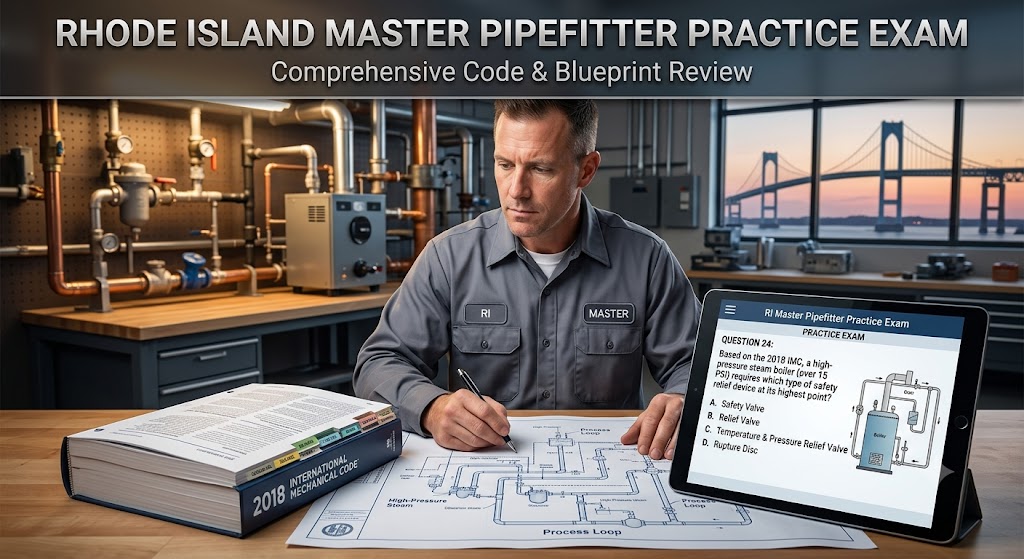
Additional Information
What the Course Entails and Exam Details
Preparing for the Rhode Island Master Pipefitter Exam is an intensive process focused on applying advanced theoretical knowledge to practical, code-based scenarios. Unlike the entry-level aptitude tests, this examination is centered on your ability to synthesize vast amounts of technical information and make critical safety and design decisions. The core subjects you must master include:
Rhode Island State Codes and Amendments: Comprehensive knowledge of the 2018 International Mechanical Code (IMC), the International Fuel Gas Code (IFGC), and specific Rhode Island amendments and administrative regulations managed by the Department of Labor and Training (DLT).
Advanced Blueprint Reading and System Design: The ability to interpret complex schematics, architectural drawings, and P&IDs (Piping and Instrumentation Diagrams) to design or troubleshoot advanced systems. This includes isometric drawing and calculating material take-offs.
Piping Systems and Standards: In-depth understanding of high-pressure and low-pressure steam systems, hydronic heating and cooling loops, process piping for industrial applications, and medical gas system installation and testing standards (NFPA 99).
Safety Protocols and Hazardous Materials: Mastery of OSHA safety regulations, hazardous material handling, proper ventilation, and the installation of safety devices like relief valves and backflow preventers.
Welding, Brazing, and Joining Technologies: Detailed knowledge of material standards (ASME, ASTM) and the specified procedures for welding (e.g., butt weld fittings, socket welds) and brazing (e.g., medical gas) to ensure system integrity.
What to Expect in the Final Exam
The Rhode Island Master Pipefitter Licensing Exam is a demanding assessment administered directly by the State of Rhode Island Department of Labor and Training (DLT). It is a timed, proctored examination that ensures candidates have the competence required to hold the master-level designation.
Exam Format: The test consists of multiple-choice questions. These are not basic recall questions; they are scenario-based and designed to test your ability to look up, interpret, and apply specific code sections.
Number of Questions: While the exact number can vary, candidates should prepare for a comprehensive exam of approximately 50 to 75 questions.
Time Limit: Candidates are typically allotted 90 to 120 minutes to complete the examination. Time management, especially the ability to navigate code books efficiently, is crucial.
Passing Score: To achieve licensure, a candidate must obtain a score of at least 70%.
Specific Rules: The exam is strictly an "Open Book" test regarding the official code references. You are permitted to use your own code books (specifically the IMC, IFGC, and NFPA standards as referenced by the DLT), but these books cannot have loose-leaf papers. Permanent indexing tabs are allowed and highly recommended. No other materials, including unofficial guides, are permitted.
How to Study and Exam Centers
Success on the Rhode Island Master Pipefitter Exam is not about memorization; it is about methodology. Your study strategy must mirror the exam's format.
Actionable Study Strategy 1: "Tab Your Codes" This is the most critical step. Purchase the exact editions of the IMC, IFGC, and appropriate NFPA standards (like NFPA 54 and NFPA 99) as specified by the Rhode Island DLT. Use permanent, legal index tabs to create a fast-reference system. Practice finding complex code sections quickly—your ability to navigate the book is just as important as knowing the answer.
Actionable Study Strategy 2: Blueprint and Math Integration Practice working on advanced math formulas related to offsets, rolling offsets, pipe sizing, and volume, while simultaneously referencing complex industrial blueprints. The Master exam often requires you to solve problems that integrate these three skill sets.
Actionable Study Strategy 3: Simulated Practice Exams Utilize targeted practice exams that simulate the timing and difficulty of the Master level. When taking practice tests, practice without looking at the answers initially, forcing yourself to locate the correct code reference for every question.
Exam Center Location: The Rhode Island Master Pipefitter Exam is administered by the State of Rhode Island Department of Labor and Training, Division of Workforce Regulation and Safety, Professional Regulations Unit. The primary examination facility is located at 1511 Pontiac Avenue, Cranston, RI 02920. Candidates must apply and receive approval before scheduling their examination date.
Job Opportunities from the Course
Earning your Rhode Island Master Pipefitter License unlocks the highest-paying and most influential roles within the piping and mechanical industry. This certification transitions you from a highly skilled installer to a leader, designer, and business owner.
Upon successfully passing the exam, your career paths include:
Lead Master Pipefitter / Foreman: Overseeing large-scale industrial and commercial installation projects, managing crews of journeymen and apprentices.
Mechanical Project Manager: Planning, budgeting, and executing complex mechanical contracts from design to completion.
Mechanical Estimator: Utilizing blueprint reading and code knowledge to accurately calculate costs for competitive project bidding.
Piping Systems Designer: Creating detailed layout and design specifications for complex process piping or hydronic systems.
Licensed Mechanical Contractor/Business Owner: Fulfilling the requirement to be the primary 'master' for a plumbing and mechanical contracting company, allowing you to pull permits and run your own business in Rhode Island.
Specialized Medical Gas System Installer/Verifier: The highest level of specialty in medical facility piping.
Frequently Asked Questions
Reviews
5.0
Based on 0 reviews
Leave a Review
No reviews yet. Be the first to review!