
Rhode Island CDL Pre-Trip Practice Test
$69.00
- Buy to unlock unlimited access to all Quiz questions.
- After purchase you can print a PDF of the whole quiz at any point. The PDF will contain the questions and the correct answers.
About this Exam
The Rhode Island Commercial Driver’s License (CDL) Pre-Trip Inspection is a critical hands-on test for aspiring commercial drivers. This evaluation is not a written test, but rather a practical assessment that demonstrates your ability to identify potential safety defects on a commercial vehicle before driving. It is a mandatory requirement for obtaining a CDL in Rhode Island and ensures that all drivers operating heavy vehicles prioritize safety above all else. Aspiring Class A, B, or C CDL holders must pass this inspection to prove they can operate their vehicles responsibly on the roads of the Ocean State.
Ready to test your knowledge?
Buy Now to Access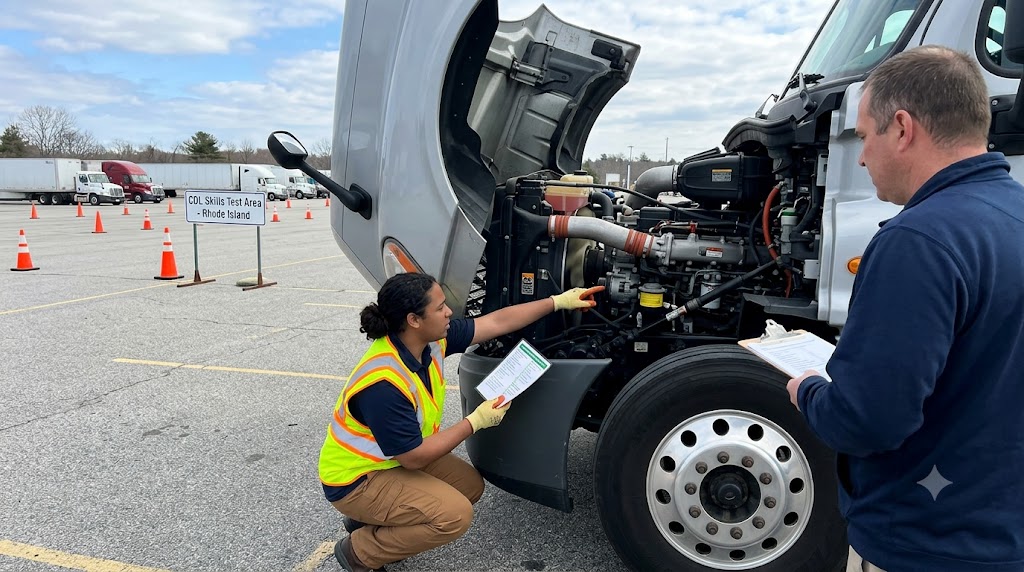
Additional Information
What the Course Entails and Exam Details
The Pre-Trip Inspection requires a comprehensive, walk-around examination of your vehicle. You will need to inspect components across several key areas, demonstrating a thorough understanding of the vehicle’s mechanics and safety systems.
Engine Compartment: Checking fluids, belts, hoses, and steering systems for leaks, wear, or damage.
Cab Check & Engine Start: Ensuring all gauges, lights, mirrors, brakes (including critical air brake checks for air-brake equipped vehicles), horns, and emergency equipment are functional.
Vehicle Walk-Around: Inspecting tires, wheels, suspension (springs, mounts, shocks), braking systems (drums, liners, chambers), fuel tanks, and lighting systems.
Coupling System (Class A only): A detailed inspection of the fifth wheel or pintle hook connection, air lines, and electrical connections between the tractor and trailer.
Trailer Inspection (Class A & B, if applicable): A specific walk-around of the trailer’s components, including its body, frame, tires, lights, and braking system.
You are expected to not only look at components but to manually check them, describe why you are checking them, and explain what defects you are looking for during the inspection.
What to Expect in the Final Exam
This is a live, practical skills assessment administered by an examiner at a designated DMV facility or authorized third-party testing site. You will meet with the examiner, perform the full walk-around inspection, and verbally explain your findings. There are no written questions in this specific part. The examiner will likely ask you to inspect certain sections and may ask follow-up questions to gauge your knowledge.
The key requirement is to accurately identify safety defects; failure to spot critical safety issues will result in failure. The passing score depends on the exact vehicle combination and the items the examiner asks you to check, but usually, missing too many critical components or failing the air brake safety check is an automatic failure. There is typically no official time limit, but you are expected to complete the inspection methodically and efficiently.
How to Study and Exam Centers
Effective preparation combines study with hands-on practice, as shown in the accompanying image of a trainee performing an inspection.
Master the Rhode Island Commercial Driver’s Manual: This is your primary study guide. Know the inspection sections verbatim, especially the Air Brake check procedure.
Practice with an Actual Vehicle: This is crucial. Get access to a commercial vehicle of the type you will be testing in. Practice the walk-around inspection repeatedly.
Verbalize Everything: While practicing, speak your actions out loud, just as you will in the test. Say what you are checking, how you are checking it, and what flaws you would be looking for.
Use Checklists: Create or find a comprehensive CDL pre-trip inspection checklist to ensure you never miss an item during your practice runs.
Practice with a Partner: Have someone hold the checklist and prompt you if you miss anything.
Rhode Island DMV testing locations:
CDL skills tests, including the pre-trip inspection, are administered at specific DMV branch offices and sometimes at third-party testing organizations authorized by the Rhode Island Division of Motor Vehicles (DMV). You must schedule your appointment in advance through the Rhode Island DMV website.
Job Opportunities from the Course
Successfully passing the Pre-Trip Inspection and obtaining your CDL in Rhode Island opens doors to numerous career paths within the transportation and logistics industry:
Over-the-Road (OTR) Truck Driver
Regional Truck Driver
Local Delivery Driver (Class A or B)
Bus Driver (School, Charter, Transit - requires specific endorsements)
Heavy Equipment Operator (often requires a CDL to transport equipment)
Dump Truck Driver
Cement Mixer Driver
Refuse Collector Driver
Delivery/Courier Driver (for larger box trucks)
Frequently Asked Questions
Reviews
5.0
Based on 0 reviews
Leave a Review
No reviews yet. Be the first to review!