
Revit for Architectural Design Professional Certification Practice Exam
$69.00
- Buy to unlock unlimited access to all Quiz questions.
- After purchase you can print a PDF of the whole quiz at any point. The PDF will contain the questions and the correct answers.
About this Exam
The Autodesk Certified Professional: Revit for Architectural Design certification is the definitive benchmark for architects, BIM managers, and designers who have mastered Autodesk Revit for architectural workflows. This professional-level credential validates your advanced understanding of the software’s complex features and confirms your ability to solve intricate design, documentation, and collaboration challenges. It is designed for individuals who typically have 400 to 1200 hours of real-world, hands-on Revit experience. Earning this certification differentiates you in a competitive job market and builds your personal brand as an industry leader.
Ready to test your knowledge?
Buy Now to Access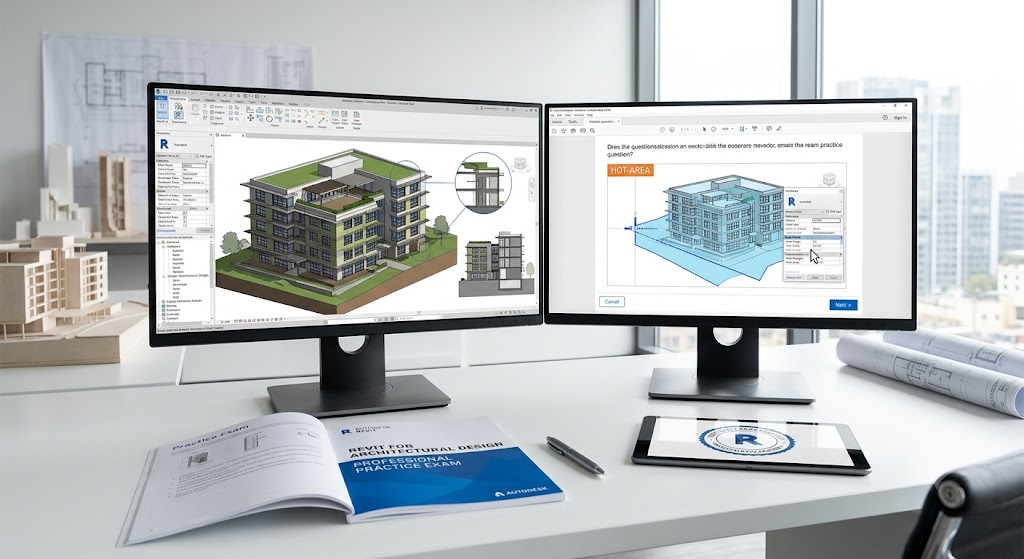
Additional Information
What the Course Entails and Exam Details
This certification doesn't just test basic knowledge; it assesses comprehensive skill sets across the entire project lifecycle. You must demonstrate proficiency in modeling advanced architectural elements, automating documentation, and managing large, collaborative projects. The exam objectives are structured into six key domains:
Modeling: advanced creation and management of architectural elements like complex walls, floors, roofs, stairs, and structural components.
Documentation: configuring view visibility, advanced schedules, annotation, details, tags, and managing revisions and sheets.
Collaboration and Coordination: setting up and managing worksharing, linked files, copy/monitor workflows, and phasing.
Project Standards and Settings: managing project templates, browser organization, information exchange, and view templates.
Families: creating, configuring, and managing 2D and 3D parametric families.
Information Analysis: performing area analysis, sun and shadow studies, and other model-based analyses.
The "practice exam" is not a formal course but a resource. The official certification prep is delivered on-demand by Autodesk and includes lessons, assessments, and challenge assignments, acting as a final check before the actual exam.
What to Expect in the Final Exam
The final certification is a rigorous, selected-response exam. It is not performance-based in the sense of building a model within the actual software; instead, it uses sophisticated question types to measure your applied knowledge. You will have 120 minutes to complete approximately 45 to 60 questions. The questions are designed to be completed without access to Revit itself. You must expect the following formats:
Multiple Choice: Standard questions with four possible answers.
Drag-and-Drop: Requires you to pair items, such as linking a term to its function, or reordering a list of procedural steps.
Active-Screen: An interactive image of the Revit user interface, where you must click the correct tool or setting to answer a prompt.
Hot-Area: Requires clicking specific regions on a complex graphic, such as identifying an element in a section view or an option in a dialog box.
Graphic-Interpretation: Analyzing a provided section, detail, or plan view to determine quantities, parameter values, or correct configurations.
The passing score varies but is generally around 70-80%, and the exam is proctored, requiring strict identification and workspace verification. Your certification is valid for three years.
How to Study and Exam Centers
Preparation is critical. Do not rely solely on practice tests. Start with Autodesk's own "Revit for Architectural Design Professional Certification Prep" course. Focus on filling gaps in your understanding of the six domains. Practical experience is essential; you cannot pass without significant time spent in the software. Create a study plan that revisits areas you don't use daily, especially family creation and advanced coordination. Take multiple, timed practice exams that simulate the "no software" environment to build your stamina and speed. Pay close attention to the phrasing of questions.
You can take the official proctored exam in two ways:
Physical Testing Centers: Autodesk partners with Pearson VUE. Use their online portal to find an authorized testing center in a specific physical location or school near you. This is ideal if you prefer a controlled environment.
Online Proctored: You can take the exam from your home or office using Pearson OnVUE. This option requires a reliable internet connection, a quiet private space, and a strict system check, including submitting photos of your ID and environment before testing.
Job Opportunities from the Course
A Revit for Architectural Design Professional Certification is a strong career catalyst. It unlocks and validates pathways to the following specific roles:
BIM Manager
BIM Coordinator
Revit Architect
Architectural Designer
Project Architect
CAD/BIM Manager
Architectural Technologist
BIM Content Developer
Virtual Design and Construction (VDC) Coordinator
Design Technology Specialist
Frequently Asked Questions
Reviews
5.0
Based on 0 reviews
Leave a Review
No reviews yet. Be the first to review!